
Handheld circular saws: selection & sourcing
For plywood work, the purchasing question is whether the complete saw-and-guide setup produces the required cut efficiently. A dedicated plunge track saw and a conventional circular saw used against a straight guide can both have useful roles, but they are not identical systems.
Choose around the cut length, edge-quality requirement and frequency of setup. Avoid ordering a rail merely because its profile looks similar to another brand’s accessory.
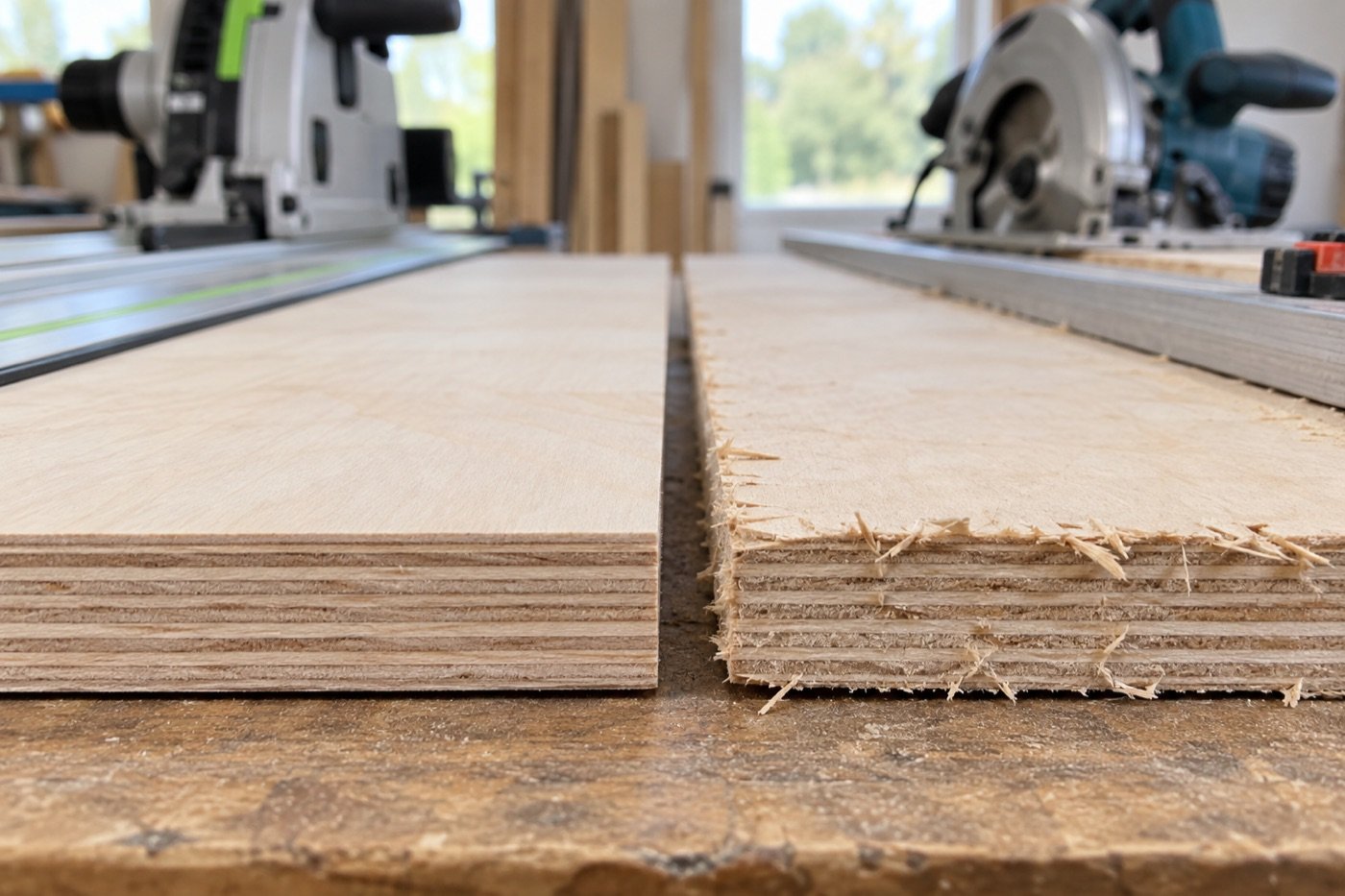
Distinguish the guide arrangements
A conventional saw may run alongside a secured straightedge, on a dedicated adapter or in a manufacturer-designed rail system. A plunge track saw adds a designed depth-controlled plunge mechanism. The presence of a rail does not, by itself, mean that a tool is approved for plunge operation.
WORX’s ExacTrack is an example of a specific guide arrangement associated with a circular-saw model. Festool’s TS55 documentation separately describes rail-related depth settings. These illustrate why the system instructions matter more than the generic word “track.”
| Comparison item | Ordinary saw with guide | Dedicated track/plunge system |
|---|---|---|
| Guide interface | Must be defined for the chosen straightedge or adapter | Must match the approved rail and saw |
| Depth setting | Confirm any accessory-related capacity change | Confirm on-rail and off-rail settings |
| Entry method | Follow the specific saw manual | Plunge only where the system permits it |
| Edge-quality setup | Blade and guide accuracy remain important | Splinter protection also needs correct setup |
| Replacement parts | Guide, clamps and base parts | Rail connectors, strips, clamps and adjustment parts |
Compare useful capacity on the rail
Ask for cutting depth at 90° and at the required bevel angle with the offered rail installed. Do not use a bare-saw maximum to describe the delivered kit. Check that the selected blade matches the tool’s diameter, bore and permitted thickness range.
Long rails need storage and shipment planning. Two shorter sections can be convenient, but the joint must align correctly. Include connectors and suitable clamps in the quotation if those are required for the intended arrangement.
Define acceptable plywood edges
“Clean cut” is too vague for sample approval. Specify the panel construction, surface finish, thickness, cut direction and which face is critical. Agree on a measurement or photo standard for visible tear-out, and assess the full cut rather than one attractive close-up.
A rail does not eliminate the influence of blade selection or damaged stock. Use consistent blades and representative panels during comparisons. Record whether a splinter strip or sacrificial support is part of the demonstrated result, so the buyer knows which consumables are needed later.
Check repeatability and handling
Have a trained operator set up, cut, remove and reset the guide for several representative pieces. Evaluate alignment time, clamping access and interference from the hose or cord. Look for adjustment play or a connector that requires repeated correction.
The aim is a reproducible purchasing trial, not an improvised operating method. Keep hands outside the cutting path, support stock as instructed and use only approved entry procedures. Do not lift or restrain a lower guard to imitate a plunge saw.
Decide when the additional system is justified
A distributor serving frequent panel installation may find a defined track kit easier to explain and support. Buyers making occasional rough crosscuts may prioritize portability and simpler accessories. Calculate the complete kit and replacement-consumable cost rather than comparing only bare tools.
Request the rail part number, length, connectors, clamps, supplied blade and transport packaging through the handheld circular saw hub. The pre-shipment checklist helps preserve that configuration.