
Once you have found a few possible suppliers, the next question is more practical: how do you verify whether a Chinese TCT saw blade factory can actually make stable blades for your market?
This article is a factory audit checklist, not another general sourcing guide. Use it when you already have a supplier name, catalogue, quotation, or sample photo, and you need to judge whether the factory is worth a trial order.
For the broader sourcing process, read our main guide: how to find a reliable saw blade manufacturer in China. This checklist goes one step deeper into production, materials, inspection, and order control.
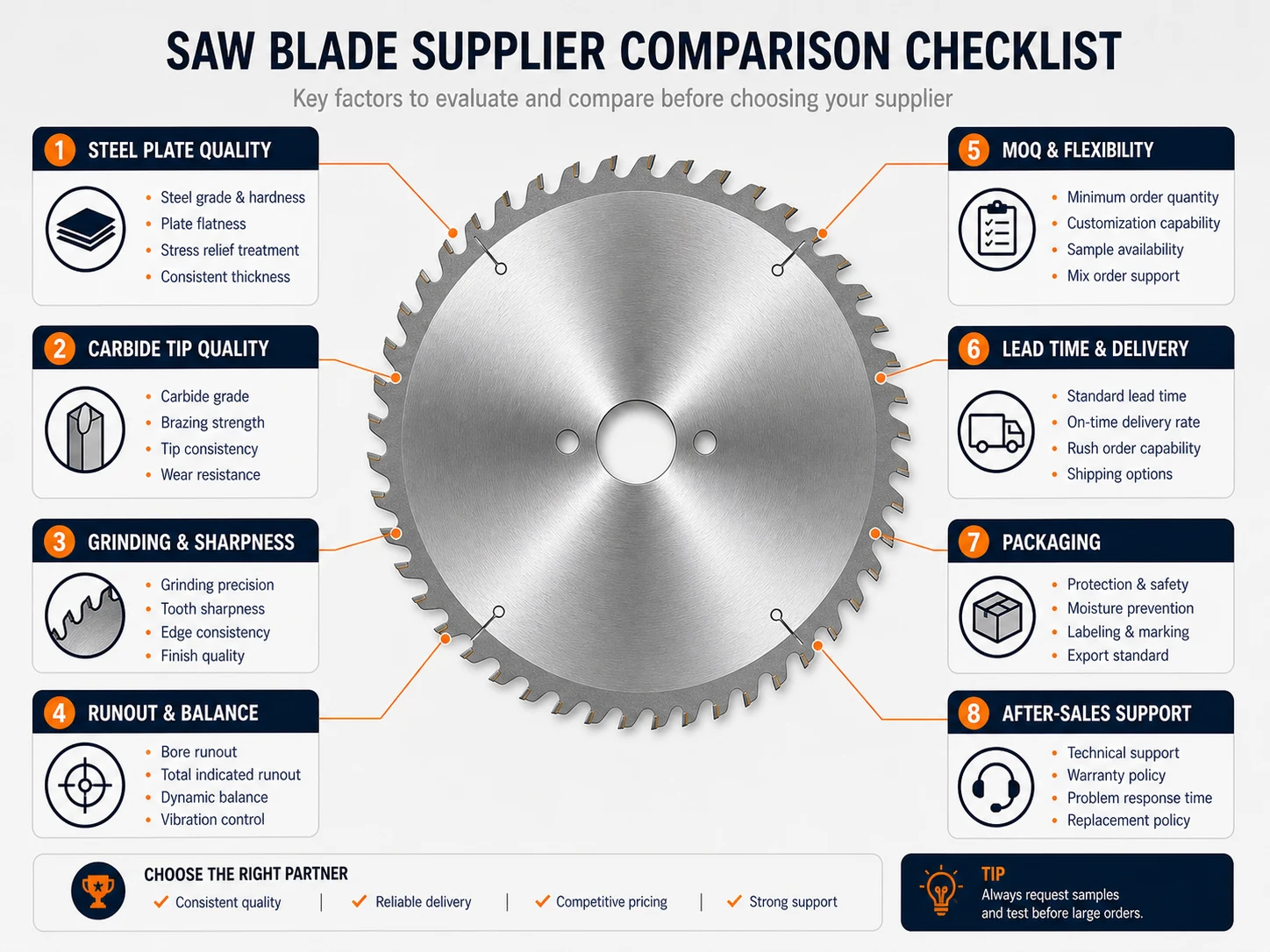
Quick Audit Scorecard for TCT Saw Blade Factories
Before discussing price, score each supplier against these five areas. A factory does not need to be perfect, but if it cannot answer these questions clearly, the low price may become expensive later.
| Audit Area | What to Check | Why It Matters |
|---|---|---|
| Factory identity | Business license, production address, workshop video, staff responsible for quality | Separates real manufacturers from pure trading offices. |
| Materials | Steel body grade, carbide grade, batch records, supplier consistency | Material changes are one of the fastest ways to create unstable cutting performance. |
| Equipment | Laser cutting, heat treatment, brazing, CNC grinding, tensioning, balancing | Good raw material still fails if the production process is not controlled. |
| Inspection | Runout tolerance, tooth angle, welding strength, hardness, sample test feedback | Shows whether the factory measures quality or only checks appearance. |
| Order control | Specification sheet, approved sample, packaging proof, production photos, pre-shipment inspection | Prevents “sample was good, bulk order changed” problems. |
1. Verify the Factory Before You Discuss Big Orders
A real saw blade factory should be able to show its production floor without turning the conversation into a performance. Ask for a short video call or a recent workshop video with your contact person in it. You do not need a cinematic factory tour. You need to see whether the supplier has actual production equipment and people working on blades.
For TCT saw blades, useful proof includes laser-cut blade bodies, brazing stations, grinding machines, tensioning equipment, inspection benches, and packaged finished goods. If a supplier can only show a catalogue and a warehouse, treat them as a trading company until proven otherwise.
2. Ask for Material Details, Not Just “Good Quality”
Many quotations look similar because the outside diameter, bore, kerf, and tooth count are the same. The difference is often inside the blade: steel plate grade, carbide tip grade, brazing consistency, heat treatment, and grinding accuracy.
For woodworking and aluminum TCT saw blades, ask which steel body they use, such as 50# carbon steel or 75Cr1 alloy steel. For higher-end industrial blades, 75Cr1 is normally more stable. For carbide, ask whether they use YG8, YG6A, YG6X, or another grade, and why they recommend it for your cutting material.
A good factory does not need to reveal every supplier name, but it should be able to explain the grade logic. If every question receives the same answer, “best quality, no problem,” that is not technical communication.
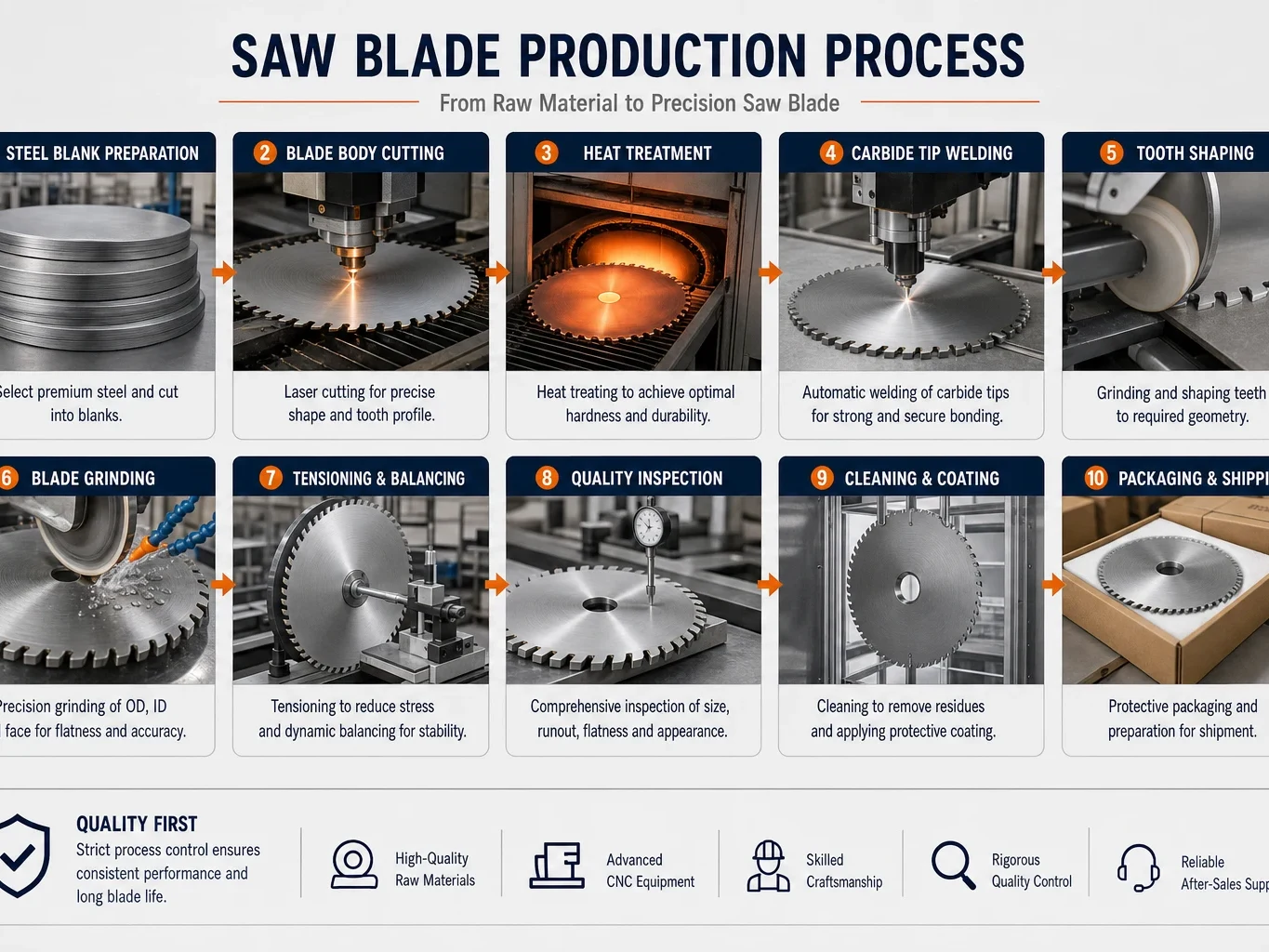
3. Check Whether Their Equipment Matches Your Target Quality
Different markets require different production lines. A budget DIY blade and a premium industrial blade should not be evaluated by the same standard. This is why comparing only unit price is dangerous.
For stable export quality, ask about:
- Laser cutting accuracy for the blade body
- Heat treatment and body hardness control
- High-frequency brazing process for carbide tips
- CNC grinding machines for tooth geometry
- Runout inspection before packaging
- Batch control for steel and carbide
If you are buying steel cutting cold saw blades, the audit becomes stricter. You should also confirm cermet or carbide grade, pin-hole layout, bore accuracy, tooth geometry, coating options, and cutting test conditions. For that product line, see our steel cutting cold saw blade specifications.
4. Demand a Real Sample Process
A sample order is not only about receiving one blade. It is about seeing how the factory handles your specification. The best factories will ask about the material you cut, machine type, RPM, feed condition, finish requirement, bore, pin-hole layout, and expected order volume.
When the sample arrives, record the test result carefully:
- Cutting material and size
- Machine model and RPM
- Cutting speed and feed
- Surface finish and burr condition
- Blade life or number of cuts
- Any vibration, noise, tooth chipping, or overheating
Send this feedback to the factory. A capable supplier can adjust tooth geometry, carbide grade, plate thickness, or quality grade based on real test results. If they only suggest “buy more pieces,” you have learned something important.
5. Confirm Tolerances and Inspection Records
For saw blades, a small tolerance difference can decide whether the customer sees a clean cut or a complaint. Ask the factory what they inspect before shipment. At minimum, they should control runout, body flatness, tooth grinding, bore accuracy, and appearance.
Do not ask only for certificates. Certificates show the company has a system. Inspection records show whether the system touches your actual order.
6. Lock the Approved Specification Before Bulk Production
After the sample is approved, create a simple specification sheet. It should include outside diameter, kerf, plate thickness, bore, teeth, tooth form, steel body, carbide grade, surface treatment, printing, packaging, and quantity. For custom products, include drawings or clear photos.
For TCT saw blades, you can start from our TCT saw blade product page and product catalog. For cold saw blades, start from diameter, kerf, plate thickness, bore, teeth, material being cut, and machine details.
Red Flags During a Saw Blade Factory Audit
- The supplier refuses video calls or recent production photos.
- They cannot explain steel body or carbide grade differences.
- Every quality level has the same description but a different price.
- They quote immediately without asking what material you cut.
- The sample marking and quotation specification do not match.
- They avoid discussing runout, tooth geometry, or inspection standards.
- The price is far below the market without a technical reason.
What to Send Us for a Practical Factory Check
If you want us to recommend a saw blade or check whether your current blade can be made, send these details:
- Blade marking photo or size: OD x kerf x plate thickness x bore x teeth
- Material to be cut: wood, aluminum, mild steel, stainless steel, pipe, tube, solid bar, or plate
- Machine photo or machine model
- Current cutting problem: short life, burr, chipping, vibration, rough finish, or high cost
- Trial quantity and expected monthly volume
We will help match the product family first: TCT saw blades, steel cutting cold saw blades, or other custom cutting tools. Then we can recommend a practical sample grade instead of guessing from a catalogue.
Frequently Asked Questions
How do I verify a TCT saw blade factory in China?
Start with a video call, business license, workshop proof, equipment photos, material explanation, sample process, and inspection standards. A real factory should be comfortable discussing production details such as steel plate, carbide grade, brazing, grinding, and runout inspection.
Is the cheapest saw blade factory always risky?
Not always, but a very low price must have a reason. It may come from lower steel grade, cheaper carbide, simpler grinding, looser tolerance, basic packaging, or a different quality line. Ask what changed before accepting the price.
Should I audit the factory before placing a sample order?
For small sample orders, a remote audit is usually enough. For large orders or private label projects, it is better to conduct a deeper audit or arrange third-party inspection before mass production.
What is the most important sample test?
Test the blade on your real machine and real material. Catalogue specifications are useful, but cutting performance depends on machine stability, material, feed, RPM, tooth geometry, and blade grade.
Can one factory supply both TCT saw blades and cold saw blades?
Some factories or manufacturing groups can supply both, but the production logic is different. TCT woodworking/aluminum blades and steel cutting cold saw blades require different tooth geometry, material selection, and testing standards. Always confirm the exact product line.