
The lowest blade price does not determine the lowest tube-mill cutoff cost. Flying cold saw and friction saw systems create different heat, burr, blade-service and line-integration conditions. A useful comparison must follow one accepted tube length through cutting, finishing, inspection and downtime.
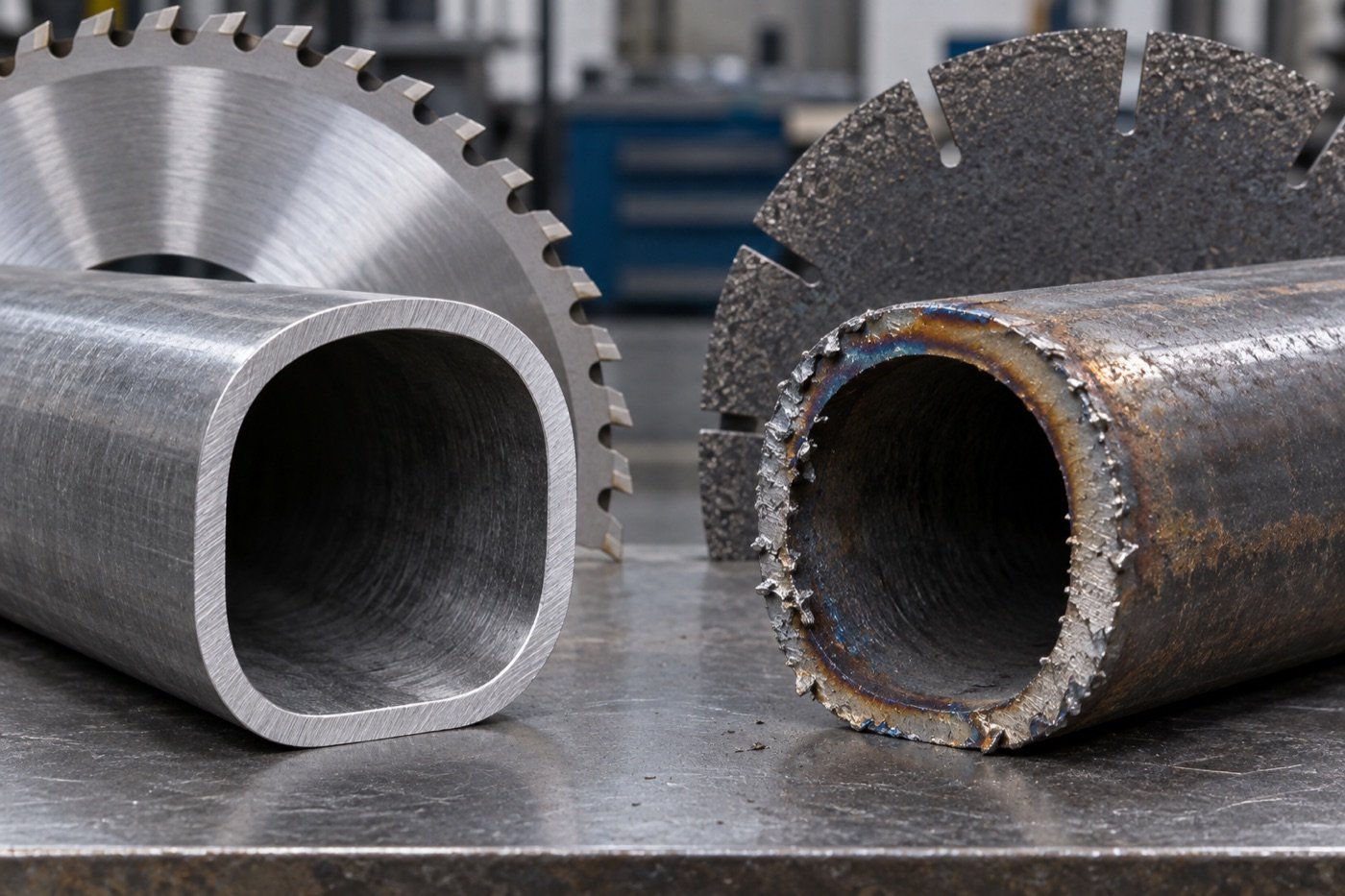
Process comparison
| Factor | Flying cold saw | Friction saw |
|---|---|---|
| Cutting mechanism | Tooth forms a controlled chip at lower thermal input | High peripheral speed creates substantial frictional heat |
| Cut face | Can reduce burr and heat-affected finishing when stable | Often accepts more burr, heat and downstream finishing |
| Blade lifecycle | Tip wear, chipping and planned resharpening | Disc consumption and replacement pattern |
| Integration | Requires synchronised carriage, feed and clamping | Also requires line-speed and cut-cycle coordination |
Define “accepted cut”
Set limits for length, squareness, burr, end deformation, heat colour, surface damage and allowable secondary work. If two systems are compared only by strokes per minute, the calculation ignores inspection, deburring, washing, handling and rejected tubes.
Normalise the production mix before comparing systems
A tube mill rarely runs one diameter, wall and grade all year. Build the business case from a weighted production mix that includes thin and heavy walls, common and difficult grades, short and long cut lengths, weld-seam conditions and realistic changeover frequency. Record which families require different blades, speeds or finishing routes. A fast result on one easy tube should not be multiplied across the annual forecast unless that tube represents the real workload.
Blade life must be measured consistently
Count accepted cuts to a defined removal criterion. For a cold saw, record each sharpening, tip repair and final discard. Do not quote the best campaign as normal life. For friction systems, record disc changes, dressing where applicable and consumable handling using the same production mix.
Cold-saw failure costs
Cold saw economics deteriorate when tooth pitch, carbide/cermet grade, clamping, scarf condition, coolant, spindle runout or carriage synchronisation is wrong. Chipped tips can stop the line and may damage multiple teeth. A controlled process can recover blade value through resharpening, but only if the body remains serviceable and traceable.
Friction-saw downstream costs
Include burr removal, heat-affected end treatment, dust or spark control, noise measures and additional inspection. The relevance depends on tube material and the customer’s finished-end requirement; some lines may accept the condition, while others pay heavily to correct it.
Cost-per-accepted-cut worksheet
| Cost element | Calculation input |
|---|---|
| Consumable | Purchase + freight + repair/sharpening − recoverable value |
| Output | Accepted cuts, not total strokes |
| Line loss | Change time + unplanned downtime × burdened line rate |
| Secondary work | Deburr, wash, inspect and rehandle per accepted tube |
| Quality loss | Scrap, rework and customer claims attributable to cutoff |
Cost per accepted cut = (consumable + line loss + secondary work + quality loss) ÷ accepted cuts.
Pilot conversion plan
- Select one representative tube family and stable coil/material condition.
- Document line speed, wall, OD, weld/scarf, clamping and cut acceptance.
- Run enough production to include wear progression and at least one planned tool change.
- Keep labour and downstream finishing records.
- Review safety, guarding, extraction, training and spare support before scaling.