
When buyers ask for cold saw blades, one question comes up again and again: should I choose carbide or cermet?
The honest answer is not “cermet is always better” or “carbide is always cheaper.” The right choice depends on the machine, material, cutting speed, feed, clamping, coolant, and what the buyer expects from the blade.
This guide explains the practical difference between carbide and cermet cold saw blades from a buyer’s point of view. It is written for wholesalers, distributors, and factory buyers who need to make a safe first decision before sample testing.
Quick answer: choose carbide when the application is not fully confirmed or the machine condition is uncertain. Choose cermet when the machine is stable, the material is consistent, and the buyer wants better finish or longer production life.
What Is a Carbide Cold Saw Blade?
A carbide cold saw blade uses tungsten carbide tips brazed onto a steel blade body. Carbide is hard, wear-resistant, and relatively tough. For many steel cutting applications, carbide is the safer starting point because it can tolerate less-than-perfect cutting conditions better than cermet.
This does not mean carbide is low grade. A well-made carbide cold saw blade still needs good body steel, heat treatment, brazing, CNC grinding, runout control and proper tooth geometry. The main advantage is that carbide is often more forgiving during first testing.
Carbide is usually a practical choice when:
- The buyer cannot confirm exact machine RPM.
- The material range is mixed or not fully stable.
- The machine condition, clamping or coolant is uncertain.
- The buyer wants to test 5-10 pieces before regular orders.
- The application is mild steel solid bar, tube or profile and the first goal is stable cutting.
What Is a Cermet Cold Saw Blade?
Cermet is a ceramic-metal cutting tip material. In suitable conditions, cermet can offer better wear resistance, smoother finish and longer life than standard carbide. This is why many buyers see cermet as the “premium” option for metal cutting.
But cermet is more sensitive to application matching. It works best when the machine is stable, speed and feed are controlled, the material is consistent, and the blade geometry is correct. If the machine has vibration, poor clamping or wrong feed, a cermet blade may not show its advantage.
Cermet is usually a stronger choice when:
- The buyer has a stable automatic or semi-automatic cold saw machine.
- The material is consistent, such as repeated mild steel or selected stainless cutting.
- The buyer wants better finish and lower burr.
- The customer is already using cermet and wants a replacement or improvement.
- The trial data confirms that RPM, feed and clamping are suitable.
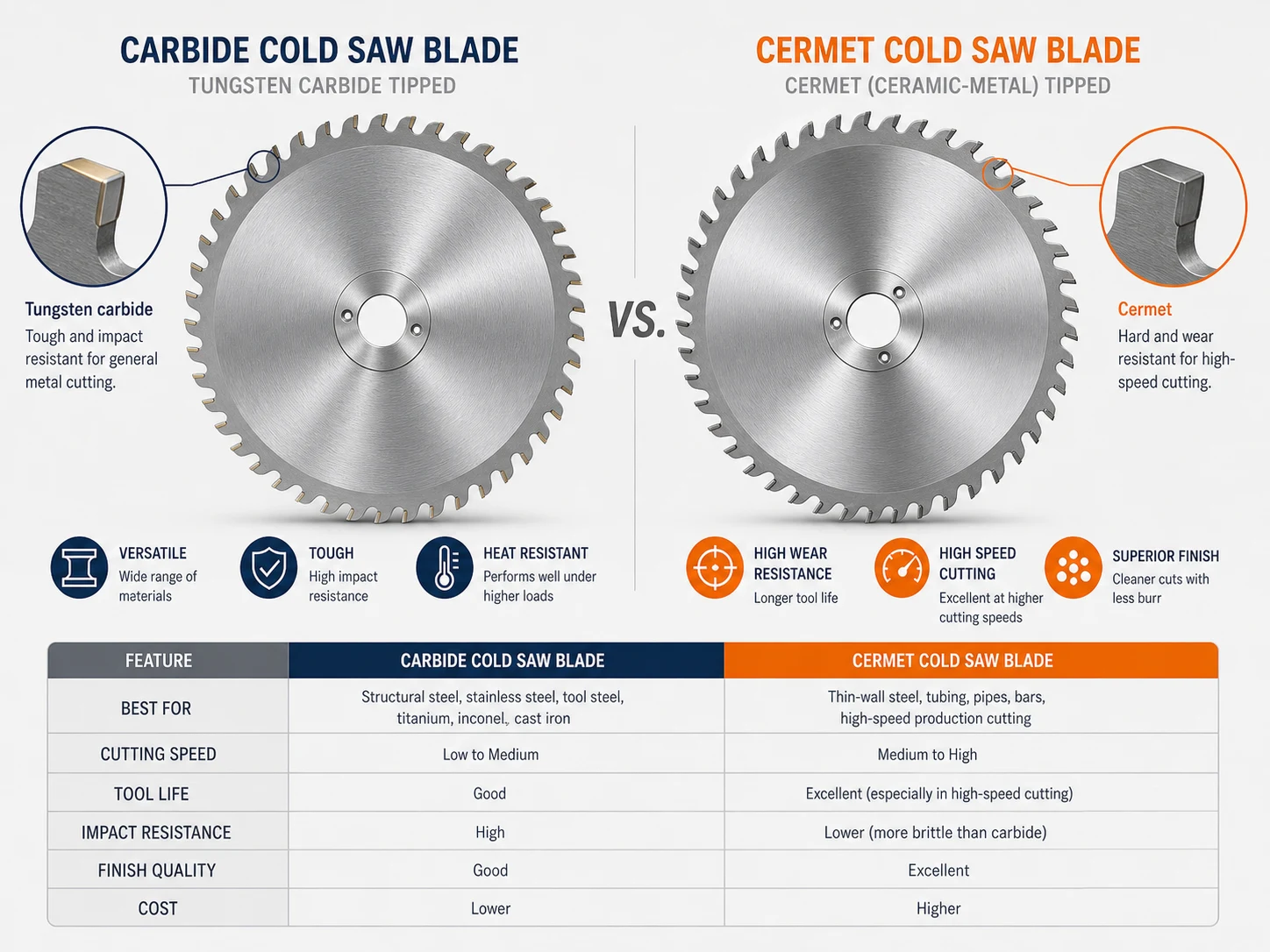
Carbide vs Cermet: Practical Comparison
| Factor | Carbide | Cermet | Buyer Note |
|---|---|---|---|
| Forgiveness | More tolerant of uncertain conditions | More sensitive to vibration, feed and machine condition | Carbide is safer for first samples. |
| Cut finish | Good when geometry is correct | Often cleaner in suitable conditions | Cermet can help when finish is a key selling point. |
| Blade life | Stable and predictable | Can be longer on the right machine | Longer life is not automatic; it depends on the full cutting setup. |
| Cost | Usually lower or medium | Usually higher | Compare cost per cut, not only unit price. |
| Best sample use | Unknown machine data, trial orders, mixed conditions | Confirmed machine and production cutting | Start safe, then upgrade if test results support it. |
For Mild Steel Solid Bar Cutting
Mild steel solid bar is a common cold saw blade application. The blade stays engaged in the material for a longer time than tube or thin profile cutting, so chip load, heat and tooth support matter.
If a buyer sends a size such as 285 x 2.0 x 1.75 x 32 x 80T and says the material is mild steel solid bar, but cannot confirm RPM or machine details, carbide is often the safer first recommendation. It helps reduce the risk of early chipping during sample testing.
Cermet can still be a good option later. If the carbide sample cuts smoothly and the buyer wants longer life or better finish, a cermet version can be tested with adjusted tooth geometry.
For Stainless Steel Cutting
Stainless steel is more sensitive to heat. It can create material pick-up, poor finish or quick dulling if speed, feed and coolant are not controlled. Both carbide and cermet can be used depending on the specific stainless grade and machine condition.
For stainless steel, do not choose only by blade diameter. Confirm stainless grade, tube wall thickness or bar size, whether coolant is used, and whether the machine is stable enough. Cermet may be useful, but the wrong cermet setup can disappoint the buyer.
For Tube and Profile Cutting
Tube and profile cutting create a different challenge from solid bar cutting. The tooth enters and exits thin walls repeatedly, and vibration or grabbing can damage the edge. In this situation, tooth geometry and clamping can be more important than simply choosing carbide or cermet.
For a first sample, carbide can be a safer way to test the application if the buyer is not sure about wall thickness, bundle cutting, feed control or machine condition. If the buyer already has stable production data, cermet can be considered for higher performance.
Why a More Expensive Grade Can Still Fail
A common mistake is assuming that buying the more expensive grade will automatically solve the cutting problem. It will not.
A cermet blade can fail early if:
- The workpiece is not clamped firmly.
- The blade bore or pin holes do not fit accurately.
- The machine has excessive runout or vibration.
- Feed is too heavy or too light.
- Coolant is missing, weak or poorly aimed.
- The tooth count or tooth form is wrong for the material shape.
This is why a professional supplier should ask questions before quoting. The purpose is not to delay the buyer. The purpose is to avoid selling a premium blade into the wrong cutting condition.
How We Recommend a First Sample
For a first sample order, especially when the buyer is a wholesaler testing a new supplier, we usually recommend a controlled approach:
- Confirm the blade marking and machine fit first.
- Confirm material type and shape: solid bar, tube, profile or plate.
- If the machine data is unclear, start with a stable carbide option.
- Ask the buyer to record test feedback: burr, finish, noise, chips, cut time and blade life.
- Adjust tooth geometry, grade or coating after the test result.
This approach is practical because it protects the buyer’s customer relationship. A wholesaler does not only need a low price. He needs a blade that helps his customer cut reliably, reorder confidently and trust him again next time.
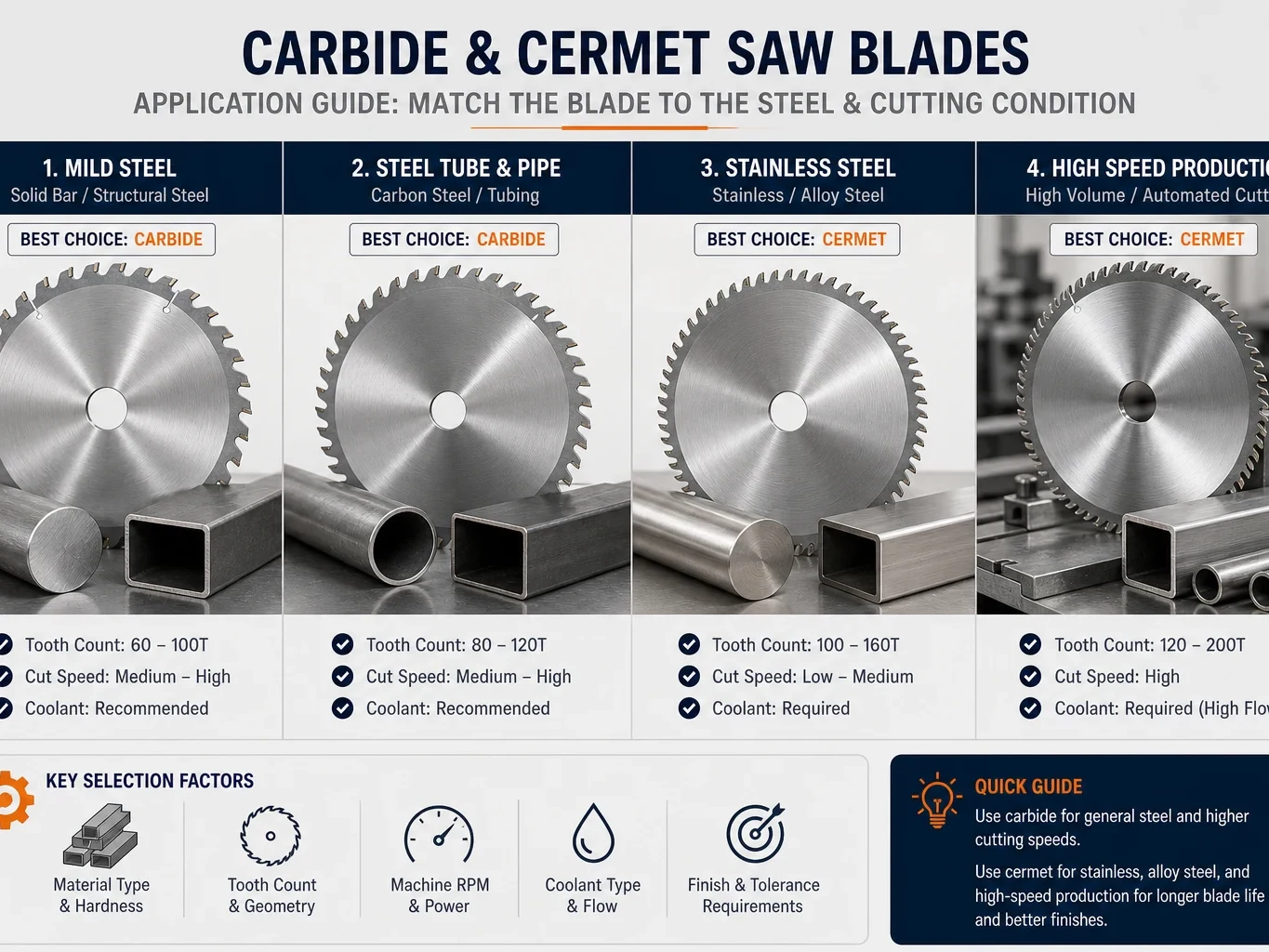
What to Send Before Choosing Carbide or Cermet
Before we recommend the grade, send the following information if possible:
- Blade size, for example 285 x 2.0 x 1.75 x 32 x 80T.
- Current blade photo and marking.
- Machine photo or model.
- Machine RPM if available.
- Material grade and shape.
- Solid bar diameter or tube/profile wall thickness.
- Dry cutting or coolant cutting.
- Trial quantity and expected monthly quantity.
If you do not know all details, send photos or a short video. That is often enough for a first technical check.
Related Guides
- How to Read Cold Saw Blade Size – understand OD, kerf, plate thickness, bore and teeth.
- Steel Cutting Cold Saw Blades – view cold saw blade product options.
- Why Saw Blade Prices Differ – compare quotation differences beyond visible size.
- Product Catalog – select by product family, application, machine and material.
Related buyer guide: Cold Saw Blade for Steel Tube Cutting: Tooth Count, Speed and Feed Guide adds practical checks for cold saw blade for steel tube cutting.
Related guide: How to Cut Stainless Steel Tube Without Burrs or Blue Heat Marks covers practical checks for cut stainless steel tube without burrs.
Related guide: Why Cold Saw Blade Teeth Chip: Buyer Troubleshooting Guide adds a practical buyer checklist for cold saw blade teeth chip.
FAQ
Is cermet always better than carbide?
No. Cermet can perform very well on suitable machines, but carbide is often safer when the machine condition or cutting data is not fully confirmed.
Is carbide only the cheap option?
No. A well-made carbide cold saw blade can be a professional and reliable solution. The grade, body, grinding and application matching still matter.
When should I test cermet?
Test cermet when the machine is stable, the material is consistent, and the buyer wants better finish or longer life after basic cutting conditions are confirmed.
What is better for a first sample order?
If machine data is unclear, a stable carbide sample is often safer. After testing, the blade can be adjusted to cermet if the application supports it.
Can the same blade cut mild steel and stainless steel?
Sometimes, but it is not always the best cost-per-cut choice. Stainless steel usually needs more careful speed, feed and grade selection.
If you are choosing between carbide and cermet for a sample order, contact Wryno Global with your blade photo, machine photo and material details. We will recommend a practical starting option first.