
Many saw blade inquiries start with a size.
A buyer may say, “I need 7 inch, 60 teeth, 25.4 bore.” That information is useful, but it is not enough to choose the right TCT saw blade.
The same size blade can behave very differently on softwood, plywood, MDF, laminate, aluminum profile or PVC. It can also behave differently on a handheld tool, table saw, panel saw or high-speed machine.
If the blade is not matched to the material and machine, common problems follow: burning, chipping, vibration, loud noise, short life, melted plastic, rough edges or tooth damage.
This guide gives buyers a practical way to think before ordering: start with the material, then match tooth geometry, tooth count, blade body, RPM and price level.
Start With the Material, Not the Size
Blade diameter and bore size decide whether the blade can fit the machine. The material decides whether the blade can cut well.
Before quoting, a useful supplier should ask what the blade will cut. Softwood and laminate are not the same. MDF and aluminum are not the same. Even two wood-based boards can need different blade choices if one has a hard coating or high glue content.
If you are buying for resale, this question becomes even more important. Your customer does not only buy the blade size. He buys the cutting result.
Material-to-Blade Matching Table
| Material | Typical Tooth Count | Tooth Geometry | Buyer Notes |
|---|---|---|---|
| Softwood | 24T-40T | FT / ATB | Fast cutting and chip clearance are usually more important than a mirror finish. |
| Hardwood | 40T-60T | ATB | Needs better carbide and a stable blade body to reduce burning and maintain edge life. |
| Plywood | 40T-80T | ATB / high ATB | Focus on reducing tear-out on the face veneer. |
| MDF | 60T-100T | ATB / TCG | MDF is abrasive and resin-heavy, so wear resistance and heat control matter. |
| Laminate / Melamine | 80T-120T+ | TCG / anti-chip | Edge quality is the priority. Machine support and feed stability are also important. |
| Aluminum profile | 80T-120T | TCG | Use aluminum-specific geometry and controlled rake angle to avoid grabbing. |
| PVC / plastic | 60T-100T | Fine tooth / low heat design | Control heat to avoid melting, burrs or edge deformation. |
| Mild steel / solid bar | Not standard wood TCT | Cold saw / cermet / metal carbide | Do not treat metal cutting as a normal woodworking TCT blade application. |
Tooth Count Is Only One Part
It is easy to think more teeth means better quality. In real cutting, that is only partly true.
More teeth usually create a smoother finish because each tooth removes a smaller chip. But more teeth also mean smaller gullets. If the material is thick, dusty, resin-heavy or difficult to evacuate, chips can stay around the cutting edge. Heat rises, the blade rubs, and the cut may become noisy or blackened.
Fewer teeth can cut faster and clear chips better, but they may leave a rougher edge. If the feed is not stable, the tooth impact can also feel stronger.
So the question is not “how many teeth is best?” The better question is: which tooth count gives the right balance between speed, finish, heat and chip clearance for this material?
For a deeper tooth-count discussion, see our TCT saw blade tooth count chart.
Tooth Geometry by Material
Two blades can both be 80T and still cut very differently. Tooth geometry controls how the tooth enters and leaves the material.
ATB: General Wood and Plywood
ATB means alternate top bevel. The teeth lean left and right alternately, creating a slicing action. It is widely used for wood, plywood and many furniture boards.
ATB is a good starting point when the buyer wants a cleaner wood cut without moving into very specialized panel cutting.
Flat Top: Fast Cutting and Ripping
Flat top teeth are more aggressive and stronger. They are useful when speed and chip clearance matter more than a very fine surface.
For softwood, rough cutting or some plywood applications, flat top can be practical. But it is usually not the first choice for laminate edge quality.
TCG: Laminate, Aluminum and Abrasive Materials
TCG means triple chip grind. It is often used for aluminum, laminate, melamine and harder surface materials because it spreads cutting load and improves edge durability.
If a buyer complains about chipped laminate or unstable aluminum cutting, tooth geometry should be checked before simply increasing tooth count.
RPM and Feed Speed Matter
Blade selection does not stop at the blade itself. RPM and feed speed can change the result dramatically.
As blade diameter increases, the safe and practical RPM normally becomes lower. If RPM is too high, the blade may create more heat, noise, vibration or burning. If RPM is too low, cutting may become rough and impact-heavy.
| Blade Diameter | Common RPM Range | Typical Machine |
|---|---|---|
| 110-125mm | 8,000-13,000 | Handheld and compact tools |
| 180-185mm | 4,500-8,500 | Circular saws and small table saws |
| 250mm | 3,000-6,000 | Table saws and miter saws |
| 300-350mm | 2,500-4,500 | Panel saws and industrial woodworking machines |
| 400mm+ | 1,500-3,500 | Large industrial cutting machines |
These ranges are only practical references. The final speed should follow the machine rating, blade rating, material condition and supplier recommendation.
Feed speed also matters. Feeding too fast can overload the teeth. Feeding too slowly can cause rubbing and heat. A good cut makes real chips, not only dust and not oversized bites.
If noise or vibration appears, read our guide on why saw blades make noise and vibrate.
Blade Plate Material: Why the Same Size Has Different Prices
Buyers often compare two blades with the same diameter, same bore and same tooth count, then ask why the price is different.
The answer is usually hidden in the blade plate material and manufacturing process.
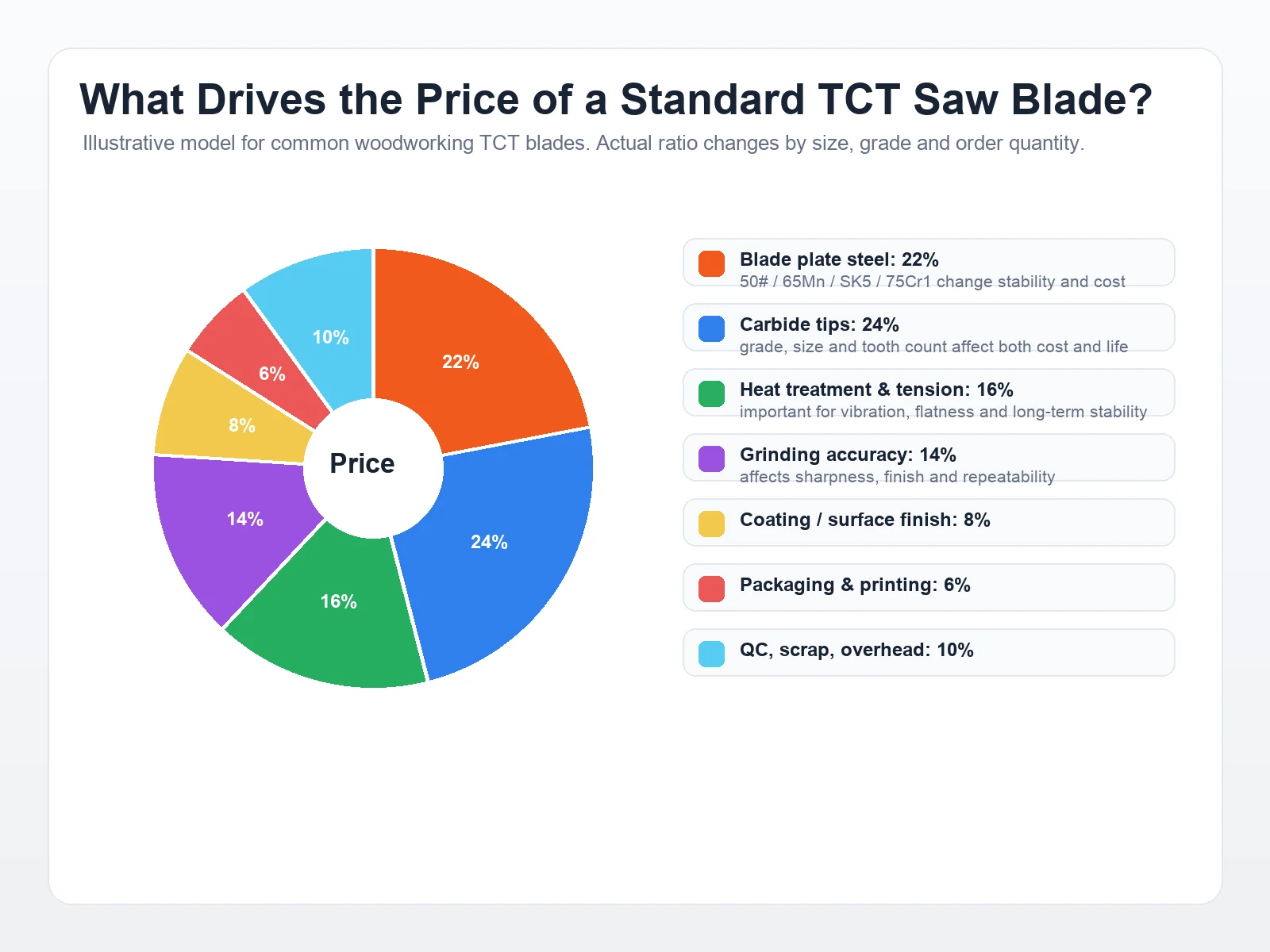
Note: the following chart is a buyer reference model. It is not a fixed factory cost formula. The real ratio changes by blade size, material grade, tooth count, order quantity and production process.
Carbon Steel: Low Cost and Basic Use
45# and 50# carbon steel are commonly used for cost-sensitive blades. They can be suitable for light-duty cutting, circulation markets or applications where the buyer needs a low entry price.
But for demanding cutting, high speed or longer service life, the blade body may not be as stable as higher-grade material.
Spring Steel: Practical Middle Range
Materials such as 65Mn are often used where buyers want a balance between price and performance. They are common in general wood and aluminum cutting blades.
This can be a useful option for wholesalers who need competitive pricing but cannot accept very unstable quality.
Tool Steel and Alloy Tool Steel: Better Stability
SK5, T8, T8A, 75Cr1, 80CrV2 and similar alloy tool steels are often used for better blade stability, heavier cutting and longer life.
They are not automatically the best choice for every market, but they are important when the buyer values consistent performance, cleaner cuts and fewer complaints.
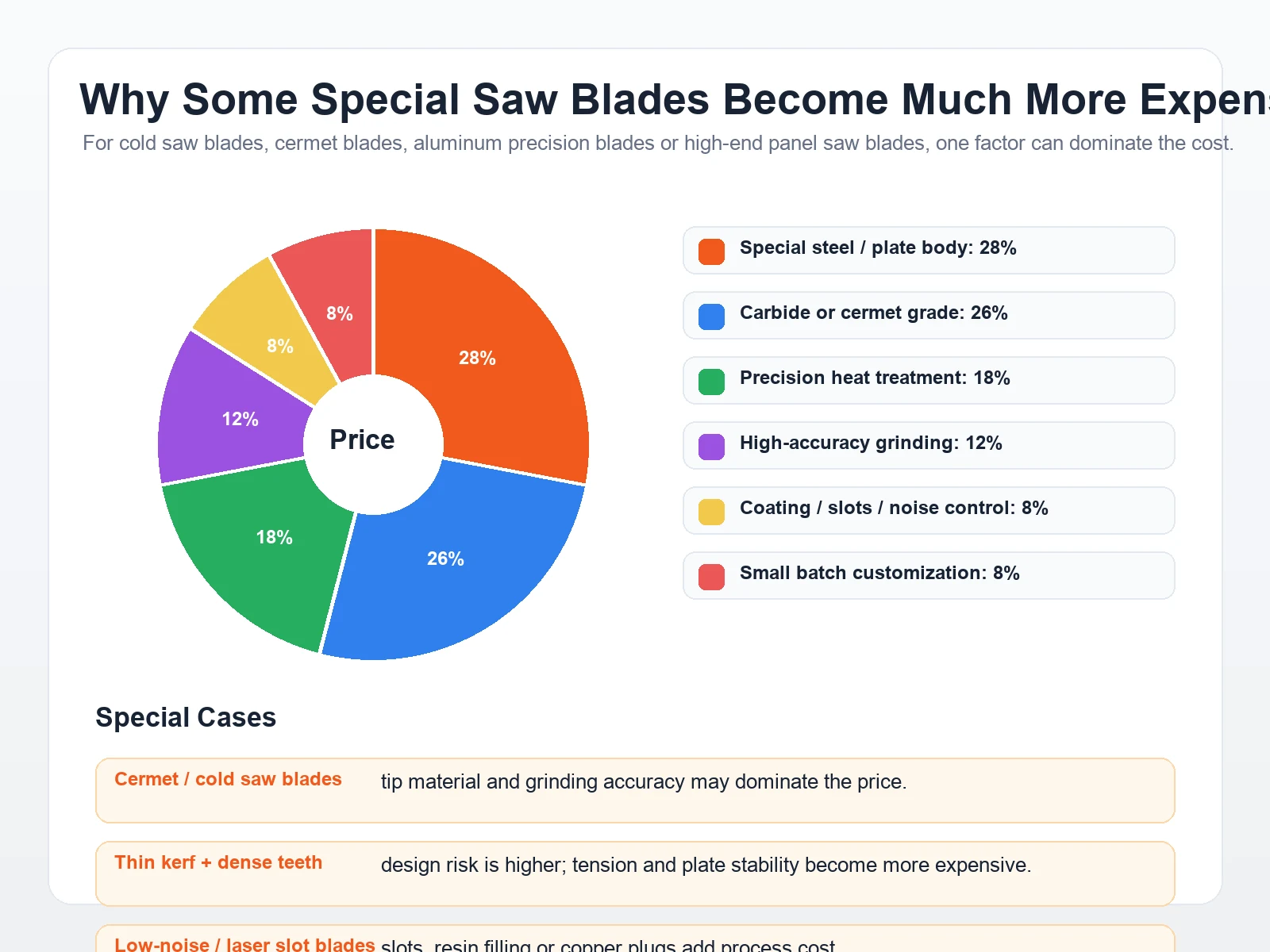
Heat Treatment and Tension Control
The steel name alone does not tell the whole story.
Heat treatment affects hardness, toughness, rigidity and brittleness. Cold rolling condition, internal stress, flatness and grain structure also affect how the blade behaves after grinding and during cutting.
Tension control is another important detail. A blade may look flat when it is not rotating, but it must stay stable at working speed. Poor tension or uncontrolled internal stress can lead to vibration, noise and unstable cutting.
This is why two blades with the same printed specification can have different cutting life and different prices.
There Is No Universal Best Blade
The best blade is not always the most expensive blade. It is also not always the blade with the highest tooth count or hardest steel.
A buyer serving a price-sensitive retail market may need an economy line. A furniture factory may need a stable mid-range blade with clean cutting. A high-volume production customer may need better steel, better carbide, tighter runout and more consistent grinding.
The right choice depends on four things:
- What material is being cut.
- What machine and RPM are used.
- What result the buyer needs: speed, finish, life or price.
- What price level the buyer’s market can accept.
What Buyers Should Send Before Quotation
To avoid wrong recommendations, send these details before ordering:
- Cutting material, such as plywood, MDF, laminate, aluminum or PVC.
- Material thickness and whether it is solid, hollow, coated or glued.
- Blade diameter, kerf, plate thickness, bore and tooth count if known.
- Machine photo, machine type or RPM.
- Current blade photo or marking if replacing an existing blade.
- Target result: faster cutting, cleaner edge, longer life or lower cost.
- Quantity and whether brand printing or packaging is needed.
With these details, the supplier can recommend a blade level that fits the real application instead of only quoting the cheapest specification.
Final Thought
A TCT saw blade should be selected as part of a cutting system.
Start with the material. Then confirm tooth geometry, tooth count, machine RPM, blade plate quality and target price level. When these factors match, the buyer gets fewer complaints, better cutting stability and a product that is easier to sell again.
That is the real value of a good blade recommendation: not simply a lower price, but a blade that fits the job.