
Saw blade quotations can be confusing.
Two suppliers may quote the same size, same bore and same tooth count, but the prices are very different. One buyer may ask a simple question: why?
The answer is that saw blades are not only size numbers.
Behind the price, there may be differences in steel plate, carbide grade, heat treatment, welding, grinding, runout control, packaging, MOQ and after-sales risk.
If buyers only compare unit price, they may miss the real cost.
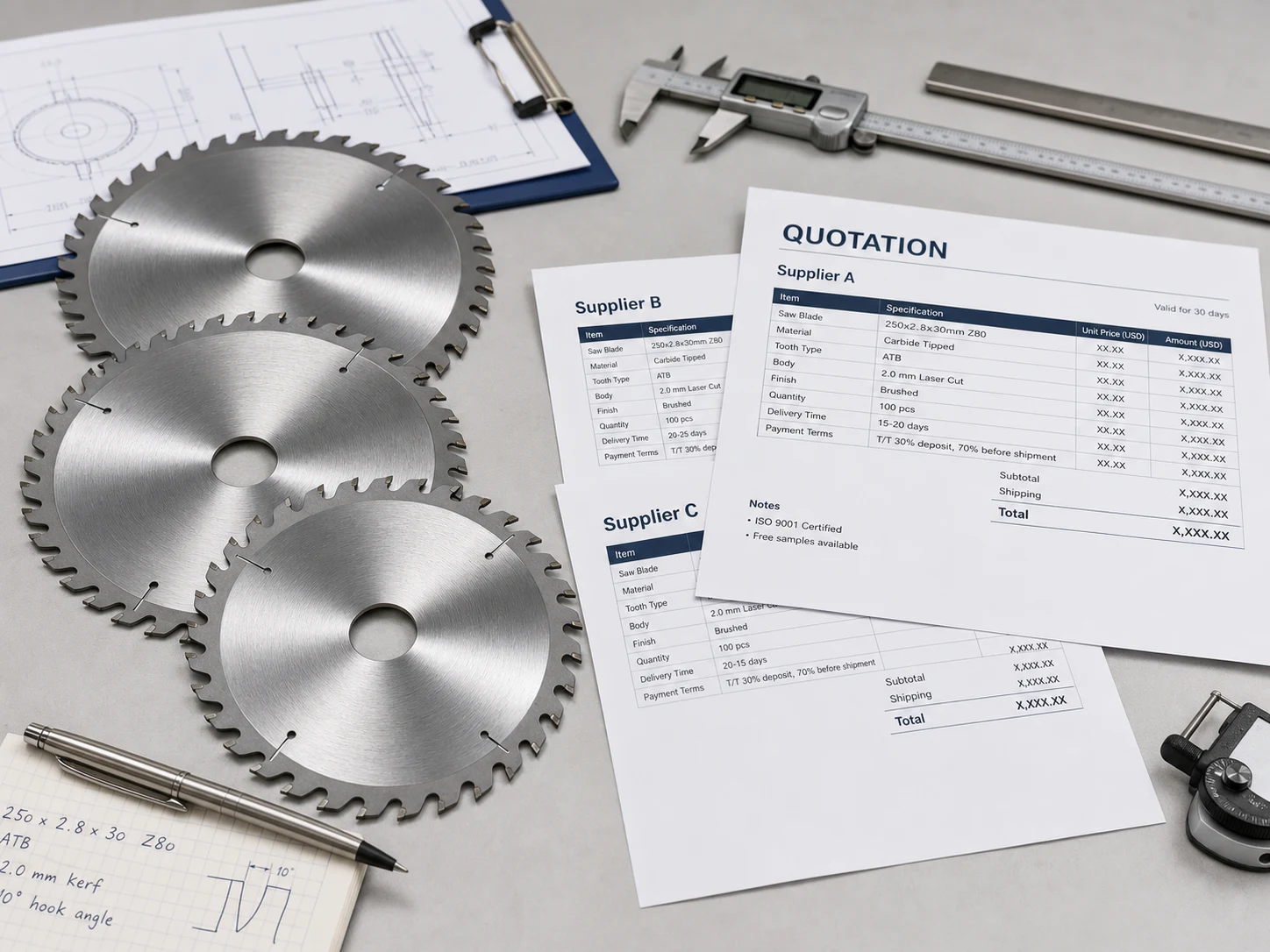
Same Size Does Not Mean Same Blade
A quotation may look like this:
180 x 2.3 x 1.5 x 25.4 x 60T
This tells us the main dimensions, but it does not tell the full quality level.
It does not show:
- steel plate grade
- plate flatness
- heat treatment stability
- carbide grade and tip size
- tooth geometry
- grinding accuracy
- runout control
- welding quality
- coating or surface treatment
- packaging and brand printing
That is why two blades with the same model can still have different performance and price.
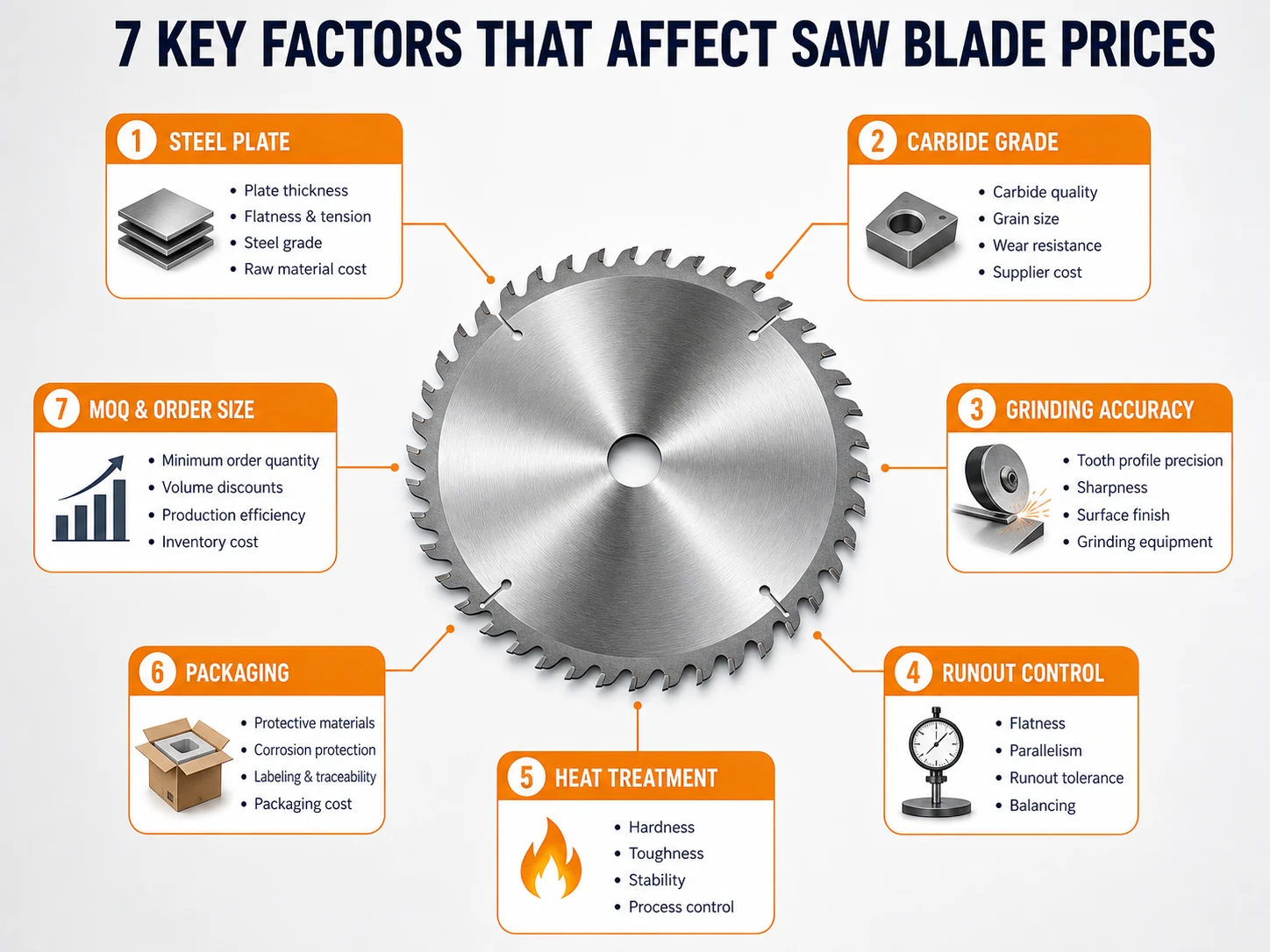
Steel Plate and Heat Treatment
The blade body affects stability.
Better steel plate and better heat treatment help the blade keep flatness, reduce deformation and improve cutting stability.
Low-cost blades may be acceptable for light use, but if the plate has poor stress control, the blade can vibrate, run hot or cut inaccurately.
For buyers, this is hard to see from a photo. It usually shows up during use.
Carbide Grade and Tip Quality
Carbide affects cutting life.
Different grades can have different hardness, toughness and wear resistance. A cheaper carbide may cut at first, but lose edge quality faster.
Tip size also matters. A blade with smaller tips may be cheaper, but it may have less grinding margin and shorter service life.
For wholesale buyers, this affects repeat orders. The first order may depend on price. The second order depends on customer feedback.
Grinding Accuracy
Grinding quality affects sharpness, cutting smoothness and edge finish.
Poor grinding can cause noise, rough cutting, chipping or uneven load on the teeth. Good grinding costs more because it requires better machines, stable process control and inspection.
This is one reason premium blades can look similar but cut differently.
Runout and Balance
Runout means the blade does not run perfectly true.
High runout can cause vibration, wider cutting marks and poor finish. Dynamic balance also matters, especially at higher RPM.
For high-speed machines, aluminum cutting, laminated board or precision work, runout control can be more important than buyers expect.
MOQ, Packaging and Brand Printing
Some price differences are not only production cost.
MOQ, packaging, private label printing, carton design, samples and special sizes can all affect the quotation.
For example, a common stock model may be cheaper and faster. A special 80T model, custom bore, special pin holes or custom brand printing may require more setup.
Buyers should confirm whether the quotation is for stock goods or custom production.
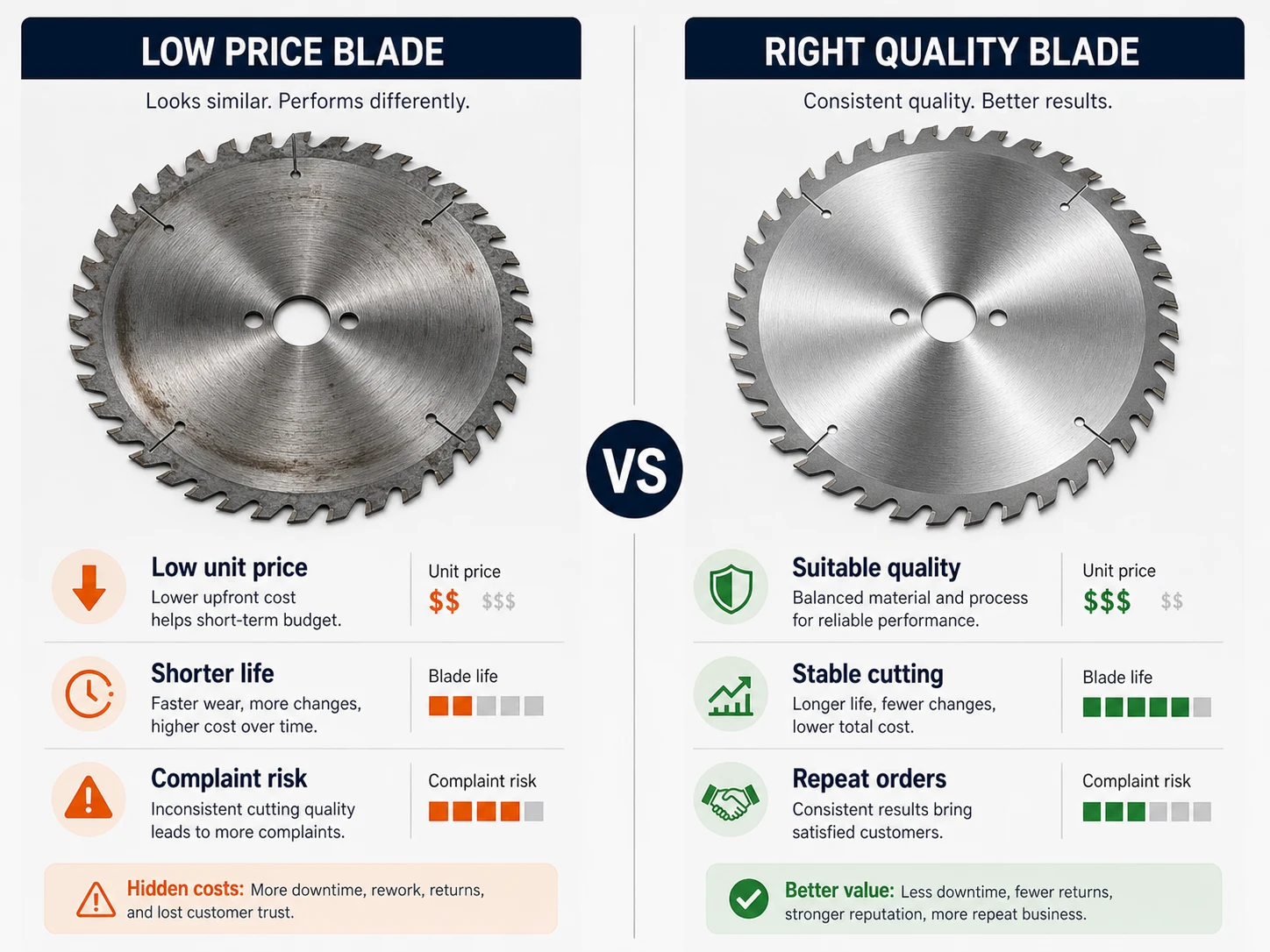
Compare Cost Per Use, Not Only Unit Price
The cheapest blade is not always the lowest cost.
If a cheaper blade has shorter life, more complaints, poor edge quality or higher replacement frequency, the real cost becomes higher.
For resellers, the hidden cost is even bigger: the customer may not buy again.
A fair comparison should include:
- unit price
- expected cutting life
- edge quality
- complaint risk
- delivery time
- MOQ
- packaging
- target market
Practical Questions to Ask Suppliers
Before choosing a quotation, ask:
- Is this economy, standard or premium grade?
- What material is the blade designed to cut?
- What carbide grade is used?
- Is the model stock or custom production?
- What is the MOQ?
- What is the lead time?
- Can the packaging or printing be customized?
- What quality level is recommended for my market?
These questions help buyers compare value instead of only comparing price.
Buyer Takeaway
Saw blade quotations should be compared by real value, not only by the lowest number.
If the application is light use, an economy blade may be enough. If the buyer serves workshops or industrial users, a better blade can reduce complaints and protect customer relationships.
A good supplier should be able to explain what changes behind different price levels. That is more useful than simply saying “our quality is good.”
Related reading: economy standard premium saw blades. match tct saw blade to material rpm. why more teeth saw blade higher moq custom production. confirm saw blade specifications before quote.