
Many saw blade inquiries start with a photo.
That is useful, but a photo alone is usually not enough for an accurate quotation. Two saw blades can look similar, yet have different bore sizes, plate thickness, tooth form, carbide grade or cutting purpose.
If the supplier quotes too quickly, the buyer may receive a blade that fits the photo but does not fit the machine or material.
Before quoting, a good supplier should confirm the real working conditions.
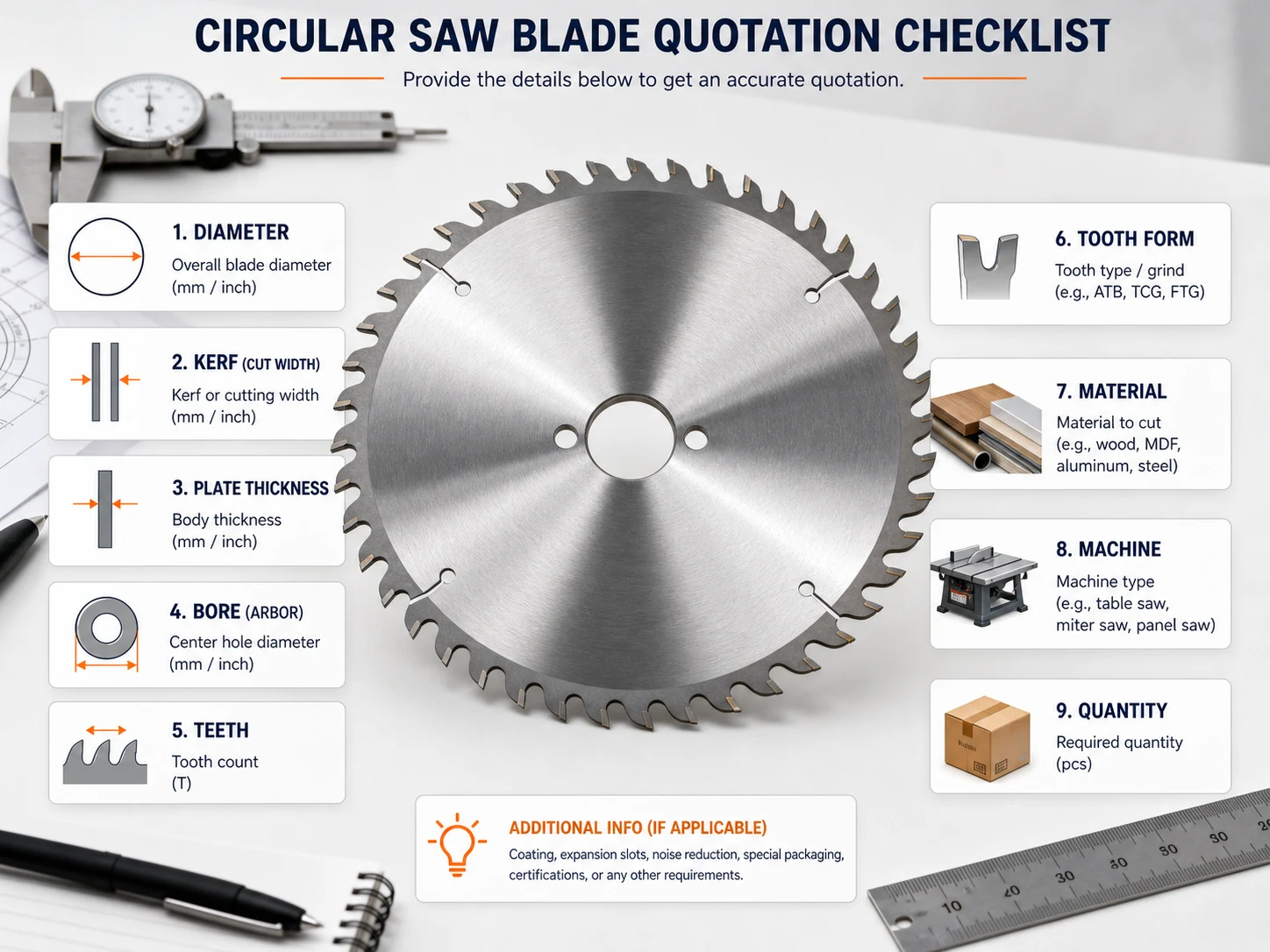
1. Outside Diameter
Outside diameter is the first number in most saw blade specifications.
For example:
180 x 2.3 x 1.5 x 25.4 x 60T
The first number, 180, is the outside diameter in millimeters.
This decides whether the blade physically fits the machine and whether the cutting depth is suitable. Buyers should not guess this number from a photo. If the marking is not clear, measure the blade directly.
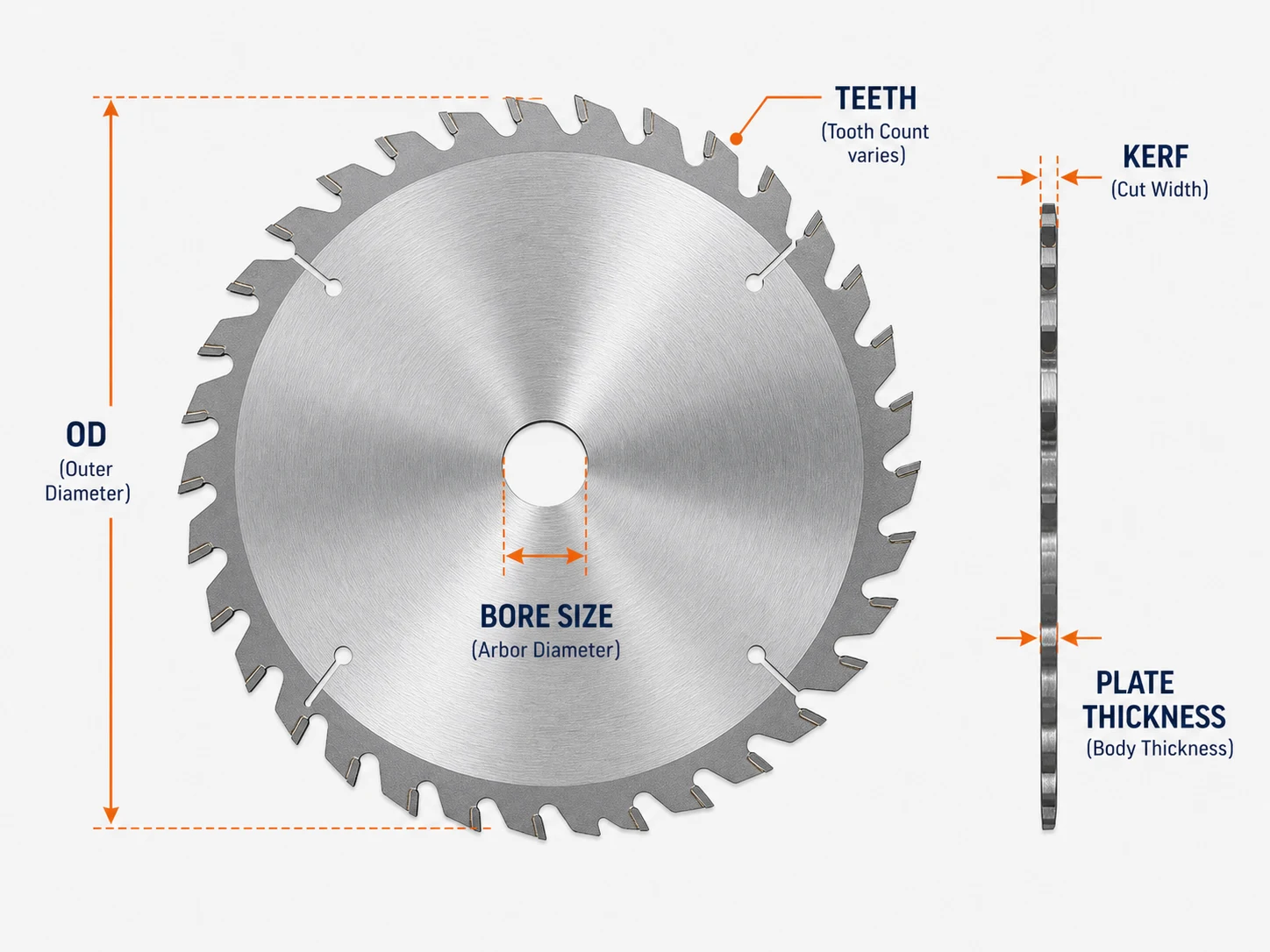
2. Kerf and Plate Thickness
Kerf is the cutting width. Plate thickness is the thickness of the steel body.
These two values affect cutting resistance, stability, material waste and heat.
If the kerf is too narrow, the blade may rub or heat up. If the kerf is too wide, the machine may need more power. If the plate is too thin for the application, vibration or deflection can become a problem.
For buyers, this is one reason why the same tooth count can still have different prices.
3. Bore Size
Bore size is the center hole of the saw blade.
Common examples include:
- 20mm
- 22.23mm / 7/8 inch
- 25.4mm / 1 inch
- 30mm
- 32mm
The bore must match the machine arbor. A wrong bore can create installation problems or runout risk.
If the buyer is not sure, they can send a photo of the current blade marking or machine arbor.
4. Tooth Count and Tooth Form
Tooth count affects cutting speed, chip space and finish quality.
Tooth form affects how the blade enters the material.
Examples:
- Flat Top: stronger, faster chip clearance
- ATB: cleaner surface cut for wood and boards
- TCG: often used for harder surface layers, laminate or non-ferrous materials
A buyer should not only say “I need 80T.” It is better to say what material will be cut and what edge quality is required.
5. Cutting Material
This is one of the most important details.
A blade for softwood is not the same as a blade for MDF, laminated board, aluminum, PVC, mild steel or granite.
The cutting material affects:
- carbide grade
- tooth geometry
- tooth count
- plate stability
- coating or surface treatment
- recommended speed and feed
If the buyer only sends size, the quotation may still be incomplete.
6. Machine Type and RPM
The same saw blade may perform differently on different machines.
A stable industrial machine can use a finer blade more safely. A light-duty electric tool may need a more practical design with better chip clearance and lower vibration risk.
Machine RPM also matters. High RPM can create heat and vibration if the blade, material and feed speed do not match.
7. Quantity and Purpose
Quantity affects price, MOQ, packaging and production plan.
A sample order, a trial order and a wholesale order should not be quoted in the same way.
The buyer should also explain whether the blade is for:
- personal workshop use
- local resale
- OEM brand
- industrial production
- market testing
This helps the supplier recommend the right quality level.
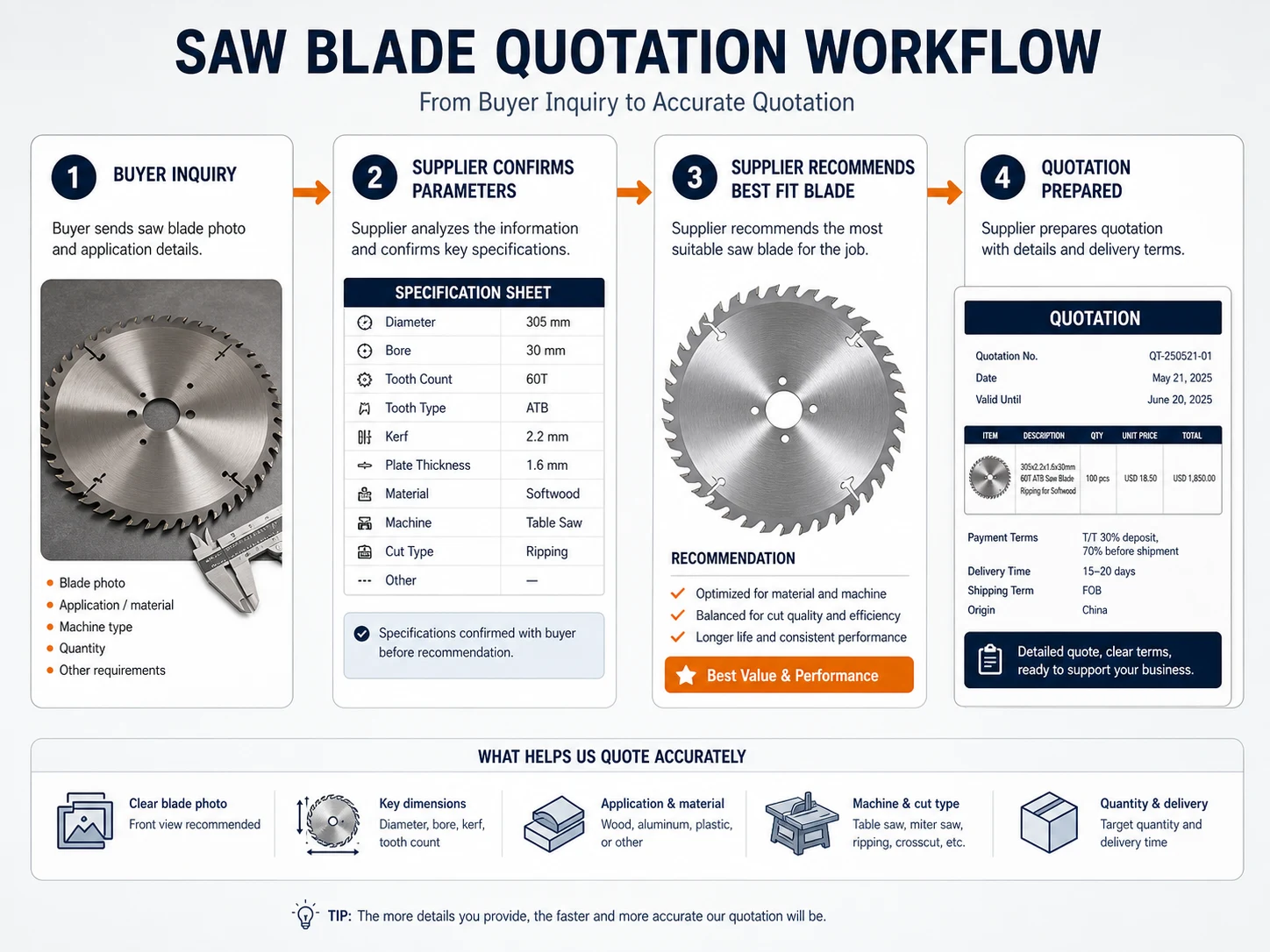
Simple Quotation Checklist
Before asking for a quotation, prepare these details:
| Item | What to Confirm |
|---|---|
| Diameter | Outside diameter in mm or inch |
| Kerf | Cutting width |
| Plate thickness | Steel body thickness |
| Bore | Center hole size |
| Teeth | Tooth count |
| Tooth form | Flat Top, ATB, TCG or other |
| Material | What the blade cuts |
| Machine | Machine type and RPM if available |
| Quantity | Sample, trial or bulk order |
| Market | Economy, standard or premium need |
Buyer Takeaway
A good quotation starts before the price.
If the buyer confirms only the blade diameter and tooth count, the supplier may still miss important details. If the buyer confirms material, machine, bore, kerf, tooth form and quantity, the quotation becomes more accurate and professional.
This saves time for both sides and reduces the risk of receiving the wrong blade.
Related reading: saw blade tooth count for different materials. saw blade bore size guide. saw blade tooth count kerf plate thickness. 40t vs 60t vs 80t saw blade buyer guide.