
Concrete is unforgiving. Use the wrong drill bit and you’ll burn through it in minutes, stall the motor, or worse — snap the bit inside the hole and spend the next hour trying to extract it. After producing drill bits for concrete and masonry applications for over 30 years at our Hangzhou factory, we’ve learned what works, what fails, and how to match the right bit to the job.
This guide breaks down the best drill bit for concrete across different scenarios — from standard poured concrete to reinforced walls and precast panels — with specific recommendations you can act on.
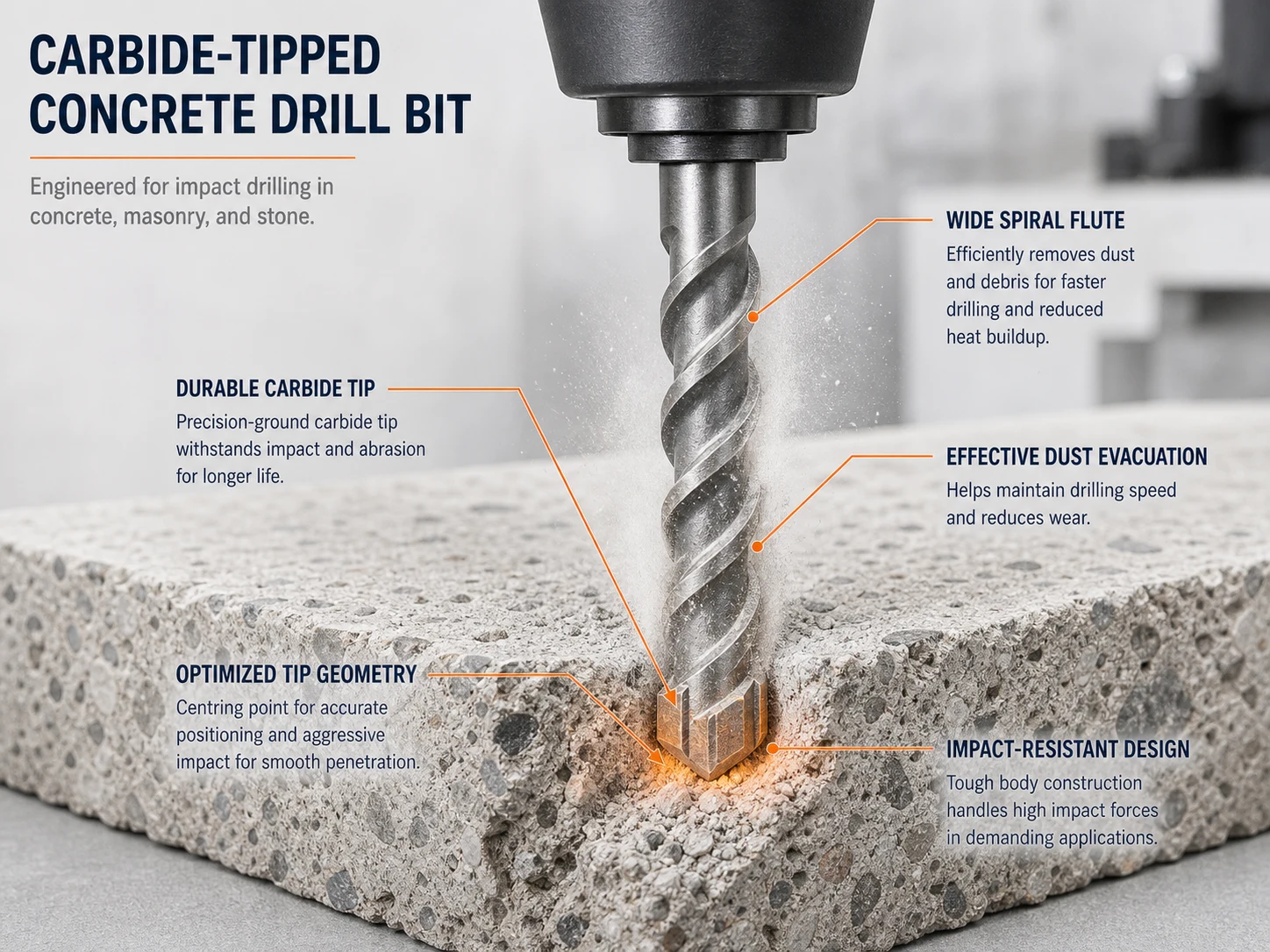
Why Concrete Requires a Dedicated Drill Bit
Concrete isn’t just “hard rock.” It’s a composite material made of aggregate (stones and sand), cement binder, and water. The hardness comes from the aggregate — typically quartz with a Mohs hardness of 7, harder than most steels. The cement matrix is abrasive. Together, they destroy standard HSS and even many cobalt bits within seconds.
Here’s what happens when you use the wrong bit:
- Overheating: The friction between a standard twist drill and concrete generates enough heat to anneal (soften) the cutting edge almost immediately.
- Blunting: The abrasive cement matrix grinds away the cutting edge faster than the bit can remove material.
- Binding: Concrete dust packs into the flutes, blocking chip evacuation and causing the bit to jam.
- Breaking: Reinforcing bar (rebar) inside concrete will snap a standard bit on contact.
Concrete demands a bit designed for impact and abrasion — not just hardness.
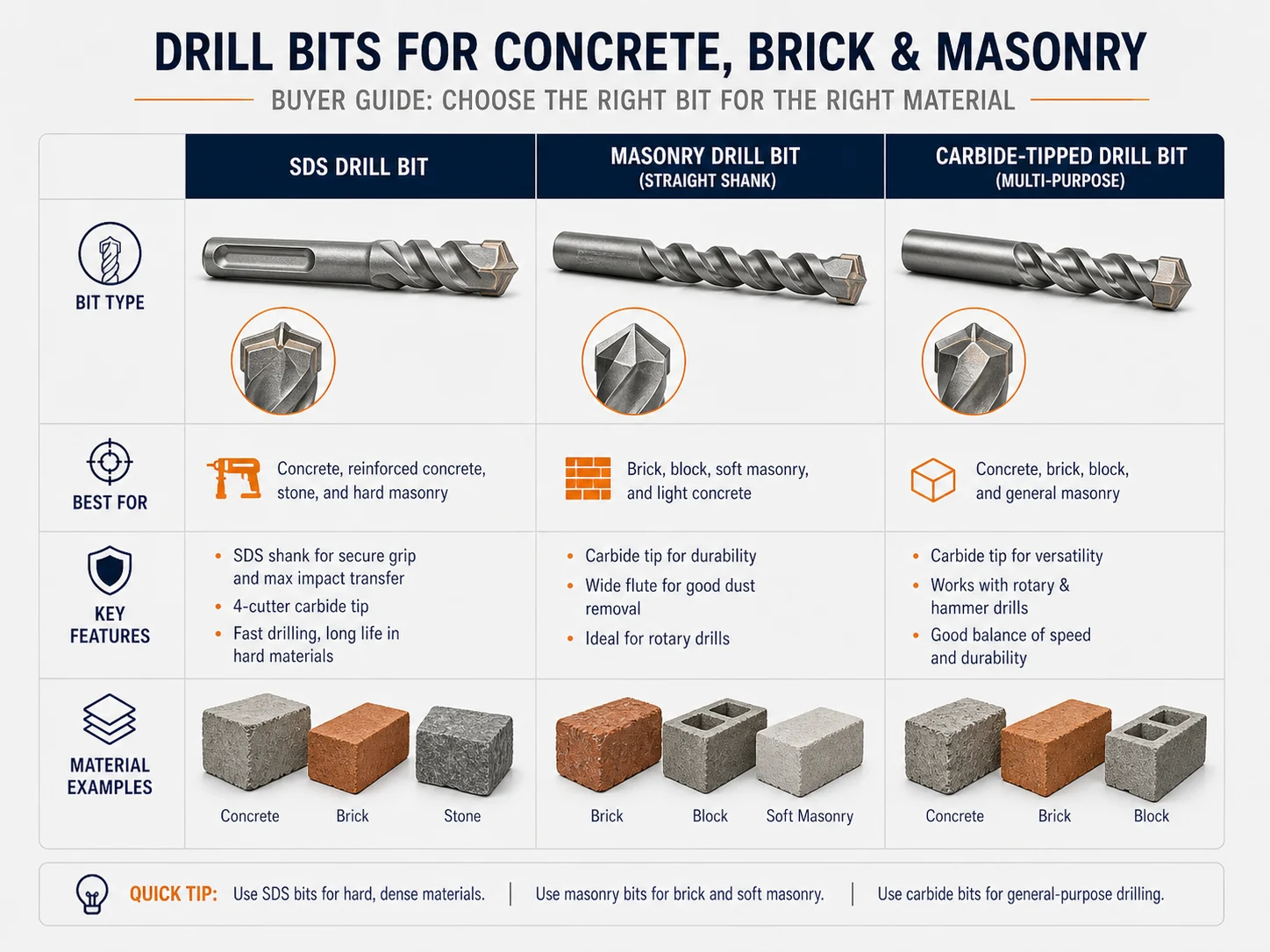
SDS vs Masonry: Which System Do You Need?
The two main categories of concrete drill bits are SDS hammer drill bits and straight-shank masonry bits. They are not interchangeable.
| Feature | SDS Hammer Drill Bits | Straight-Shank Masonry Bits |
|---|---|---|
| Shank type | SDS Plus (10mm) or SDS Max (18mm) | Cylindrical straight shank (usually 3/8″ or 1/2″) |
| Required tool | Rotary hammer drill | Standard drill or impact driver |
| Impact mechanism | Pneumatic hammer action (2–10+ joules) | None (relies on rotation + pressure) |
| Best for | Concrete, reinforced concrete, stone | Brick, block, soft concrete, tile |
| Hole size range | 4mm–52mm (SDS Plus), 12mm–60mm (SDS Max) | 3mm–20mm typically |
| Drilling speed | Fast — impact pulverizes concrete | Slow — grinds material away |
| Price per bit | Higher upfront, longer life | Lower upfront, wears faster |
Our factory recommendation: If you’re drilling more than 20 holes in concrete, invest in a rotary hammer and SDS hammer drill bits. The productivity gain is enormous. For occasional holes in brick or block, straight-shank masonry bits are fine.
Choosing the Best Drill Bit by Concrete Type
Standard Poured Concrete (C20–C30)
This is the most common concrete you’ll encounter in residential and light commercial construction. For this material:
- SDS Plus bits with YG8 carbide tips are the standard choice. YG8 (ISO K40) has the right balance of hardness and toughness for non-reinforced concrete.
- Optimal flute design: Double-flute with wide spiral angle for dust evacuation. Our factory uses a 25°–30° spiral on standard concrete bits.
- Typical life: 200–400 holes of 80mm depth for a 10mm bit in C25 concrete.
Reinforced Concrete (with Rebar)
This is where most bits fail. Hitting rebar unexpectedly is the #1 cause of bit breakage and project delays.
- Use SDS Max for larger holes (16mm+). The higher impact energy of SDS Max rotary hammers (8–15 joules) can handle rebar encounters better than SDS Plus.
- Carbide grade matters: Step up to YG11C or YG15C carbide — tougher grades designed to survive impact against steel reinforcement.
- Four-cutter head design: Cross-shaped carbide tips (four cutting edges) center the bit better when transitioning from concrete to rebar and back. They also reduce vibration.
- Pro tip from our export team: When you hit rebar, don’t force the bit. Pull back, switch to “rotation only” mode if your drill has it, and let the carbide grind through the steel slowly. Hammering against rebar will snap the tip.
Precast Concrete and High-Strength Concrete (C40+)
Precast panels and high-strength concrete are denser and harder than standard poured concrete. The aggregate is finer and the cement ratio higher.
- Carbide grade: YG6X (K20) or harder. The finer grain structure handles dense concrete better than standard YG8.
- Tip geometry: Four-cutter or full-head carbide design for maximum cutting edge durability.
- Cooling: Use water cooling for deep holes (>150mm) in high-strength concrete. The heat buildup is significant and will anneal even quality carbide.
- Reduced speed: Lower your rotary hammer’s RPM by 20–30% compared to standard concrete. Slower rotation + full impact = longer bit life.
Size Selection Guide
Choosing the right diameter isn’t just about the fastener — it’s about the load, the embedment depth, and the concrete quality.
| Application | Bit Diameter | Typical Embedment | Anchor Type |
|---|---|---|---|
| Light fixtures, cable clips | 5–6mm | 30–40mm | Plastic plug anchors |
| Shelving, brackets, conduit | 8–10mm | 50–80mm | Metal expansion anchors |
| Structural steel, handrails | 12–16mm | 80–120mm | Heavy-duty wedge anchors |
| Machine bases, large structures | 18–25mm | 120–200mm | Epoxy anchors, undercut anchors |
| HVAC, plumbing penetrations | 28–52mm | Through-hole | Core bits (hollow) |
Rule of thumb: The bit diameter should match the anchor diameter exactly. A 10mm anchor needs a 10mm hole. Oversized holes reduce pull-out strength by 30–50%. Undersized holes make anchor installation impossible and can crack the concrete.
Factory Experience: What We See in the Field
Our factory ships SDS and masonry drill bits to distributors across Southeast Asia, South Asia, and the Middle East. Here are the patterns we’ve observed from customer feedback:
- Most returned bits: Tip breakage from hitting rebar. The solution was switching customers from standard two-cutter tips to four-cutter heads — breakage complaints dropped by roughly 60%.
- Most common sizing mistake: Buyers ordering 6mm and 8mm bits in huge quantities but neglecting 10mm and 12mm, which are the actual workhorse sizes for construction anchoring.
- Best-selling configuration: SDS Plus 10mm × 160mm (overall length). This one specification alone accounts for about 25% of our SDS Plus output. It’s the universal size for standard expansion anchors.
- Regional preference: South Asian customers (India, Bangladesh, Pakistan) favor longer bits (200mm, 310mm) because wall thicknesses tend to be greater. Southeast Asian markets prefer 110mm and 160mm for lighter construction.
Production note: We test every SDS bit batch by drilling 50 holes in C30 concrete, then measuring tip wear under a microscope. A good bit should show less than 0.3mm tip wear after 50 holes. Bits that exceed this are rejected. It’s a time-consuming test, but it’s why our return rate stays below 1%.
Browse our full range of SDS hammer drill bits and other drill bit products. We produce SDS Plus and SDS Max in diameters from 4mm to 52mm, with standard and four-cutter head options. Trial orders start at 100 pieces per specification.
Frequently Asked Questions
Can I use a regular drill bit on concrete?
No — not if you want to finish the job. Standard HSS twist drill bits will go dull within seconds on concrete and may break on aggregate. Even cobalt bits are not designed for the abrasive nature of concrete. You need a masonry bit (minimum) or an SDS hammer drill bit for any serious concrete drilling.
What is the best drill bit for a concrete wall?
For standard concrete walls (C20–C30), an SDS Plus hammer drill bit with a two-cutter carbide tip (YG8 grade) is the best choice for holes up to 16mm. For reinforced concrete walls or holes above 16mm, use SDS Max with four-cutter heads and tougher carbide (YG11C or YG15C). Always match the bit diameter to your anchor specification.
How do I know if my concrete has rebar?
If you’re working on a commercial or industrial structure built after 1980, assume rebar is present. For residential walls, rebar is common in columns, beams, and foundations but less frequent in partition walls. A rebar detector (ferromagnetic scanner) costs $50–150 and saves you from broken bits and damaged walls.
Why does my SDS bit keep getting stuck?
Most likely cause is poor dust evacuation. Pull the bit out every 10–15 seconds to clear dust from the hole. In deep holes, use a bellows or vacuum to remove dust. Another common cause is drilling at too low an impact setting — the bit needs sufficient hammer energy to pulverize the concrete ahead of the cutting edge.
How long should a concrete drill bit last?
In standard C25 concrete, a quality SDS Plus bit should drill 200–400 holes of 80mm depth before the cutting edge wears significantly. In reinforced concrete, expect 100–200 holes. In soft brick or block, life can exceed 500 holes. If your bits are wearing out much faster, check your drilling technique — excessive speed, no dust clearing, or hitting rebar will all reduce life.