
Handheld circular saws: selection & sourcing
A useful handheld circular saw RFQ makes competing quotations comparable. It tells the supplier what the customer cuts, how the tool will be used and what the delivered kit must contain. Asking only for “best price for 20 V saw” leaves too many variables open.
The checklist below is a proposed purchasing workflow. It is not an offer of a particular MOQ, production lead time, certification package or exclusive territory.
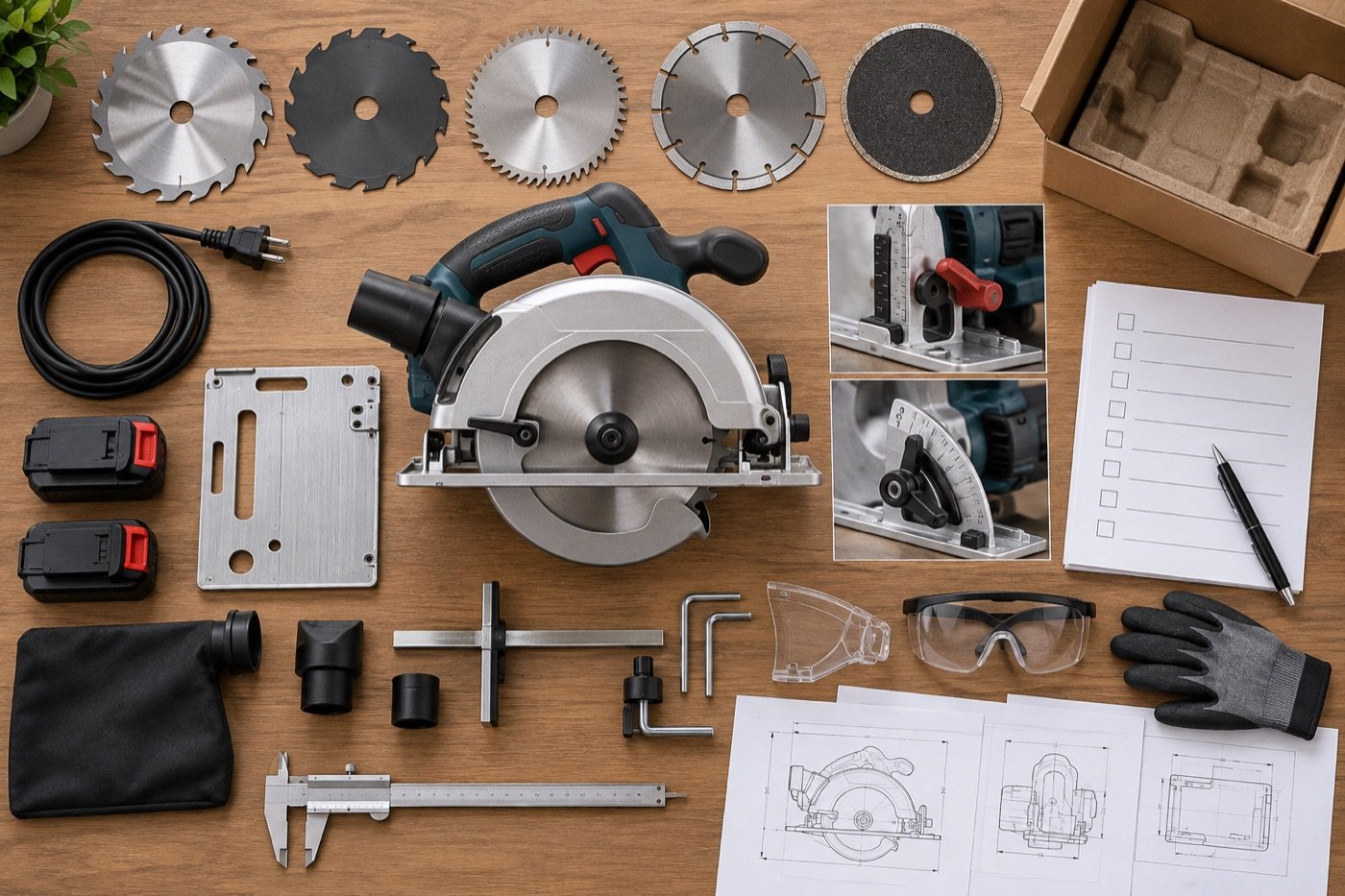
Define the commercial route
State whether the inquiry concerns an authorized branded product, an existing unbranded platform or a private-label development. For branded distribution, obtain the authorization and territory terms. For OEM work, identify who owns the design, tooling, artwork and technical documentation, and which changes are permitted.
A supplier willing to print a logo is not automatically responsible for every regulatory or intellectual-property obligation. Allocate those responsibilities in the agreement and verify them for the destination market.
Send an application brief
Include material, thickness, cut length, straight or bevel cuts, finish requirement and approximate workload. Describe the worksite and available power. Identify whether the customer needs a compact tool, a general-purpose circular saw, a track system or a dedicated metal-cutting configuration.
Attach a drawing or non-confidential photograph where it clarifies the work. A dimensional requirement is more useful than a vague request for professional quality.
Use a comparable quotation table
| Quote component | Required detail |
|---|---|
| Tool | Full model code, motor type, rated supply and capacity |
| Blade | Diameter, bore, material application and part number |
| Cordless package | Exact battery and charger models and quantities |
| Accessories | Guide, clamps, extraction adapter, wrench and case |
| Packaging | Artwork, language, labels, carton and transport protection |
| Documentation | Applicable reports, manual and traceable model identifiers |
| Service | Spare parts, warranty workflow and replacement process |
| Commercial terms | Quantity breaks, sample cost, MOQ, lead time and agreed trade terms |
Request separate prices for optional batteries and accessories. Compare quotes on the same currency, configuration and delivery basis. A low bare-tool number cannot be compared directly with a complete kit delivered to a different location.
Ask about changes and production control
Identify which components may change and what requires written approval. Battery, charger, motor-control, guard and blade substitutions can affect more than price. Preserve the approved specification and the evidence connecting production units to it.
Ask how serial or batch identifiers relate to production records. For a repeat order, require notice of changes before manufacturing rather than discovering them after the goods arrive.
Set the sample and acceptance sequence
Agree who provides material for the trial, which measurements define a pass and how disagreements are resolved. Combine the sample specification with the pre-shipment inspection plan. A sample approval should not become a vague statement that any later model is acceptable.
Include service parts in the discussion before ordering. A replacement guard, switch, base assembly or charger can matter more to customer retention than another cosmetic accessory. Confirm availability and procedures rather than promising indefinite support.
Keep the first range focused
A sensible launch begins with a few clearly differentiated applications and a manageable accessory list. Evaluate one compact/installation option, one general-purpose format and a specialist configuration only where demand supports it. This is a range-planning suggestion, not a claim that Wryno holds those items in stock.
Send your quantity, destination, material, thickness and preferred power source through the handheld circular saw inquiry page. Use the China sourcing research to structure supplier screening and the battery checklist for cordless orders.
Research context
The workflow recommendations above are Wryno’s purchasing framework; the linked company descriptions are research references, not evidence of a supply agreement with Wryno.