
China produces more cutting tools than any other country — from budget HSS drill bits to precision carbide end mills. For distributors and manufacturers worldwide, importing cutting tools from China can reduce procurement costs by 30–60% compared to domestic suppliers. But the process involves risks: quality inconsistency, communication gaps, logistics complexity, and payment security concerns.
Our factory in Hangzhou has been exporting saw blades and drill bits since 1994. We’ve worked with hundreds of importers — from first-time buyers ordering sample quantities to long-term partners purchasing millions of RMB annually. This guide walks you through the entire import process with practical, experience-based advice.
Why Import Cutting Tools from China?
The case for Chinese cutting tool imports comes down to three factors:
- Cost advantage: Lower labor costs, established supply chains, and economies of scale result in prices 30–60% below equivalent products from Western manufacturers. For standard HSS bits and TCT blades, the price gap is even wider.
- Manufacturing depth: China has complete supply chains for cutting tool production — from raw material (tungsten ore, steel billets) to finished, packaged products. This vertical integration keeps costs low and lead times reasonable.
- Customization flexibility: Chinese factories, especially mid-size operations like ours, can accommodate custom specifications (sizes, coatings, packaging, branding) at volumes that Western manufacturers won’t touch. Our minimum order starts at 100 pieces per specification.
The trade-off is that you must invest time in supplier verification and quality control. The savings are real, but they require due diligence.
Major Production Regions
China’s cutting tool industry is concentrated in several specialized regions:
Danyang, Jiangsu — Saw Blade Capital
Danyang produces approximately 60% of China’s diamond saw blades and a significant portion of TCT circular saw blades. The city has a mature supply chain for blade manufacturing, from steel plate cutting to carbide tip brazing and grinding. Most factories here focus on construction and woodworking blades.
Hangzhou, Zhejiang — Our Base
Hangzhou and the broader Zhejiang region produce a wide range of cutting tools — HSS drill bits, cobalt bits, TCT saw blades, and masonry bits. The region benefits from proximity to Ningbo port (one of the world’s busiest) and a well-established export infrastructure. Our factory operates 10+ production lines here, covering both saw blades and drill bits.
Chongqing — Emerging Hub
Chongqing has been developing as a cutting tool manufacturing center, particularly for drill bits and cutting inserts. Labor costs are lower than coastal cities, and government incentives support manufacturing. Quality levels are improving but vary more widely than established coastal regions.
Other Regions
- Tianjin/Hebei: Heavy-duty cutting tools, mining bits
- Fujian: Stone-cutting diamond tools
- Guangdong: CNC tooling, precision carbide end mills and inserts
Supplier Verification and Selection
Choosing the right supplier is the most important decision in the import process. Here’s our recommended verification process:
Step 1: Basic Qualification Check
- Business license verification (through local administration of industry and commerce)
- Export license or trading rights confirmation
- ISO 9001 certification (or equivalent quality management system)
- Factory audit report (if available from third parties like SGS, TÜV, or Bureau Veritas)
Step 2: Technical Capability Assessment
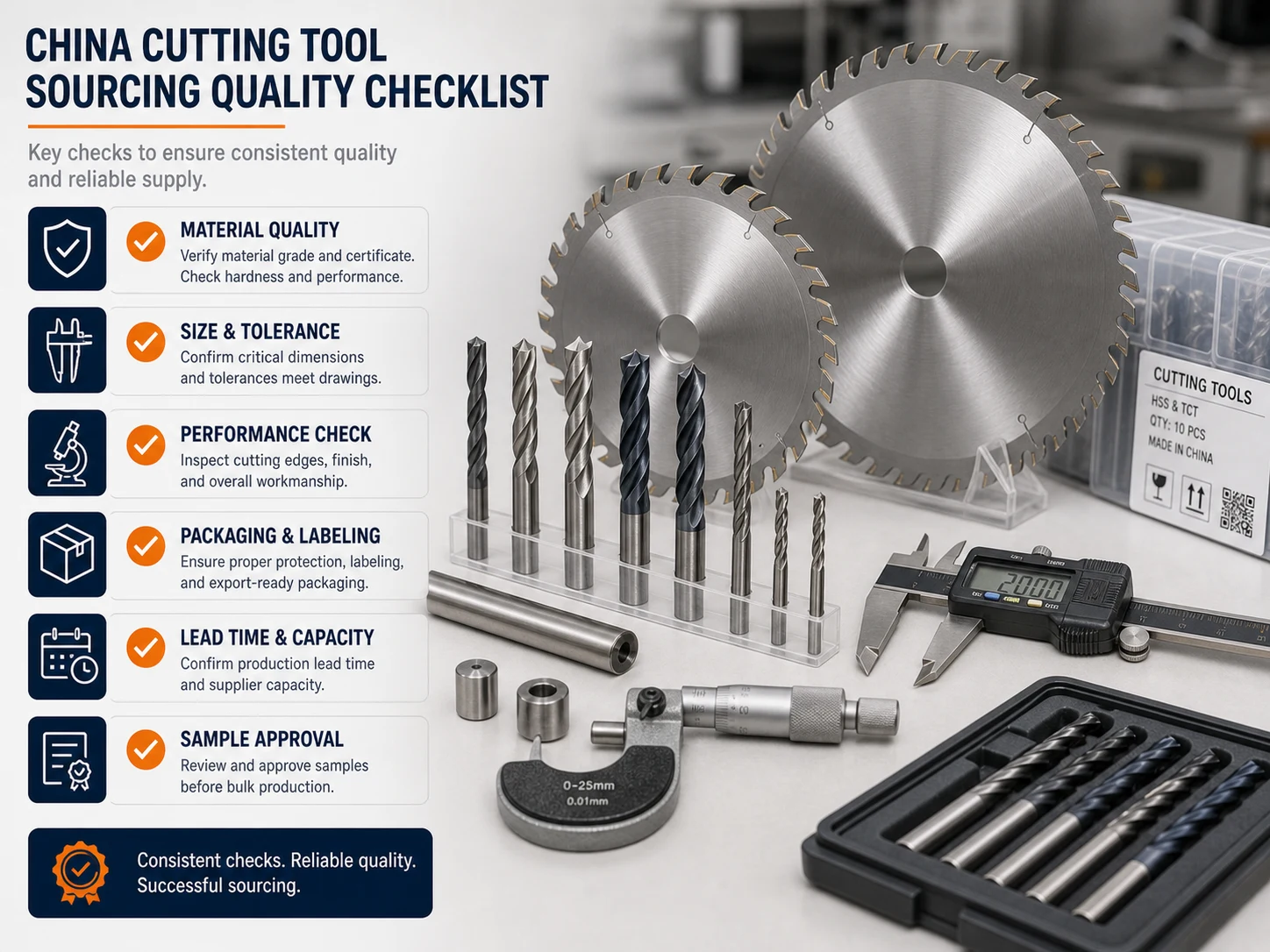
- Request product specifications with tolerances, not just catalog descriptions
- Ask about their quality grade system — how do they differentiate between economy and professional quality?
- Inquire about testing equipment: hardness testers, runout gauges, dynamic balancing machines
- Ask for material certificates (steel grade, carbide grade, cobalt content)
Step 3: Customer References
- Ask for references in your market or region
- Check how long they’ve been working with their longest-standing customer
- Look for trade show participation (Canton Fair, Hardware Fair Cologne, etc.)
Red flags: Factories that can’t provide material certificates, won’t allow factory visits, quote prices dramatically below market (likely material substitution), or can’t explain their quality control process in specific terms. A trustworthy factory can tell you exactly what steel grade they use, what carbide grade, and what their rejection rate is.
The Sample Process
Never skip the sample stage. It’s the cheapest insurance you’ll ever buy.
How to Order Samples
- Specify exactly what you want: Diameter, material grade, coating, point angle, shank type, and any tolerances. “Same as your catalog” is not a specification.
- Order multiple specifications: Test the range, not just one size. A factory that makes a great 6mm bit might have issues at 12mm.
- Request 20–50 pieces per spec for meaningful testing. One or two bits tell you nothing about consistency.
- Test on your actual materials and machines. Don’t just measure them — drill with them, cut with them, and compare against your current supplier.
What to Evaluate
- Dimensional accuracy: Measure diameter, overall length, flute length, and point angle against specifications
- Performance: Number of holes/cuts before dulling, cutting speed, surface finish quality
- Consistency: Do all 50 bits perform similarly, or is there wide variation?
- Packaging: Are bits properly protected, labeled, and boxed for shipping?
At our factory, we offer sample orders at 100 pieces per specification with pricing that reflects the actual production cost (samples aren’t free, but they shouldn’t carry a premium either). See our OEM drill bits sourcing guide for more details on the sample evaluation process.
Tariffs, Logistics, and Incoterms
Understanding Incoterms
| Incoterm | Who Arranges Shipping | Who Pays Freight | Risk Transfer Point | Best For |
|---|---|---|---|---|
| FOB | Buyer | Buyer (after loading) | Ship’s rail at port | Experienced importers with freight forwarders |
| CIF | Seller | Seller (to destination port) | Ship’s rail at port | First-time importers; simpler logistics |
| DDP | Seller | Seller (to buyer’s door) | Buyer’s premises | Small orders; maximum convenience |
| EXW | Buyer | Buyer (from factory) | Seller’s factory | Buyers with China-based logistics partners |
Our recommendation for first-time importers: Start with CIF. The factory handles shipping to your local port, and you only need to arrange customs clearance and last-mile delivery. Once you’re comfortable with the process and have a reliable freight forwarder, switch to FOB for better cost control.
Import Duties on Cutting Tools
Most cutting tools fall under HS code 8207 (interchangeable tools for hand or machine tools) or 8202 (saw blades). Import duties vary by country and trade agreements:
- EU: Typically 2.5–4.5% for drill bits and saw blades
- US: Generally 3.5–5.5% (subject to any Section 301 tariffs in effect)
- Southeast Asia (ASEAN): Often 0–5% under ASEAN-China FTA
- India: 10–15% basic customs duty plus applicable GST
- Middle East: Usually 5% for most GCC countries
Always verify current duty rates with a licensed customs broker in your country before placing an order. Trade agreements and tariff policies change frequently.
Quality Standards and Inspection
Reputable cutting tool manufacturers test against international standards. The three most relevant standards are:
DIN Standards (German)
- DIN 338: HSS twist drill bits — the most widely referenced standard for metric drill bits
- DIN 8025: SDS hammer drill bits
- DIN 1838: Circular saw blades for wood
ANSI/ASTM Standards (American)
- ANSI B94.11M: Twist drill bits — the standard for fractional and wire gauge bits
- ASTM E18: Rockwell hardness testing
ISO Standards (International)
- ISO 235: HSS twist drill bits with cylindrical shank
- ISO 494: HSS twist drill bits with Morse taper shank
- ISO 9001: Quality management systems (factory certification)
Practical advice: When requesting quotes, specify the standard you need. “DIN 338 compliant” is more meaningful than “high quality.” Our factory produces to DIN and ISO standards and provides material test certificates with each shipment.
Payment Methods
| Method | Risk to Buyer | Risk to Seller | Typical Use |
|---|---|---|---|
| T/T (Wire Transfer) | High (after shipment) | Low | Established relationships, repeat orders |
| 30/70 T/T | Medium | Medium | Standard for new relationships (30% deposit, 70% before shipment) |
| L/C (Letter of Credit) | Low | Low | Large orders, new relationships, bank-guaranteed |
| PayPal / Credit Card | Low (buyer protection) | High (chargeback risk) | Sample orders only |
Our standard terms: 30% deposit by T/T, 70% balance before shipment (after inspection). For orders over $20,000, we accept L/C. Samples can be paid via PayPal or credit card.
Complete Import Timeline
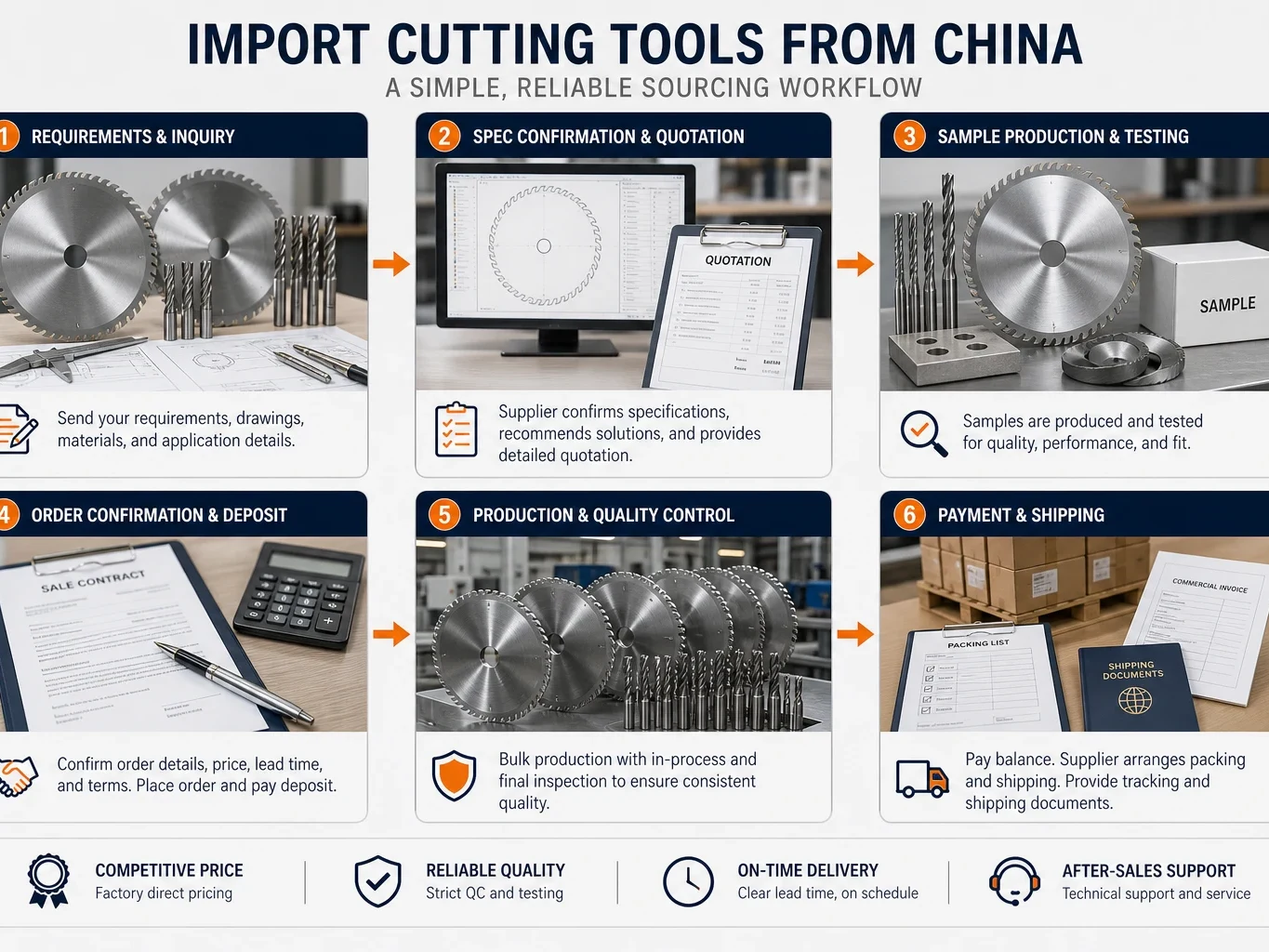
From first inquiry to goods in your warehouse, here’s a realistic timeline:
| Phase | Activity | Duration |
|---|---|---|
| 1. Inquiry | Send specifications, receive quotation, negotiate terms | 1–2 weeks |
| 2. Sampling | Produce and ship samples; buyer tests and approves | 2–4 weeks |
| 3. Order | Place order, pay deposit, confirm production schedule | 1 week |
| 4. Production | Manufacture, in-process QC, final inspection | 3–5 weeks |
| 5. Pre-shipment | Buyer or third-party inspects, balance payment | 1 week |
| 6. Shipping | Booking, loading, ocean freight | 2–4 weeks (sea) or 3–5 days (air) |
| 7. Customs | Import clearance, duty payment | 3–7 days |
| 8. Delivery | Last-mile transport to warehouse | 1–3 days |
| Total: First Order | 10–18 weeks | |
| Repeat Order (no sampling) | 6–10 weeks | |
Acceleration tips: Order samples while negotiating terms (parallel process). Use air freight for samples. Maintain a stock forecast so you can place repeat orders 10 weeks before you need the goods. The longest lead time is always ocean freight — if you’re in a hurry, air freight cuts shipping to days but costs 4–6× more.
How Wryno Works with Importers
Our process is designed for first-time and experienced importers alike:
- Inquiry: Send us your specifications or tell us what you’re cutting. We’ll recommend the right product and grade. Contact us to start.
- Quotation: We quote within 24 hours with detailed specifications — steel grade, carbide grade, tolerances, and packaging options. No vague “best quality” claims.
- Sampling: 100-piece trial orders per specification. We ship worldwide via DHL/FedEx. Typical delivery: 5–7 days.
- Production: After sample approval, we schedule production. We send production photos and quality reports at key milestones.
- Inspection: You’re welcome to visit the factory, or we can arrange third-party inspection (SGS, TÜV, Bureau Veritas).
- Shipping: FOB Ningbo or CIF your port. We handle export documentation, packing lists, and certificates of origin.
- After-sales: If any quality issues arise, we investigate and replace. Our return rate is below 1%.
For more on finding the right saw blade supplier, see our guide to finding a saw blade manufacturer in China. To learn about our company, visit the about page.
Frequently Asked Questions
What is the minimum order quantity for cutting tools from China?
It varies by factory. Our minimum is 100 pieces per specification for trial orders. For production orders, typical MOQs range from 500–2,000 pieces depending on the product. Smaller factories may offer lower MOQs but with less consistent quality. Don’t judge a supplier by MOQ alone — consistency and reliability matter more.
How do I avoid quality problems when importing from China?
Three steps: (1) Never skip the sample stage — test on your actual materials. (2) Specify quality standards explicitly (DIN, ISO, ANSI) in your purchase contract. (3) Use pre-shipment inspection, either by your own team or a third party. The cost of inspection (typically $200–500 per visit) is trivial compared to the cost of receiving a container of defective goods.
How long does shipping take from China?
Ocean freight from Ningbo/Shanghai to major ports: 2–3 weeks to Southeast Asia, 3–4 weeks to the Middle East, 4–5 weeks to Europe, 2–4 weeks to the US (West Coast faster than East Coast). Air freight: 3–5 days worldwide but costs 4–6× more. For sample orders, express courier (DHL/FedEx) takes 5–7 days.
Can I get custom-branded cutting tools from Chinese factories?
Yes. Most factories, including ours, offer OEM branding — your logo on the bits/blades, your packaging design, your part numbers. Tooling costs for custom logos are typically $100–500 depending on the marking method (laser etching, roll stamping, or print). For custom packaging, the MOQ for printed boxes is usually 1,000–2,000 pieces per size.
Is it safe to pay a Chinese factory in advance?
The 30/70 T/T structure (30% deposit, 70% before shipment) is the industry standard and balances risk between buyer and seller. For large orders (over $20,000), use a Letter of Credit — the bank guarantees payment only after shipping documents confirm the goods meet the contract terms. Never pay 100% in advance with a new supplier.