
A buyer may ask for three 7 inch saw blades:
- 40T Flat Top
- 60T ATB
- 80T ATB
At first glance, this looks like a simple tooth-count choice. In real use, these three blades serve different cutting needs.
The best choice depends on material, edge quality, chip evacuation and the machine condition.
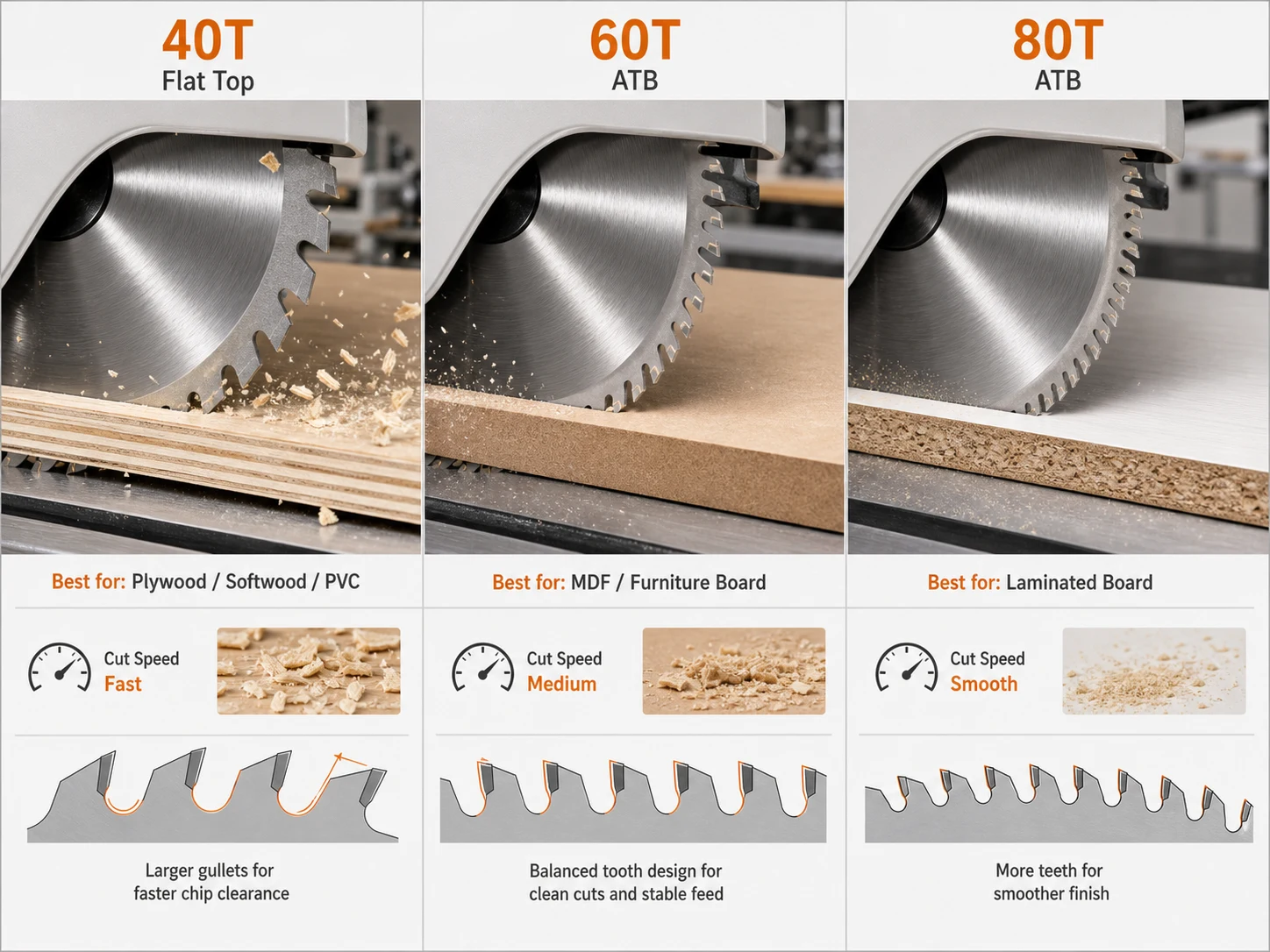
A comparison, not a universal ranking
Use this guide to compare 40T, 60T and 80T blades for a specified diameter and application. More teeth do not automatically make a blade better; compare geometry, feed, workpiece and machine compatibility as well.
40T Flat Top: Fast Cutting and Better Chip Space
For a 7 inch blade, 40T usually has larger tooth spacing. The gullet is bigger, so chips have more room to leave the cut.
This makes 40T useful for faster cutting and materials where a super fine edge is not the first requirement.
Typical applications include:
- plywood
- soft wood
- PVC
- general cutting
Flat Top teeth are strong and direct. They are not always the cleanest choice for visible laminated edges, but they can be practical when speed, durability and chip clearance matter.
60T ATB: A Balanced Choice for Board Cutting
60T is often a middle-ground option. It gives a cleaner cut than 40T while still keeping more chip space than 80T.
For many furniture and board applications, 60T ATB is a safe starting point.
Typical applications include:
- MDF board
- furniture board
- plywood with better edge requirement
- general lamination board cutting
ATB teeth slice the surface fibers from alternating directions, which helps reduce tear-out. This is why 60T ATB is commonly used when the buyer wants better finish but still needs practical cutting efficiency.
80T ATB: Finer Finish, But More Sensitive
80T has more teeth and smaller tooth spacing. It can create a finer edge when the machine is stable and the feed speed is controlled.
Typical applications include:
- lamination board
- MDF with visible edge
- furniture panels
- cleaner finish cutting
But 80T is not automatically better. Because each gullet is smaller, chip evacuation becomes harder. If the board is thick, resin-heavy or cut too fast, heat can build up. That can lead to burning, noise, shorter blade life or a blade that feels like it cannot cut smoothly.
Another practical issue is production. Some factories do not keep 7 inch 80T as a regular stock model. It may require separate blade body preparation and tooling, which affects MOQ, price and delivery time.
Tooth Count Must Work With Kerf and Plate Thickness
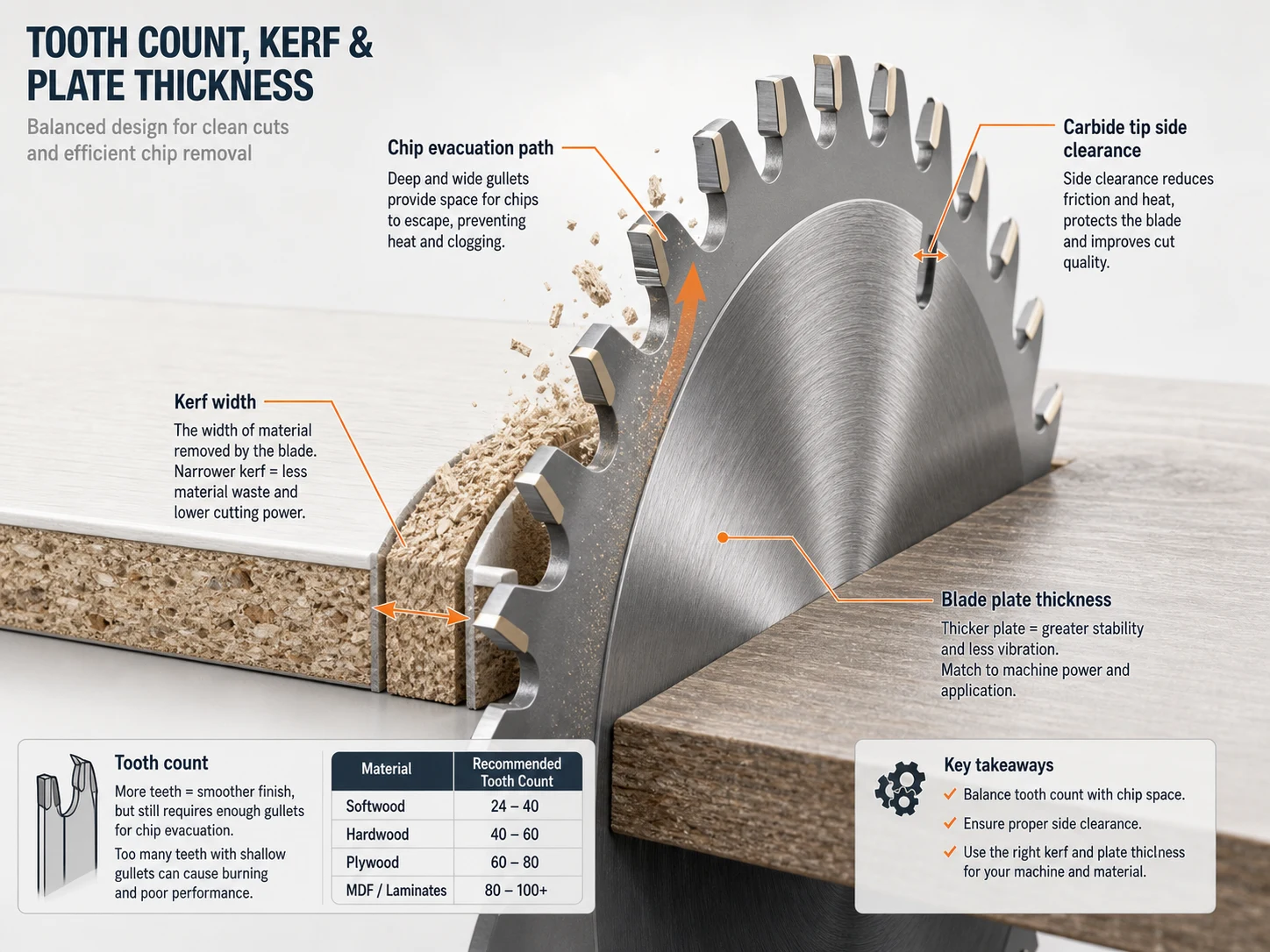
Tooth count should not be considered alone.
Kerf, plate thickness and side clearance also matter. If the blade plate is too thick or the side clearance is too small, cutting resistance increases. If the tooth count is high and the gullet space is small, chip evacuation becomes even more difficult.
For MDF and lamination board, a fine blade must still have enough room to remove dust and heat from the cut.
Machine Condition Also Matters
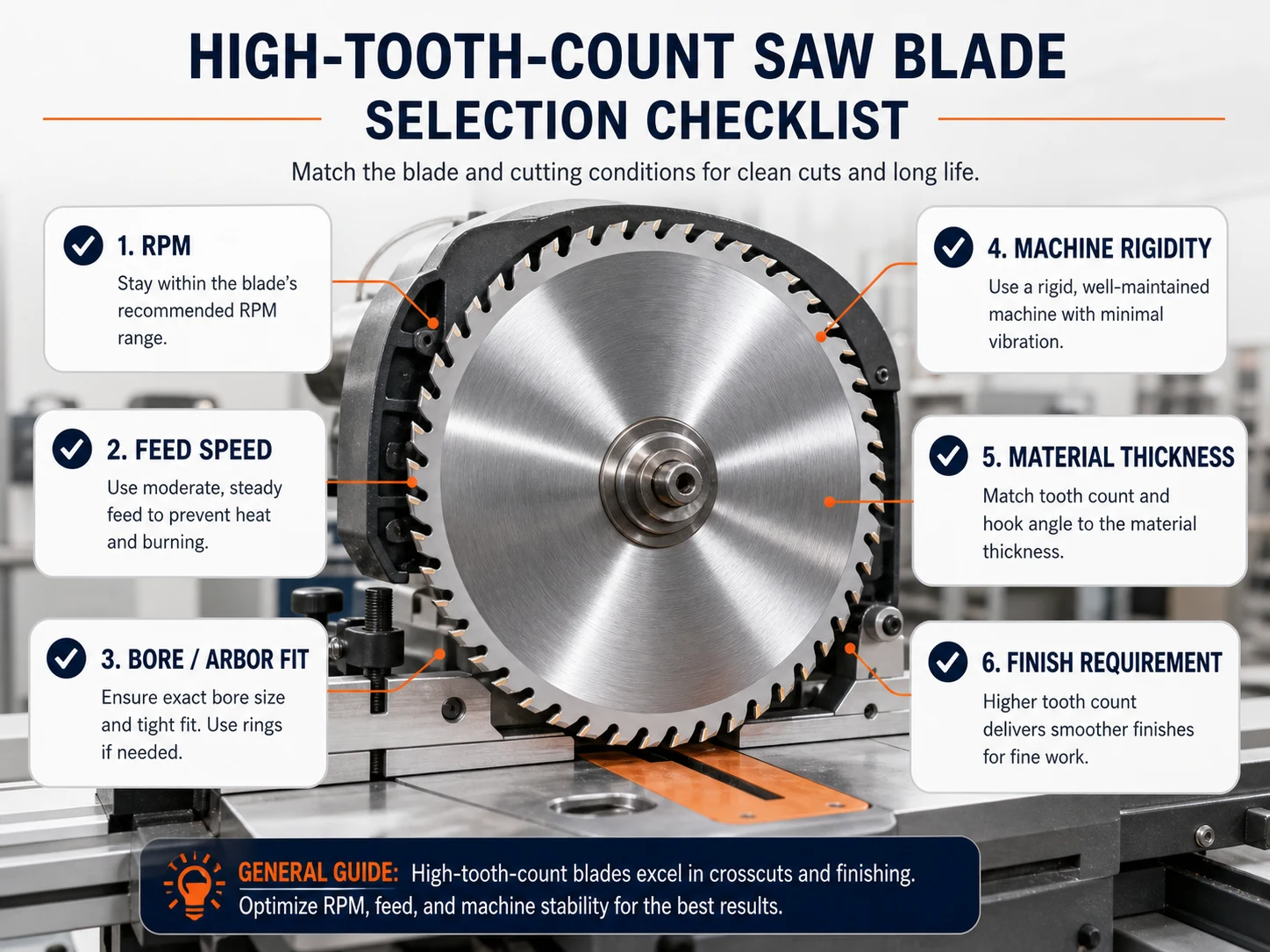
The same 80T blade can work well on one machine and poorly on another.
Before choosing a high-tooth-count blade, check:
- machine RPM
- feed speed
- arbor and bore fit
- flange cleanliness
- machine rigidity
- whether the workpiece is clamped or stable
If the machine is light, unstable or running too fast, more teeth can increase heat and vibration instead of improving the cut.
Quick Selection Guide
| Model | Better For | Main Advantage | Main Risk |
|---|---|---|---|
| 40T Flat Top | plywood, softwood, PVC | fast cutting, chip clearance | rougher edge |
| 60T ATB | MDF, furniture board | balanced finish and speed | may not be fine enough for premium laminate |
| 80T ATB | lamination board, visible furniture edge | cleaner finish | heat, smaller chip space, higher MOQ |
Buyer Takeaway
Do not choose tooth count only by thinking “more teeth means better.”
Choose 40T when chip space and cutting speed matter. Choose 60T when you need a balanced board-cutting blade. Choose 80T when the edge finish is important and the machine condition can support a finer blade.
For wholesalers, it can make sense to offer more than one model. A 40T blade can serve price-sensitive and general cutting users. A 60T blade can cover common furniture board work. An 80T blade can be positioned for cleaner finish, but buyers should understand that it may have a higher MOQ or longer lead time.
For deeper background, see why high tooth count can affect MOQ, TCT saw blades for MDF and lamination board and material and RPM matching.