
When an industrial buyer compares saw blades, the quoted blade price
is only one part of the real production cost. Every cut converts a strip
of valuable workpiece into chips. That strip is the saw blade kerf.
For inexpensive material and occasional cutting, a difference of a
few tenths of a millimeter may look unimportant. For aluminum billet,
copper bar, stainless steel, engineered board or high-volume cutoff
production, the accumulated loss can be worth much more than the
blade.
This guide explains how to calculate kerf loss, usable yield and cost
per cut—and why the thinnest blade is not automatically the most
economical choice.
Quick answer: material loss per cut is approximately
the workpiece cross-sectional area multiplied by the effective kerf.
Monetary loss per cut is that volume multiplied by material density and
material cost. The calculation must then be combined with blade life,
cycle time, downtime and scrap risk.
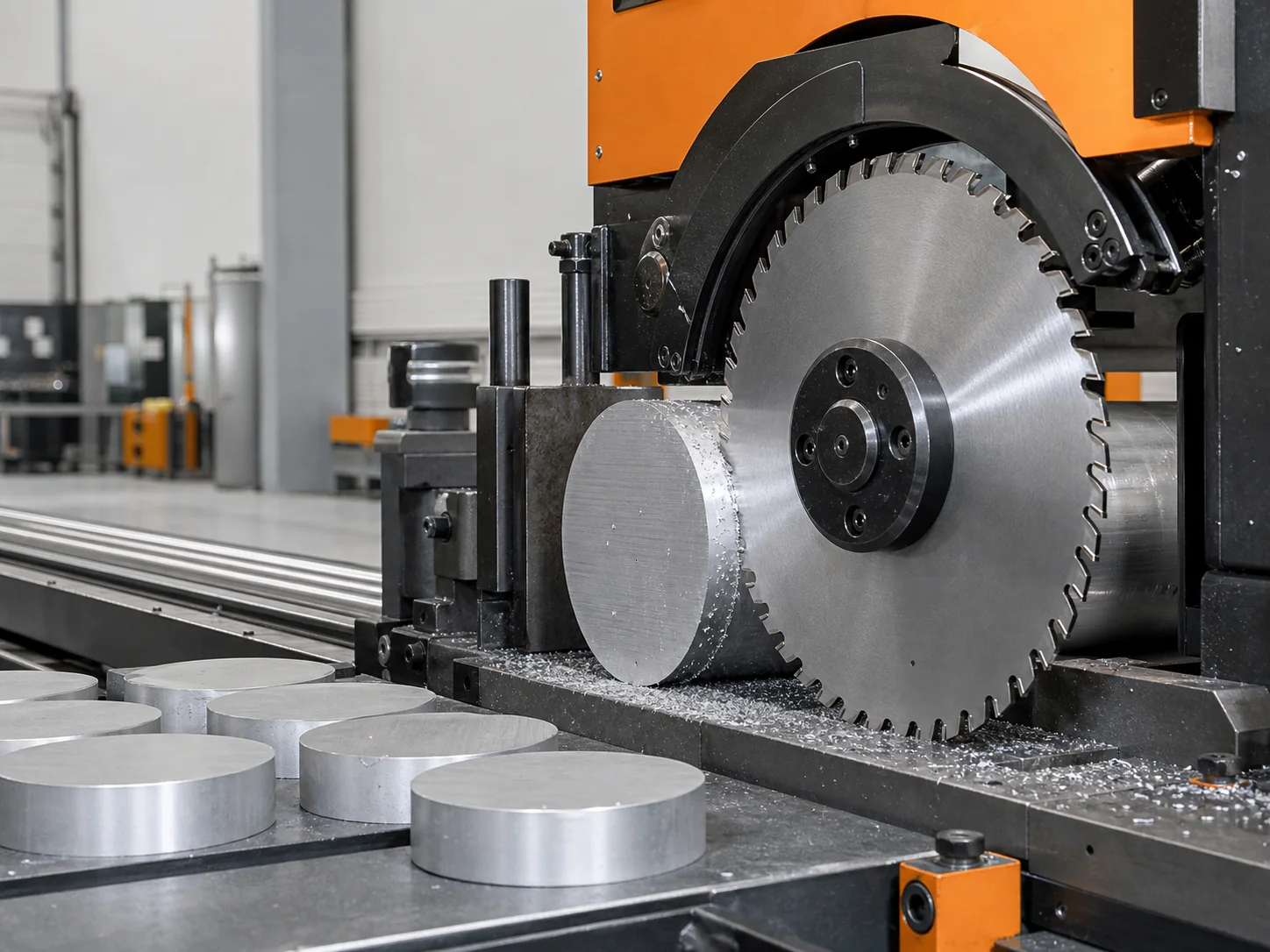
What Is Saw Blade Kerf?
Kerf is the width of material removed by the cutting teeth. On a
tipped circular saw blade, it is normally close to the width swept by
the carbide, cermet or PCD tips—not simply the steel plate
thickness.
Three values should therefore be kept separate:
| Term | Meaning | Why it matters |
|---|---|---|
| Plate thickness | Thickness of the steel blade body | Influences stiffness and stability |
| Tip width / nominal kerf | Width across the cutting tips | Starting point for loss calculations |
| Effective kerf | Actual width removed in production | Includes runout, vibration, side wear and machine condition |
A blade marked with a 3.2 mm kerf does not guarantee that the actual
slot will always measure exactly 3.2 mm. Arbor runout, flange
cleanliness, blade tension, feed stability and tip condition can widen
the effective cut.
The Basic Kerf-Loss Formula
For a straight cutoff through a uniform section:
kerf
Use matching units. If area is in mm² and kerf is in mm, the result
is in mm³.
For a solid round bar with diameter D:
Therefore:
To convert mm³ to cm³, divide by 1,000. To estimate mass loss:
Finally:
unit mass
Worked Example: 250 mm
Aluminum Bar
The article applies to large-diameter stock generally; 250 mm is used
only as an easy-to-read example.
Assume:
- solid aluminum bar diameter: 250 mm
- effective kerf: 4.0 mm
- aluminum density: approximately 2.70 g/cm³
- material purchase price: USD 3.00/kg
Cross-sectional area:
Volume converted into chips per cut:
Mass loss:
Material cost lost per cut:
At 1,000 cuts, the theoretical kerf-related material cost is about
USD 1,590, before allowing for trim cuts, remnants,
defects or recycling value.
This is why large-diameter and high-value material deserves a yield
calculation before blade price is negotiated.
What Happens If Kerf Changes?
Using the same 250 mm aluminum bar and USD 3.00/kg material
price:
| Effective kerf | Approx. mass lost/cut | Approx. material cost/cut | Approx. cost at 1,000 cuts |
|---|---|---|---|
| 3.2 mm | 0.424 kg | USD 1.27 | USD 1,272 |
| 3.6 mm | 0.477 kg | USD 1.43 | USD 1,431 |
| 4.0 mm | 0.530 kg | USD 1.59 | USD 1,590 |
| 4.5 mm | 0.596 kg | USD 1.79 | USD 1,789 |
In this example, reducing effective kerf from 4.0 mm to 3.2 mm
theoretically saves about USD 0.32 per cut, or roughly
USD 318 per 1,000 cuts.
These values are planning estimates rather than guaranteed operating
results. Actual density, alloy price, true kerf and chip recovery value
must be entered for the buyer’s production line.
Yield Calculation for
Repeated Slices
Suppose a bar of usable length L is cut into pieces
of finished thickness T. Ignoring the final remainder,
the approximate number of pieces is:
This makes the relationship clear: every additional piece normally
consumes one finished thickness plus one kerf allowance.
For purchasing and production planning, also include:
- front and rear trim allowance
- facing or finishing allowance
- clamp-end remainder
- damaged or oxidized material
- process inspection samples
- out-of-tolerance cuts
Kerf is only one component of total yield, but it is one of the most
repeatable components and therefore one of the easiest to improve.
A Better Cost-per-Cut
Formula
Material loss alone does not determine the best blade. A practical
cost-per-cut model is:
machine time + labor + downtime + secondary finishing + scrap risk −
recoverable chip value
1. Blade consumption
cost) ÷ acceptable cuts produced
Count acceptable parts, not merely spindle cycles. A blade that makes
more cuts but produces unstable dimensions can have a worse real
cost.
2. Machine and labor time
Slower cutting can erase the material saving from a thin kerf.
Estimate:
rate
3. Secondary processing
Burr removal, facing, washing and edge correction add cost. A stable
blade with a slightly wider kerf may reduce these operations.
4. Scrap and rework
Include pieces rejected for taper, poor squareness, heavy burrs, burn
marks, chipped edges or dimensional variation.
5. Chip recovery
Aluminum, copper and some steel chips have recycling value. Subtract
the actual net recovery value after handling, contamination and recycler
deductions—not the original raw-material price.
Why the
Thinnest Kerf Is Not Always the Lowest Cost
A thin-kerf blade removes less material and normally requires less
cutting power. However, making the blade body too thin for the machine
and workpiece can reduce lateral rigidity.
Possible consequences include:
- blade wandering or dishing
- wider effective kerf than the nominal specification
- tapered or non-square parts
- vibration and poor finish
- slower permissible feed
- tooth damage
- more frequent blade changes
- extra facing or deburring
The economical target is therefore the narrowest stable
effective kerf, not the smallest number available in a
catalog.
Nominal Kerf vs Effective
Kerf
Buyers should verify effective kerf during a sample trial.
- Clean and inspect the arbor and flanges.
- Check blade and spindle runout.
- Cut several representative workpieces under stable conditions.
- Measure the actual slot or calculate material removal from part and
remnant dimensions. - Inspect squareness, finish and burrs.
- Repeat after the blade has completed part of its expected service
interval.
This distinguishes a genuinely efficient thin-cutting system from a
thin blade that becomes unstable in production.
Compare Two Blades by Total
Cost
The table below shows why purchase price alone is misleading.
| Cost item | Blade A | Blade B |
|---|---|---|
| Blade price | Lower | Higher |
| Effective kerf | 4.0 mm | 3.4 mm |
| Acceptable cuts per service cycle | Lower | Higher |
| Cycle time | Similar | Similar |
| Burr/rework | Higher | Lower |
| Material recovery | Lower | Higher |
Blade B can be the cheaper production choice even if its invoice
price is higher. Conversely, if the thinner blade must run much slower
or causes dimensional rejects, Blade A may have the lower total
cost.
The comparison must use real shop data.
Which Materials
Benefit Most From Kerf Control?
Kerf optimization has the greatest financial effect when one or more
of the following are true:
- the workpiece has a large cross-section
- the raw material is expensive
- cut volume is high
- the finished slices are thin
- the remnant length is tightly controlled
- secondary finishing is expensive
- the production contract is priced per accepted part
Typical examples include large aluminum billet, copper and brass bar,
stainless or alloy steel stock, high-silicon aluminum, engineered panels
and valuable composite materials.
Data Buyers Should
Send for a Yield Review
Send the supplier:
- workpiece material and grade
- solid, tube, profile, plate or panel form
- diameter or section dimensions
- finished piece thickness or length
- current nominal and measured kerf
- blade diameter, bore, plate thickness and tooth count
- machine model, spindle speed and feed mode
- monthly cut volume
- current blade life and sharpening history
- raw-material price and chip recovery value
- dimensional tolerance and surface requirement
Without this information, a supplier can quote a blade but cannot
credibly estimate production economics.
Buyer Checklist
Before Choosing Thin Kerf
- Is the machine rigid enough for the proposed plate thickness?
- Does the spindle and flange system control runout?
- Is the workpiece clamped close to the cut?
- Can feed speed remain stable?
- Is chip evacuation adequate?
- Will the blade maintain a square cut over its service interval?
- What is the measured effective kerf—not only the catalog kerf?
- How much material value is recovered from chips?
- What is the cost of a rejected or reworked part?
Final Recommendation
Do not ask only, “How much does the blade cost?” Ask four linked
questions:
- How much material does each acceptable cut consume?
- How many acceptable cuts does the blade produce?
- What cycle time and secondary work are required?
- Is the cut stable enough to protect yield throughout the service
interval?
A good blade specification balances kerf, plate rigidity, machine
power, cutting speed, finish and tool life. That balance—not the lowest
blade price or the thinnest nominal kerf—produces the lowest sustainable
cost per accepted part.
Related guide: PCD Saw Blade vs TCT Saw Blade for Aluminum: When Is Diamond Worth It? explains when PCD diamond tooling is worth upgrading from TCT carbide for aluminum cutting.
Frequently Asked Questions
How do I
calculate material lost from saw blade kerf?
Multiply the workpiece cross-sectional area by the effective kerf.
Convert the resulting volume to mass using the material density, then
multiply by the material cost per unit mass.
Does plate thickness equal
kerf?
No. Plate thickness is the steel body thickness. Kerf is normally
determined by the width swept by the cutting tips and may become wider
in practice because of runout, vibration or wear.
Is a thin-kerf
saw blade always more economical?
No. It can reduce material loss and power demand, but only if the
blade remains stable and produces acceptable parts at the required feed
rate.
Should
chip recycling value be deducted from cost per cut?
Yes. Use the actual net value received for clean recovered chips
after handling and recycler deductions, not the purchase price of the
original bar.
What should be
measured during a blade trial?
Record actual kerf, cycle time, acceptable cuts, blade changes, burr
and finish, dimensional rejects, secondary processing and recovered chip
value.