
A dull industrial saw blade does not always need to be replaced. A
correctly serviced TCT circular saw blade can often return to productive
cutting, but grinding the carbide is only one part of the decision.
Tooth wear, remaining tip size, blade-body flatness, tension, runout,
brazing condition and the value of rejected workpieces all matter.
This guide helps saw blade buyers, production managers and sharpening
services decide when to resharpen, when to repair, and when replacement
is safer and more economical.
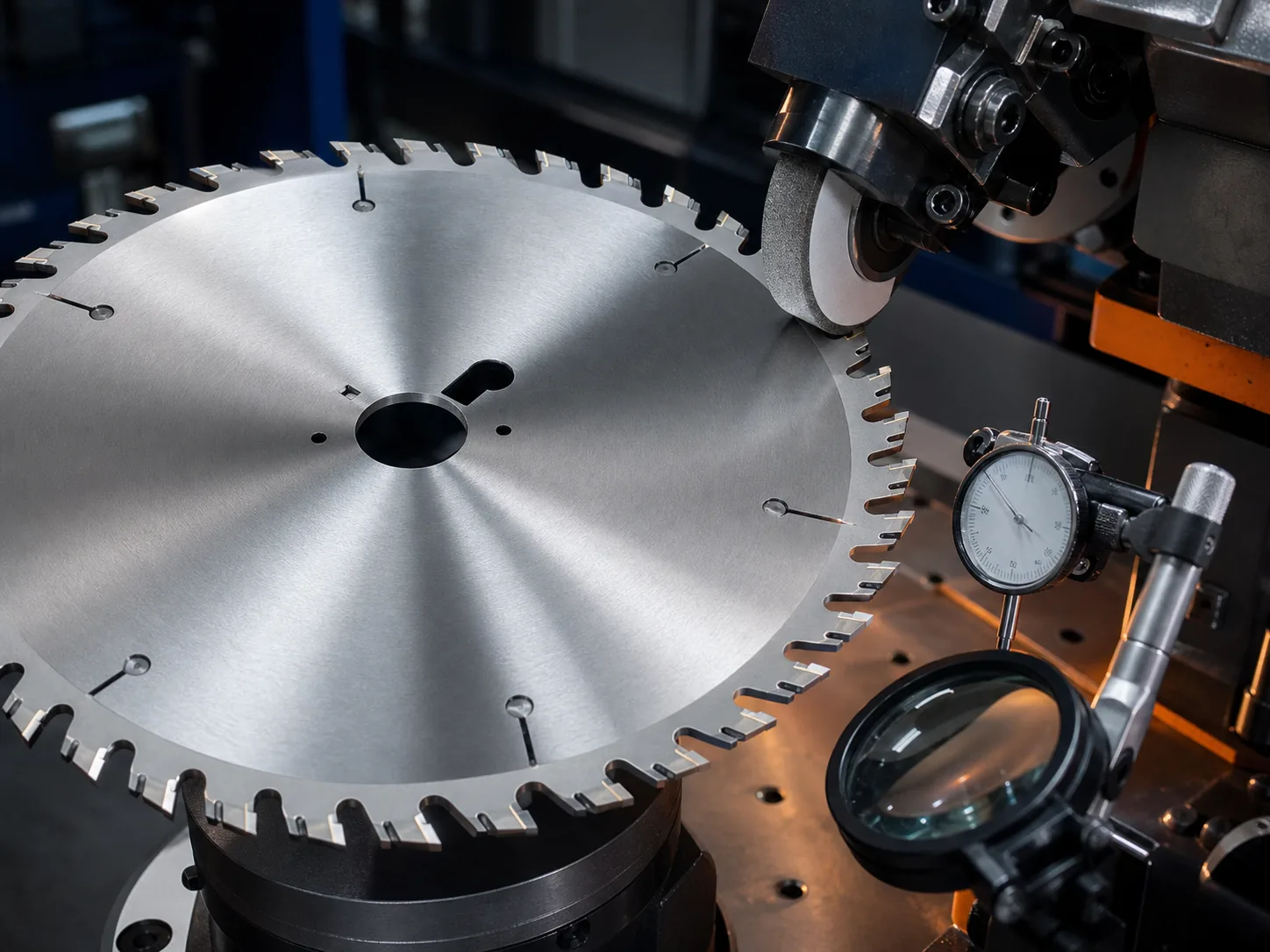
Quick Decision:
Resharpen, Repair or Replace?
| Blade condition | Recommended action | Why |
|---|---|---|
| Cutting edge is uniformly dull; tips and body are intact | Resharpen | Restores cutting edge while preserving the original blade specification |
| One or a few carbide tips are chipped or missing; tooth seats and plate remain sound |
Inspect for retipping and resharpening | Individual tips may be replaced by a qualified service, followed by full geometry and runout checks |
| Blade has resin, aluminum pickup or packed chips but little edge wear |
Clean and inspect before grinding | Contamination can imitate a dull edge and cause heat or poor finish |
| Tooth geometry is uneven after repeated service | Full professional regrind and measurement | Face, top and side geometry must remain consistent around the blade |
| Plate is warped, cracked, badly overheated or has damaged tooth seats |
Replace | Grinding cannot restore structural integrity or reliable tension |
| Remaining carbide is below the service limit | Replace | Further grinding may leave insufficient tip support and unsafe geometry |
Do not use the number of previous sharpenings as the only rule. Two
identical blades can reach different end-of-life conditions because
contamination, feed, tooth damage and the amount removed per service are
different.
Signs a Saw Blade Needs
Service
Schedule inspection before poor cutting becomes severe. Common
signals include:
- feed force increases at the same machine settings;
- burrs, tear-out or edge chipping increase;
- the cut surface becomes rough or wavy;
- cutting noise changes or vibration begins;
- the motor load rises and cycle time becomes longer;
- burning, heat discoloration or material pickup appears;
- dimensional accuracy changes even after the machine and clamping are
checked.
These symptoms are not proof that sharpening alone will solve the
problem. Dirty flanges, incorrect feed, loose workholding, spindle
runout and unsuitable tooth count can create similar symptoms. Record
the machine condition before removing the blade.
Clean Before You Grind
Wood resin, adhesive, aluminum pickup and dried coolant can reduce
clearance and make a sharp tooth behave like a dull one. Cleaning first
has three benefits:
- it reveals cracks, chipped tips and brazing defects;
- it prevents contamination from damaging the grinding wheel;
- it avoids removing carbide unnecessarily.
Use a cleaning method compatible with the blade material and coating.
Avoid aggressive scraping that damages the tooth face, side clearance or
protective surface.
What a
Professional Resharpening Service Should Check
Professional service is more than touching the tooth face with a
grinding wheel. The incoming inspection should cover:
| Inspection item | What is checked | Why it matters |
|---|---|---|
| Blade identification | Diameter, bore, kerf, plate thickness, tooth count and tooth geometry |
Prevents the wrong program or geometry from being applied |
| Carbide condition | Wear land, chips, cracks, remaining tip height and side width | Determines whether grinding or retipping is viable |
| Tooth-seat and braze condition | Seat damage, loose tips, porosity and local overheating | A sound cutting edge still requires secure tip support |
| Plate flatness and runout | Axial and radial condition relative to bore and body | Poor body condition causes unstable cutting after sharpening |
| Tension | Blade-body tension appropriate to diameter, speed and application |
Incorrect tension can create wandering, noise and poor finish |
| Expansion slots and gullets | Cracks, deformation and packed material | Damage here can make continued use unsafe |
The returned blade should be clean, protected from tooth impact and
identified with the completed work.
Face, Top and Side
Grinding Explained
TCT teeth have several functional surfaces. The tooth face
establishes rake or hook geometry. The tooth top establishes clearance
and cutting diameter. Side grinding controls side clearance and strongly
affects cut finish and kerf consistency.
Grinding only one surface can leave the rounded wear area partly in
place or gradually distort the original geometry. For maximum usable
service life, face and top grinding must be coordinated, while side
grinding should be corrected only when measurement shows it is
required.
Every visible tooth should retain the intended carbide shape and the
same relationship to neighboring teeth. Alternating-top, triple-chip and
group tooth patterns must be preserved rather than converted into a
generic shape.
How Much Carbide Should Be
Removed?
The objective is to remove all damaged or rounded cutting-edge
material with the smallest consistent stock removal. Removing too little
leaves wear behind and shortens the next run. Removing too much consumes
the finite carbide reserve and changes diameter, geometry and cutting
behavior faster than necessary.
The correct removal amount depends on:
- maximum wear land around the blade;
- chipped depth at the worst serviceable tooth;
- face and top geometry;
- carbide grade and grain structure;
- number of teeth that require retipping;
- previous sharpening history.
A service provider should grind to the worst acceptable tooth, then
verify uniformity around the full circumference.
How Many
Times Can a TCT Saw Blade Be Resharpened?
There is no universal number. The answer is controlled by the
original carbide size and the amount removed during every service.
Light, timely resharpening may allow several service cycles; late
service after heavy chipping may consume much more carbide in one
cycle.
Track the following instead of promising a fixed count:
- original and current tip height;
- original and current cutting diameter;
- cumulative face and top removal;
- number and location of replaced tips;
- plate repairs, flattening and tension corrections;
- application and material used after each service.
As a conservative maintenance reference, the Leitz user encyclopedia
states that a circular saw blade reaches end of life when the tooth
height measured from the tip seat is 1 mm. The blade manufacturer’s own
drawing and service limits should take priority for each design.
When Retipping Makes Sense
Individual damaged carbide tips may be replaced when the plate and
tooth seat remain suitable. Retipping requires the correct carbide,
braze and flux, controlled heating, correct tip position, and final
grinding to match the full tooth group.
Retipping becomes unattractive when many teeth are missing, adjacent
seats are damaged, the plate has lost flatness or tension, or total
repair cost approaches a correctly specified replacement blade.
Retipping should be performed by a qualified service rather than with
uncontrolled local heating.
When the Blade Body Needs
Correction
A perfectly sharpened tooth cannot compensate for an unstable plate.
During service, check:
- axial runout near the rim;
- radial consistency of the tooth circle;
- flatness across the plate;
- tension distribution;
- bore and pin-hole damage;
- cracks near gullets or expansion slots;
- blue or dark heat discoloration.
Flattening and tensioning are specialized operations. Thin-kerf and
large-diameter blades are especially sensitive because a small body
error can produce a large deviation at the cutting edge.
When to Replace Instead of
Resharpen
Replace the blade when continued service cannot provide a stable and
safe cutting system. Typical reasons include:
- cracks in the plate, gullets or expansion slots;
- severe overheating or permanent body discoloration;
- damaged bore, pin holes or mounting surfaces;
- excessive plate distortion that cannot be corrected reliably;
- damaged tooth seats across multiple positions;
- carbide below the specified remaining-size limit;
- repair cost plus expected residual life is worse than
replacement; - the original specification is wrong for the current
application.
The last point is important. Repeatedly sharpening an unsuitable
blade does not fix the wrong tooth count, rake angle, carbide grade,
kerf or diameter.
Resharpening Cost vs
Replacement Cost
Compare cost per accepted cut, not only the workshop invoice.
Service-cycle cost per accepted cut = (inspection + cleaning
+ grinding + retipping + freight + downtime + rejects) ÷ accepted cuts
before the next service
For a replacement blade, include purchase price, freight, setup,
trial cuts and expected accepted output. A lower resharpening price is
not economical if the blade returns with runout, incorrect geometry or a
much shorter cutting interval.
Use this simple decision table:
| Cost factor | Resharpen | Replace |
|---|---|---|
| Service or purchase price | ||
| Two-way freight | ||
| Machine downtime | ||
| Setup and trial material | ||
| Expected accepted cuts | ||
| Expected reject cost | ||
| Residual service cycles |
Information to Send
to a Sharpening Service
Provide enough information to preserve the application-specific
geometry:
- blade manufacturer or drawing number;
- diameter, bore, kerf, plate thickness and tooth count;
- tooth geometry and hook/rake angle;
- workpiece material, section and coating;
- machine model, RPM and feed method;
- finish, burr and dimensional requirement;
- current problem and when it began;
- previous service record and any retipped teeth;
- photos of the complete blade and damaged areas.
Mark blades individually when a batch contains different
specifications. Do not mix similar-looking aluminum, wood and
steel-cutting blades without identification.
Packaging Saw Blades for
Service
Carbide damage often occurs during transport. Use a rigid blade
carrier or two protective boards larger than the blade diameter. Prevent
the blade from sliding, keep teeth from touching metal fasteners,
protect the bore, and separate multiple blades with rigid spacers.
Do not wrap the tooth line only in loose paper. A blade returned from
service should receive the same protection because freshly ground
carbide edges are vulnerable to impact.
Incoming Inspection
After Resharpening
Before production, verify:
- blade identity and dimensions;
- tooth sequence and uniform carbide geometry;
- no missing, cracked or loose tips;
- clean bore and mounting faces;
- acceptable axial and radial runout;
- low-risk trial cut at approved settings;
- surface finish, burr, dimensions and machine load;
- service record updated with accepted output target.
If the blade behaves differently, stop and confirm whether geometry,
diameter, side clearance or machine setup changed.
Buyer Checklist for
a Resharpening Supplier
Ask the service provider:
- Do you record incoming blade dimensions and tooth geometry?
- Can you grind face, top and side surfaces for the required tooth
form? - How do you control equal tooth height and runout?
- Do you inspect flatness, tension, brazing and remaining
carbide? - Can you retip individual teeth with a compatible carbide grade?
- What conditions cause you to reject a blade as unsafe?
- Do you provide a service report or identification mark?
- How are blades protected for return transport?
The best supplier does not promise to sharpen every blade. A reliable
service rejects blades that cannot return to stable, safe
production.
Frequently Asked Questions
Can every TCT saw blade
be resharpened?
No. The carbide, tooth seats and blade body must remain serviceable.
Cracks, severe overheating, damaged mounting features or insufficient
remaining carbide can make replacement necessary.
Should only the tooth face
be ground?
Not as a universal rule. Face, top and side geometry work together. A
professional service measures wear and preserves the original tooth
sequence and angles.
Can a missing carbide tip
be replaced?
Sometimes. Retipping is possible when the tooth seat and plate are
sound, but it requires compatible carbide, controlled brazing and final
grinding to match neighboring teeth.
Why does a
resharpened blade still cut poorly?
Possible causes include incorrect geometry, unequal tooth height,
excessive runout, insufficient tension, dirty flanges, wrong feed
settings or an unsuitable original blade specification.
Is resharpening
always cheaper than replacement?
No. Compare total service cost, freight, downtime, rejects, expected
accepted cuts and remaining service cycles. Replacement can be more
economical when the blade body or specification is poor.
Heat, chip adhesion and recutting can distort both cutting performance and inspection results. Use our saw blade coolant and lubrication guide to compare flood coolant, MQL, dry cutting and nozzle setup.
Final Recommendation
Resharpen early enough to avoid deep wear, but never treat sharpening
as a routine cosmetic operation. Record blade identity, preserve
application-specific tooth geometry, inspect the body and brazed tips,
and compare total cost per accepted cut. This approach extends usable
blade life without sacrificing production stability or safety.
Before operation or servicing: review our circular saw blade safety guide and pre-use checklist for compatibility, maximum RPM, guarding and machine-specific maintenance precautions.
Related procurement guide: Saw Blade and Drill Bit Safety Stock Calculator.