
Find metric and fractional drill sizes, all number drill sizes #1–#80, and letter sizes A–Z in the tables below. Use the nominal diameter to identify the drill; use the drawing, required fit and tooling manufacturer’s recommendation to choose the hole size.
Conversion: inches × 25.4 = millimeters; millimeters ÷ 25.4 = inches. A nearby fractional or metric size is not automatically a suitable substitute.
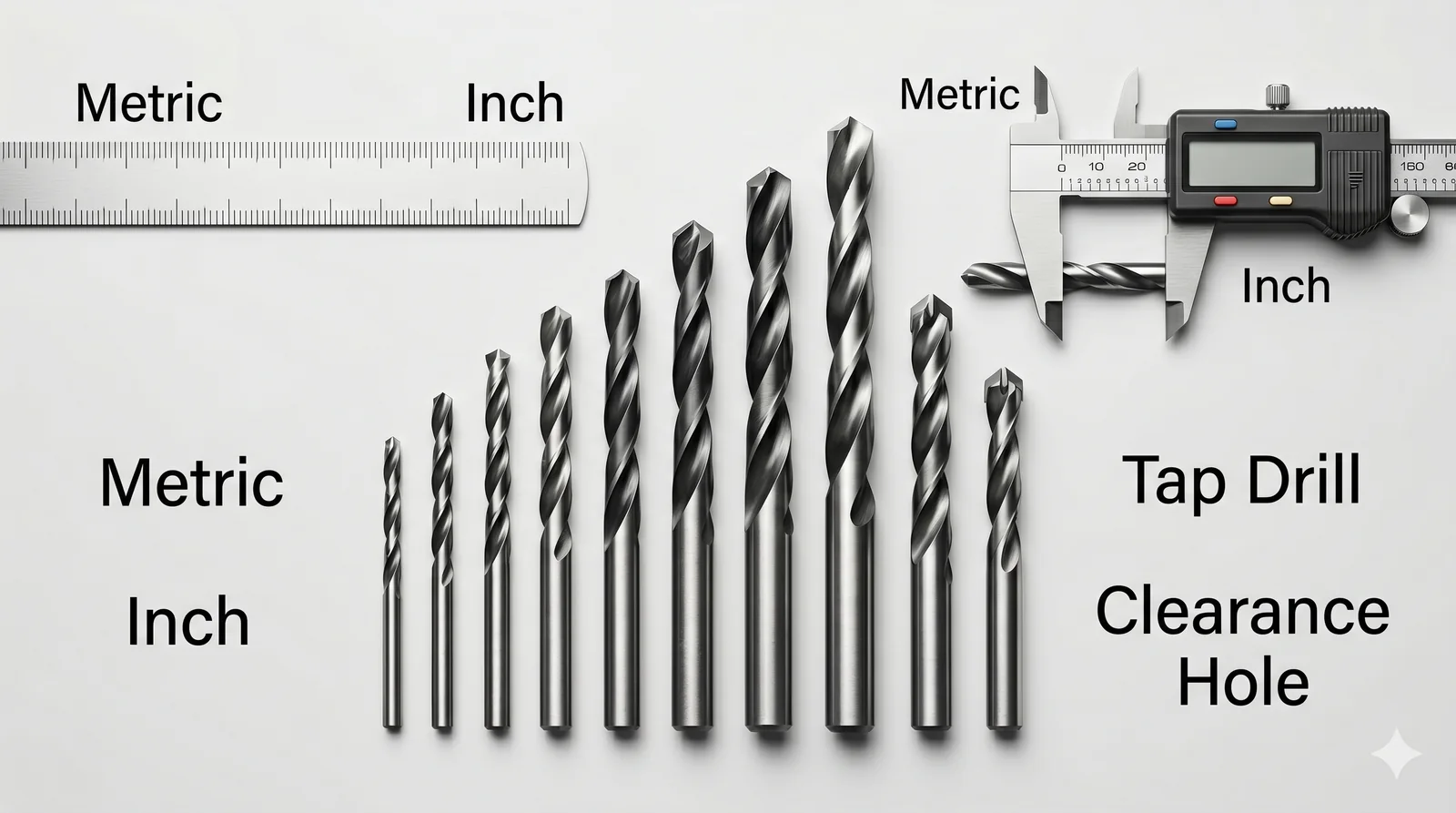
Turn a chart size into an order specification
Choose the exact nominal size first, then specify material grade, shank, flute length, hole depth and quantity. A numerical conversion is not approval to substitute a nearby size in a tolerance-critical hole.
Metric Drill Bit Size Chart
The table below lists selected metric diameters from 0.5 mm to 25 mm with inch conversions. Metric drills are used in many markets, including the US; availability and increments vary by tool range.
| Size (mm) | Inch Equiv. | Size (mm) | Inch Equiv. | Size (mm) | Inch Equiv. |
|---|---|---|---|---|---|
| 0.5 | 0.0197″ | 3.6 | 0.1417″ | 8.5 | 0.3346″ |
| 0.6 | 0.0236″ | 3.7 | 0.1457″ | 8.6 | 0.3386″ |
| 0.7 | 0.0276″ | 3.8 | 0.1496″ | 8.7 | 0.3425″ |
| 0.8 | 0.0315″ | 3.9 | 0.1535″ | 8.8 | 0.3465″ |
| 0.9 | 0.0354″ | 4.0 | 0.1575″ | 8.9 | 0.3504″ |
| 1.0 | 0.0394″ | 4.1 | 0.1614″ | 9.0 | 0.3543″ |
| 1.1 | 0.0433″ | 4.2 | 0.1654″ | 9.5 | 0.3740″ |
| 1.2 | 0.0472″ | 4.3 | 0.1693″ | 10.0 | 0.3937″ |
| 1.3 | 0.0512″ | 4.4 | 0.1732″ | 10.2 | 0.4016″ |
| 1.4 | 0.0551″ | 4.5 | 0.1772″ | 10.5 | 0.4134″ |
| 1.5 | 0.0591″ | 4.6 | 0.1811″ | 11.0 | 0.4331″ |
| 1.6 | 0.0630″ | 4.7 | 0.1850″ | 11.5 | 0.4528″ |
| 1.7 | 0.0669″ | 4.8 | 0.1890″ | 12.0 | 0.4724″ |
| 1.8 | 0.0709″ | 4.9 | 0.1929″ | 12.5 | 0.4921″ |
| 1.9 | 0.0748″ | 5.0 | 0.1969″ | 13.0 | 0.5118″ |
| 2.0 | 0.0787″ | 5.1 | 0.2008″ | 13.5 | 0.5315″ |
| 2.1 | 0.0827″ | 5.2 | 0.2047″ | 14.0 | 0.5512″ |
| 2.2 | 0.0866″ | 5.3 | 0.2087″ | 14.5 | 0.5709″ |
| 2.3 | 0.0906″ | 5.4 | 0.2126″ | 15.0 | 0.5906″ |
| 2.4 | 0.0945″ | 5.5 | 0.2165″ | 15.5 | 0.6102″ |
| 2.5 | 0.0984″ | 5.6 | 0.2205″ | 16.0 | 0.6299″ |
| 2.6 | 0.1024″ | 5.7 | 0.2244″ | 16.5 | 0.6496″ |
| 2.7 | 0.1063″ | 5.8 | 0.2283″ | 17.0 | 0.6693″ |
| 2.8 | 0.1102″ | 5.9 | 0.2323″ | 17.5 | 0.6890″ |
| 2.9 | 0.1142″ | 6.0 | 0.2362″ | 18.0 | 0.7087″ |
| 3.0 | 0.1181″ | 6.1 | 0.2402″ | 18.5 | 0.7283″ |
| 3.1 | 0.1220″ | 6.2 | 0.2441″ | 19.0 | 0.7480″ |
| 3.2 | 0.1260″ | 6.3 | 0.2480″ | 19.5 | 0.7677″ |
| 3.3 | 0.1299″ | 6.4 | 0.2520″ | 20.0 | 0.7874″ |
| 3.4 | 0.1339″ | 6.5 | 0.2559″ | 20.5 | 0.8071″ |
| 3.5 | 0.1378″ | 6.6 | 0.2598″ | 21.0 | 0.8268″ |
| 6.7 | 0.2638″ | 22.0 | 0.8661″ | ||
| 6.8 | 0.2677″ | 23.0 | 0.9055″ | ||
| 6.9 | 0.2717″ | 24.0 | 0.9449″ | ||
| 7.0 | 0.2756″ | 25.0 | 0.9843″ | ||
| 7.1 | 0.2795″ | ||||
| 7.2 | 0.2835″ | ||||
| 7.3 | 0.2874″ | ||||
| 7.4 | 0.2913″ | ||||
| 7.5 | 0.2953″ | ||||
| 7.6 | 0.2992″ | ||||
| 7.7 | 0.3031″ | ||||
| 7.8 | 0.3071″ | ||||
| 7.9 | 0.3110″ | ||||
| 8.0 | 0.3150″ | ||||
| 8.1 | 0.3189″ | ||||
| 8.2 | 0.3228″ | ||||
| 8.3 | 0.3268″ | ||||
| 8.4 | 0.3307″ |
Commonly stocked sizes are in 0.1mm increments from 1.0–10.0mm, and 0.5mm increments from 10.0–25.0mm. Intermediate sizes (0.05mm steps) are available as precision bits.
Fractional (Imperial) Size Chart
Used primarily in the United States and in markets with US-influenced standards. Here are the most commonly used fractional sizes:
| Fraction | Decimal (in) | mm Equiv. | Fraction | Decimal (in) | mm Equiv. |
|---|---|---|---|---|---|
| 1/16″ | 0.0625 | 1.59 | 7/16″ | 0.4375 | 11.11 |
| 5/64″ | 0.0781 | 1.98 | 29/64″ | 0.4531 | 11.51 |
| 3/32″ | 0.0938 | 2.38 | 15/32″ | 0.4688 | 11.91 |
| 7/64″ | 0.1094 | 2.78 | 31/64″ | 0.4844 | 12.30 |
| 1/8″ | 0.1250 | 3.18 | 1/2″ | 0.5000 | 12.70 |
| 9/64″ | 0.1406 | 3.57 | 33/64″ | 0.5156 | 13.10 |
| 5/32″ | 0.1563 | 3.97 | 17/32″ | 0.5313 | 13.49 |
| 11/64″ | 0.1719 | 4.37 | 35/64″ | 0.5469 | 13.89 |
| 3/16″ | 0.1875 | 4.76 | 9/16″ | 0.5625 | 14.29 |
| 13/64″ | 0.2031 | 5.16 | 19/32″ | 0.5938 | 15.08 |
| 7/32″ | 0.2188 | 5.56 | 5/8″ | 0.6250 | 15.88 |
| 15/64″ | 0.2344 | 5.95 | 21/32″ | 0.6563 | 16.67 |
| 1/4″ | 0.2500 | 6.35 | 11/16″ | 0.6875 | 17.46 |
| 17/64″ | 0.2656 | 6.75 | 23/32″ | 0.7188 | 18.26 |
| 9/32″ | 0.2813 | 7.14 | 3/4″ | 0.7500 | 19.05 |
| 19/64″ | 0.2969 | 7.54 | 25/32″ | 0.7813 | 19.84 |
| 5/16″ | 0.3125 | 7.94 | 13/16″ | 0.8125 | 20.64 |
| 21/64″ | 0.3281 | 8.33 | 7/8″ | 0.8750 | 22.23 |
| 11/32″ | 0.3438 | 8.73 | 15/16″ | 0.9375 | 23.81 |
| 23/64″ | 0.3594 | 9.13 | 1″ | 1.0000 | 25.40 |
| 3/8″ | 0.3750 | 9.53 | |||
| 25/64″ | 0.3906 | 9.92 | |||
| 13/32″ | 0.4063 | 10.32 |
Letter and Number Size Chart
The letter and number drill bit system is used almost exclusively in the US, primarily for tap drill sizes. These sizes fill the gaps between fractional sizes.
Number Drill Bits (#1–#80)
A larger gauge number indicates a smaller diameter in this series. For example, #25 is 0.1495 inches, while #70 is 0.0280 inches.
| Number | Inches | mm | Number | Inches | mm |
|---|---|---|---|---|---|
| #1 | 0.2280 | 5.791 | #41 | 0.0960 | 2.438 |
| #2 | 0.2210 | 5.613 | #42 | 0.0935 | 2.375 |
| #3 | 0.2130 | 5.410 | #43 | 0.0890 | 2.261 |
| #4 | 0.2090 | 5.309 | #44 | 0.0860 | 2.184 |
| #5 | 0.2055 | 5.220 | #45 | 0.0820 | 2.083 |
| #6 | 0.2040 | 5.182 | #46 | 0.0810 | 2.057 |
| #7 | 0.2010 | 5.105 | #47 | 0.0785 | 1.994 |
| #8 | 0.1990 | 5.055 | #48 | 0.0760 | 1.930 |
| #9 | 0.1960 | 4.978 | #49 | 0.0730 | 1.854 |
| #10 | 0.1935 | 4.915 | #50 | 0.0700 | 1.778 |
| #11 | 0.1910 | 4.851 | #51 | 0.0670 | 1.702 |
| #12 | 0.1890 | 4.801 | #52 | 0.0635 | 1.613 |
| #13 | 0.1850 | 4.699 | #53 | 0.0595 | 1.511 |
| #14 | 0.1820 | 4.623 | #54 | 0.0550 | 1.397 |
| #15 | 0.1800 | 4.572 | #55 | 0.0520 | 1.321 |
| #16 | 0.1770 | 4.496 | #56 | 0.0465 | 1.181 |
| #17 | 0.1730 | 4.394 | #57 | 0.0430 | 1.092 |
| #18 | 0.1695 | 4.305 | #58 | 0.0420 | 1.067 |
| #19 | 0.1660 | 4.216 | #59 | 0.0410 | 1.041 |
| #20 | 0.1610 | 4.089 | #60 | 0.0400 | 1.016 |
| #21 | 0.1590 | 4.039 | #61 | 0.0390 | 0.991 |
| #22 | 0.1570 | 3.988 | #62 | 0.0380 | 0.965 |
| #23 | 0.1540 | 3.912 | #63 | 0.0370 | 0.940 |
| #24 | 0.1520 | 3.861 | #64 | 0.0360 | 0.914 |
| #25 | 0.1495 | 3.797 | #65 | 0.0350 | 0.889 |
| #26 | 0.1470 | 3.734 | #66 | 0.0330 | 0.838 |
| #27 | 0.1440 | 3.658 | #67 | 0.0320 | 0.813 |
| #28 | 0.1405 | 3.569 | #68 | 0.0310 | 0.787 |
| #29 | 0.1360 | 3.454 | #69 | 0.0292 | 0.742 |
| #30 | 0.1285 | 3.264 | #70 | 0.0280 | 0.711 |
| #31 | 0.1200 | 3.048 | #71 | 0.0260 | 0.660 |
| #32 | 0.1160 | 2.946 | #72 | 0.0250 | 0.635 |
| #33 | 0.1130 | 2.870 | #73 | 0.0240 | 0.610 |
| #34 | 0.1110 | 2.819 | #74 | 0.0225 | 0.572 |
| #35 | 0.1100 | 2.794 | #75 | 0.0210 | 0.533 |
| #36 | 0.1065 | 2.705 | #76 | 0.0200 | 0.508 |
| #37 | 0.1040 | 2.642 | #77 | 0.0180 | 0.457 |
| #38 | 0.1015 | 2.578 | #78 | 0.0160 | 0.406 |
| #39 | 0.0995 | 2.527 | #79 | 0.0145 | 0.368 |
| #40 | 0.0980 | 2.489 | #80 | 0.0135 | 0.343 |
Reference for number-size inch diameters: Gühring decimal-equivalent chart (PDF). Metric values above are calculated using 1 inch = 25.4 mm and rounded to three decimal places. These are nominal size conversions, not finished-hole tolerances or interchangeable drill recommendations.
Letter Drill Bits (A–Z)
| Letter | Inch | mm | Letter | Inch | mm |
|---|---|---|---|---|---|
| A | 0.234 | 5.94 | N | 0.302 | 7.67 |
| B | 0.238 | 6.05 | O | 0.316 | 8.03 |
| C | 0.242 | 6.15 | P | 0.323 | 8.20 |
| D | 0.246 | 6.25 | Q | 0.332 | 8.43 |
| E | 0.250 | 6.35 | R | 0.339 | 8.61 |
| F | 0.257 | 6.53 | S | 0.348 | 8.84 |
| G | 0.261 | 6.63 | T | 0.358 | 9.09 |
| H | 0.266 | 6.76 | U | 0.368 | 9.35 |
| I | 0.272 | 6.91 | V | 0.377 | 9.58 |
| J | 0.277 | 7.04 | W | 0.386 | 9.80 |
| K | 0.281 | 7.14 | X | 0.397 | 10.08 |
| L | 0.290 | 7.37 | Y | 0.404 | 10.26 |
| M | 0.295 | 7.49 | Z | 0.413 | 10.49 |
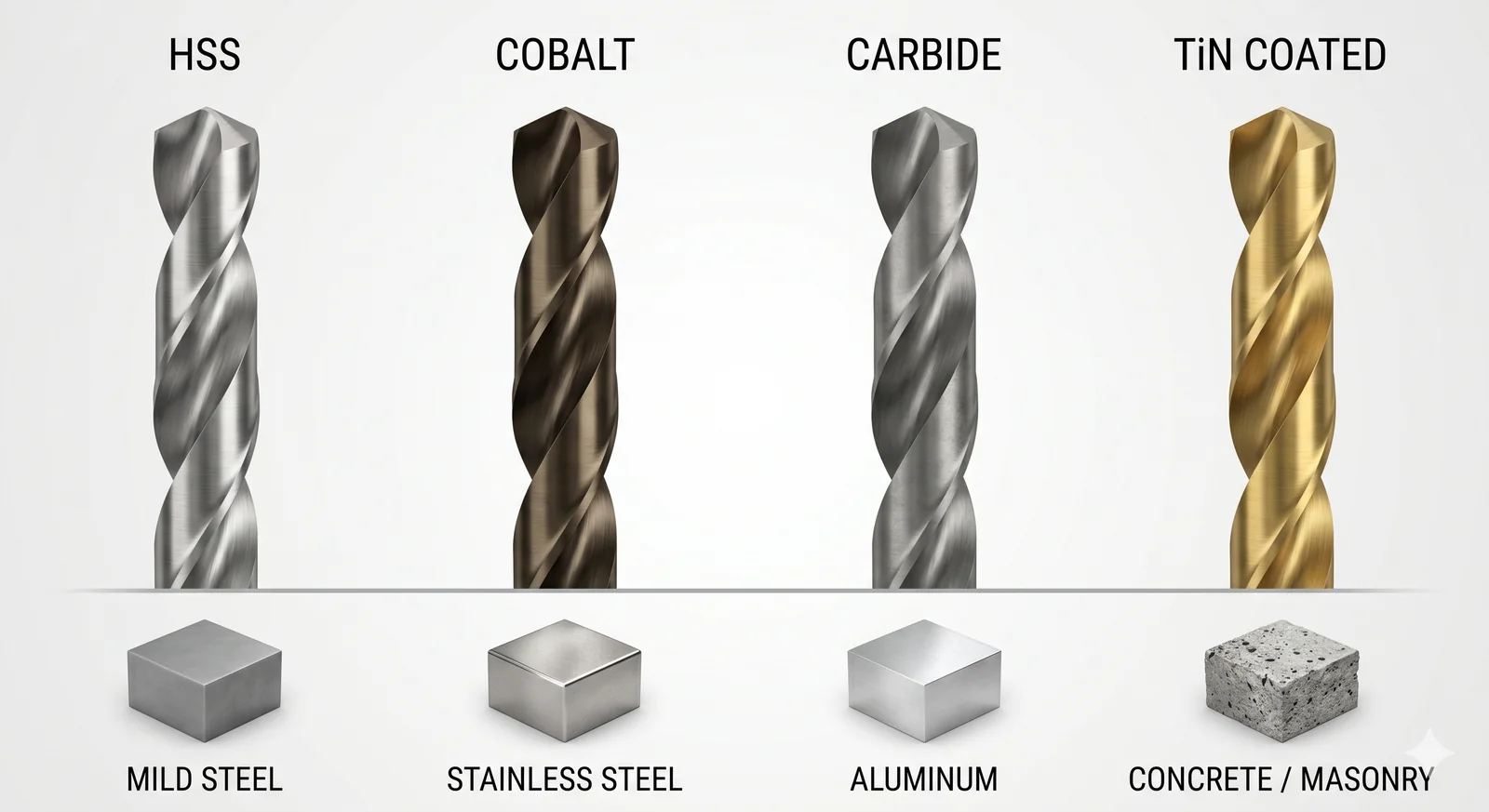
How to Choose the Right Drill Bit Size by Application
- Bolt clearance: choose the clearance and positional tolerance specified on the assembly drawing. Do not add a universal allowance to every bolt diameter. See the tap drill versus clearance hole guide.
- Tapping metal: confirm thread diameter, pitch, workpiece material and whether the tap cuts or forms threads. Cutting-tap and forming-tap pre-hole sizes are not interchangeable.
- Wood screws and dowels: follow the fastener or joint specification. Wood species, screw geometry and the intended joint fit affect pilot-hole selection; a single percentage is not suitable for every application.
- Anchors in concrete: use the anchor manufacturer’s specified bit type, hole diameter, depth and cleaning procedure rather than choosing a near-equivalent size.
- Plastic and precision holes: check the material supplier’s machining guidance and the drawing’s tolerance. Trial holes and measurement may be needed; nominal drill diameter alone does not guarantee the finished hole size.
For product selection, compare HSS twist drill bits and carbide drill bits for the workpiece and machine setup.
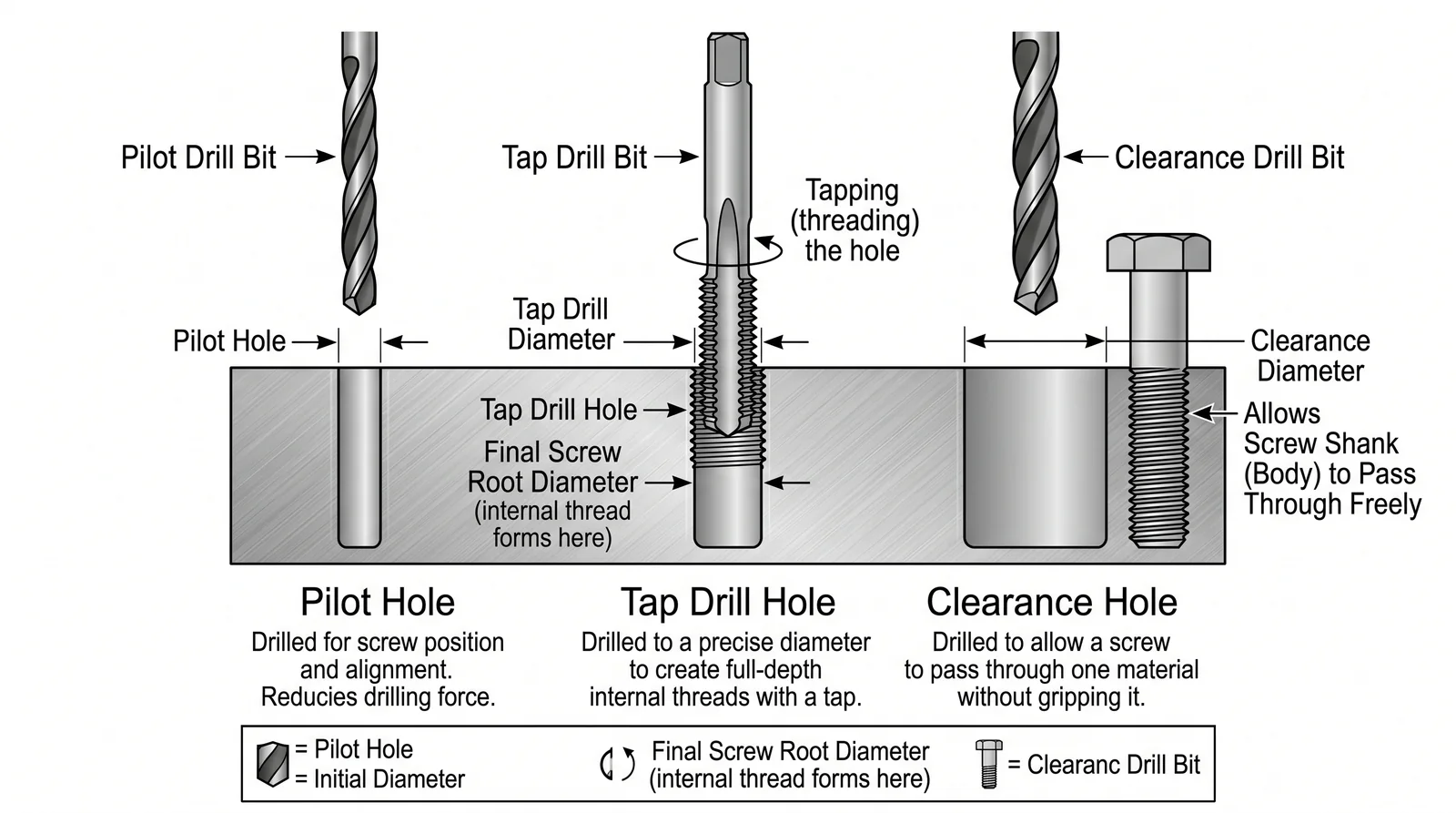
Drill Bit Size for Tap Holes
The following tables are starting references for cutting taps, not forming taps. Confirm the exact tap manufacturer’s recommended pre-hole diameter, thread requirement and material before machining.
Metric Tap Drill Sizes
| Tap Size | Pitch (mm) | Tap Drill (mm) |
|---|---|---|
| M3 | 0.5 | 2.5 |
| M3.5 | 0.6 | 2.9 |
| M4 | 0.7 | 3.3 |
| M5 | 0.8 | 4.2 |
| M6 | 1.0 | 5.0 |
| M8 | 1.25 | 6.8 |
| M10 | 1.5 | 8.5 |
| M12 | 1.75 | 10.2 |
| M14 | 2.0 | 12.0 |
| M16 | 2.0 | 14.0 |
| M18 | 2.5 | 15.5 |
| M20 | 2.5 | 17.5 |
For bolts that pass through without threading, use the separate clearance hole chart and confirm the fit on the drawing.
Imperial (UNC/UNF) Tap Drill Sizes
| Tap Size | TPI | Tap Drill | Decimal (in) |
|---|---|---|---|
| #6-32 UNC | 32 | #36 | 0.1065 |
| #8-32 UNC | 32 | #29 | 0.1360 |
| #10-24 UNC | 24 | #25 | 0.1495 |
| #10-32 UNF | 32 | #21 | 0.1590 |
| 1/4″-20 UNC | 20 | #7 | 0.2010 |
| 5/16″-18 UNC | 18 | F | 0.2570 |
| 3/8″-16 UNC | 16 | 5/16″ | 0.3125 |
| 1/2″-13 UNC | 13 | 27/64″ | 0.4219 |
| 5/8″-11 UNC | 11 | 17/32″ | 0.5313 |
| 3/4″-10 UNC | 10 | 21/32″ | 0.6563 |
Blind-hole caution: do not reduce the pre-hole diameter simply because the hole is blind. Confirm the tap’s diameter recommendation, lead length, chip evacuation and usable thread depth. See Gühring’s tapping chamfer and application guidance (PDF).
Common Mistakes When Selecting Drill Bit Sizes
Check the hole function and required tolerance before ordering a drill by diameter alone.
- Using bolt diameter as the only instruction. A tapped hole and a clearance hole for the same bolt require different diameters. Confirm thread pitch or clearance fit before choosing the drill.
- Ignoring tolerance stack-up. In production drilling, your “6.0mm” bit might actually be 5.98mm or 6.03mm depending on wear. For close-tolerance holes, use HSS-G or carbide bits — they hold size better than roll-forged HSS.
- Assuming one screw pilot size suits all wood. Follow the screw manufacturer’s guidance for the species and joint; test on representative material when needed.
- Not accounting for coating thickness. If you’re using TiN-coated bits, the coating adds about 2–3 microns. For precision work below 3mm, this can push your hole over tolerance. Always test the actual hole size, not just the bit size.
- Confusing tap drill size with clearance drill size. These serve opposite purposes. Tap drill = for cutting internal threads. Clearance drill = for the bolt to pass through freely. Getting them mixed up results in either stripped threads or a bolt that won’t fit.
Specify Drill Sizes for a Quotation
Send the nominal diameter and sizing system, workpiece material, required hole tolerance, hole depth, machine type, quantity and packaging requirements. State whether the hole is for tapping, clearance or another operation; include the thread pitch when applicable.
Compare our drill bit product range or send a drawing and request a quotation. Confirm availability, tolerances, minimum order quantity and lead time for the exact specification before ordering.
Frequently Asked Questions
What is the most commonly used drill bit size?
There is no single size that suits all drilling jobs. Select the diameter from the fastener, drawing or hole specification rather than from a general popularity claim.
How do I convert metric drill bit sizes to imperial?
Divide millimeters by 25.4. For example, 6 mm is approximately 0.2362 inches. A 1/4-inch drill is 6.35 mm, not 6 mm; a 15/64-inch drill is 5.953125 mm. Compare the actual difference with the allowed tolerance before substituting sizes.
What drill bit size do I need for an M8 tap?
An M8x1.25 standard pitch tap requires a 6.8mm tap drill bit. For M8x1.0 fine pitch, use a 7.0mm drill bit. Always verify the pitch before selecting your tap drill — standard vs. fine pitch makes a significant difference in the required hole size.
Why do my drill bits drill oversized holes?
Oversized holes are typically caused by: (1) drill bit wobble due to a worn chuck or poor bit concentricity, (2) too much feed pressure causing the bit to flex, (3) using roll-forged bits instead of ground (HSS-G) bits for precision work, or (4) a dull cutting edge that causes the bit to wander. For tolerance-critical holes, validate the complete drilling and measurement process against the drawing. A precision-ground drill and a good holder alone do not guarantee the finished-hole tolerance.