
If you’ve ever stood in front of a drill bit display wondering whether to grab the HSS or the cobalt option, you’re not alone. It’s one of the most common questions we get from buyers — and after producing both types for over 30 years at our Hangzhou factory, we’ve developed some strong opinions about when each one makes sense.
Here’s the short version: HSS drill bits are the versatile workhorse for everyday drilling. Cobalt drill bits are the heat-resistant specialist for tough metals. But the real answer depends on what you’re drilling, how often, and what your customers expect from the finished hole.
Let’s break it down properly.
What Are HSS Drill Bits?
HSS stands for High-Speed Steel — a category of tool steel specifically designed to cut at high speeds without losing hardness. The most common grade is M2, which contains approximately:
- Tungsten: 6% — provides hot hardness
- Molybdenum: 5% — adds toughness
- Chromium: 4% — improves wear resistance
- Vanadium: 2% — refines grain structure
- Carbon: 0.85% — base hardness
M2 HSS achieves a working hardness of HRC 62–65 after proper heat treatment. This is more than sufficient for drilling wood, most plastics, and softer metals like aluminum and mild steel.
Most HSS drill bits you see on the market fall into one of three categories:
- Standard HSS (M2) — the baseline. Good for general-purpose drilling in wood, plastic, and mild steel up to about 300–400 Brinell.
- HSS-G (ground) — the flutes are precision-ground rather than rolled, giving better concentricity and a sharper cutting edge. Preferred for cleaner holes.
- TiN-coated HSS — a titanium nitride surface coating (gold color) that adds ~2–3 HRC of surface hardness and reduces friction. Helps with chip evacuation in aluminum.
On our production line, HSS twist drill bits account for roughly 60% of our drill bit output. They’re the bread and butter for markets where cost-effectiveness matters — which is most markets, honestly.
What Are Cobalt Drill Bits?
Cobalt drill bits are not made of pure cobalt. They’re HSS with a significant percentage of cobalt added to the alloy. The two standard grades are:
- M35 (5% cobalt) — a step up from M2 in heat resistance, while retaining most of M2’s toughness. Working hardness: HRC 65–67.
- M42 (8% cobalt) — the premium grade. Exceptional red hardness (the ability to maintain hardness at elevated temperatures). Working hardness: HRC 67–69.
The cobalt doesn’t make the bit harder at room temperature — that’s a common misconception. What it does is allow the bit to retain its hardness at much higher cutting temperatures. When you’re drilling stainless steel, the cutting edge can easily reach 600°C or more. At that temperature, standard M2 HSS starts to soften and deform. M35 and M42 keep their edge.
This is why cobalt bits are the go-to for:
- Stainless steel (304, 316, etc.)
- Cast iron
- Hardened steel (up to about HRC 38–40)
- Titanium alloys
- High-temperature alloys
The trade-off? Cobalt bits are more brittle than HSS. They’ll snap if you apply side pressure or use them in a handheld drill without a steady hand. And they cost 30–60% more, depending on the cobalt percentage and brand markup.
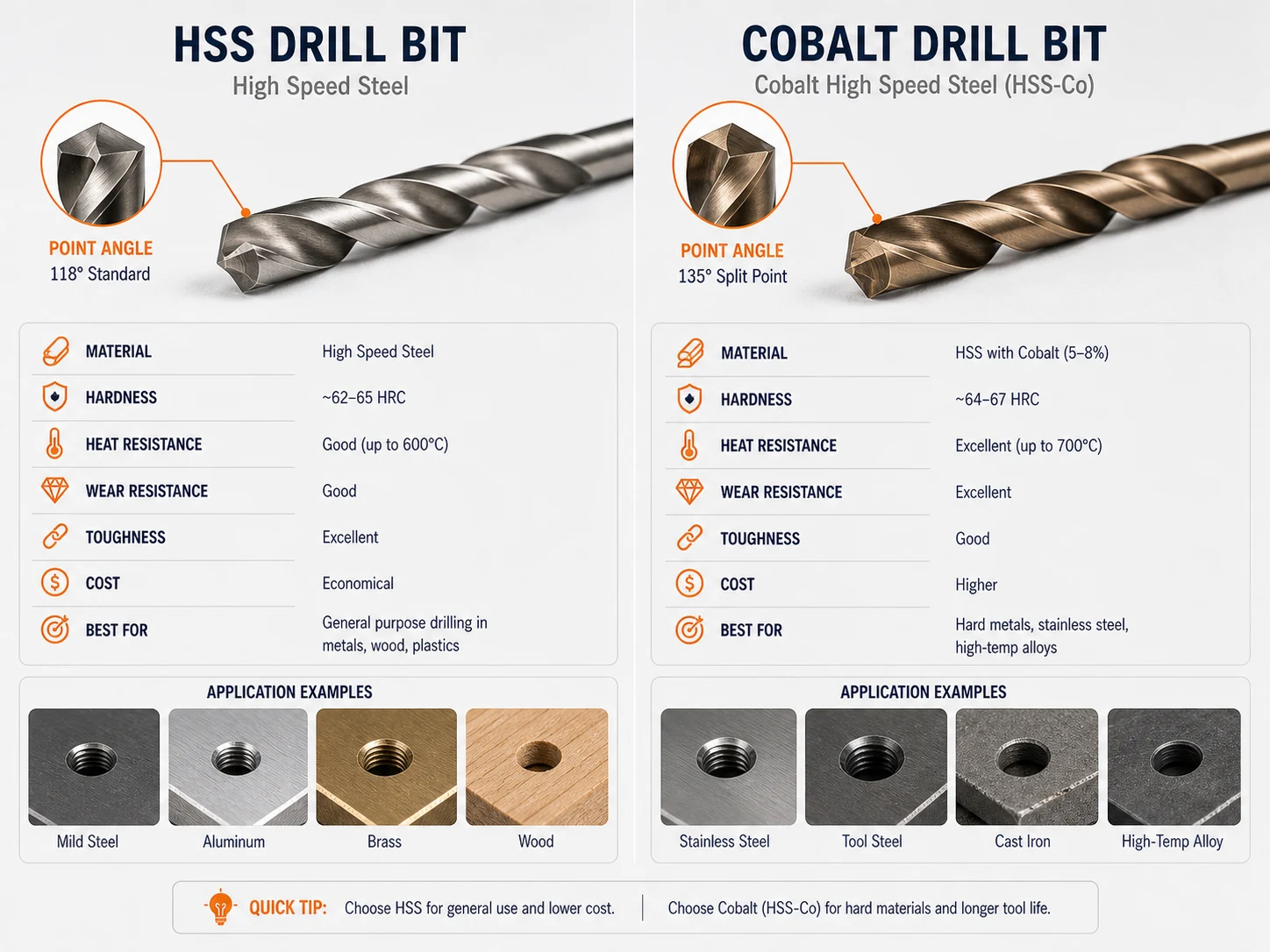
Head-to-Head Comparison
| Property | HSS (M2) | Cobalt M35 (5%) | Cobalt M42 (8%) |
|---|---|---|---|
| Working Hardness | HRC 62–65 | HRC 65–67 | HRC 67–69 |
| Red Hardness (max temp) | ~600°C | ~650°C | ~700°C+ |
| Toughness | High | Medium | Lower |
| Best For | Wood, plastic, mild steel, aluminum | Stainless steel, tool steel | Hardened steel, cast iron, titanium |
| Typical Price Ratio | 1.0x (baseline) | 1.3–1.5x | 1.5–1.8x |
| Expected Life (mild steel) | 150–250 holes* | 200–350 holes* | 250–400 holes* |
| Expected Life (stainless steel) | 30–60 holes* | 120–200 holes* | 180–300 holes* |
| Breakage Risk (handheld) | Low | Medium | Medium-High |
| Sharpening | Easy | Moderate | More difficult |
*Hole counts are approximate — 10mm diameter, 25mm depth, proper speed and feed. Actual results vary significantly with technique and workpiece condition.
The gap between HSS and cobalt becomes most dramatic in stainless steel drilling. HSS can drill stainless — but the bit will blue, lose its temper, and dull after just a few holes if you’re not extremely careful with speed and pressure. Cobalt handles the heat and keeps cutting.
When to Choose HSS Drill Bits
Choose HSS when:
- You’re drilling wood, plastic, or non-ferrous metals — cobalt offers zero advantage here. You’re paying for capability you don’t need.
- Your end users are DIYers or general contractors — they need toughness (resistance to breakage) more than heat resistance. HSS forgives a lot of abuse.
- Price sensitivity is high — if your market is hardware retail in Southeast Asia or South Asia, HSS is what moves. A 13-piece HSS-G set at the right price point will outsell a cobalt set every time.
- You’re buying in bulk for general-purpose kits — HSS is the default for multi-purpose drill bit sets. It covers 80% of drilling applications at a fraction of the cost.
- You need roll-forged bits for speed of production — HSS can be roll-forged efficiently, which is why the per-piece cost is significantly lower.
In our factory, we produce HSS bits across the full metric range (1mm–25mm) and fractional sizes (1/16″–1″). For our HSS twist drill bit lineup, we offer both standard and HSS-G versions, with optional TiN coating for the aluminum-cutting market.
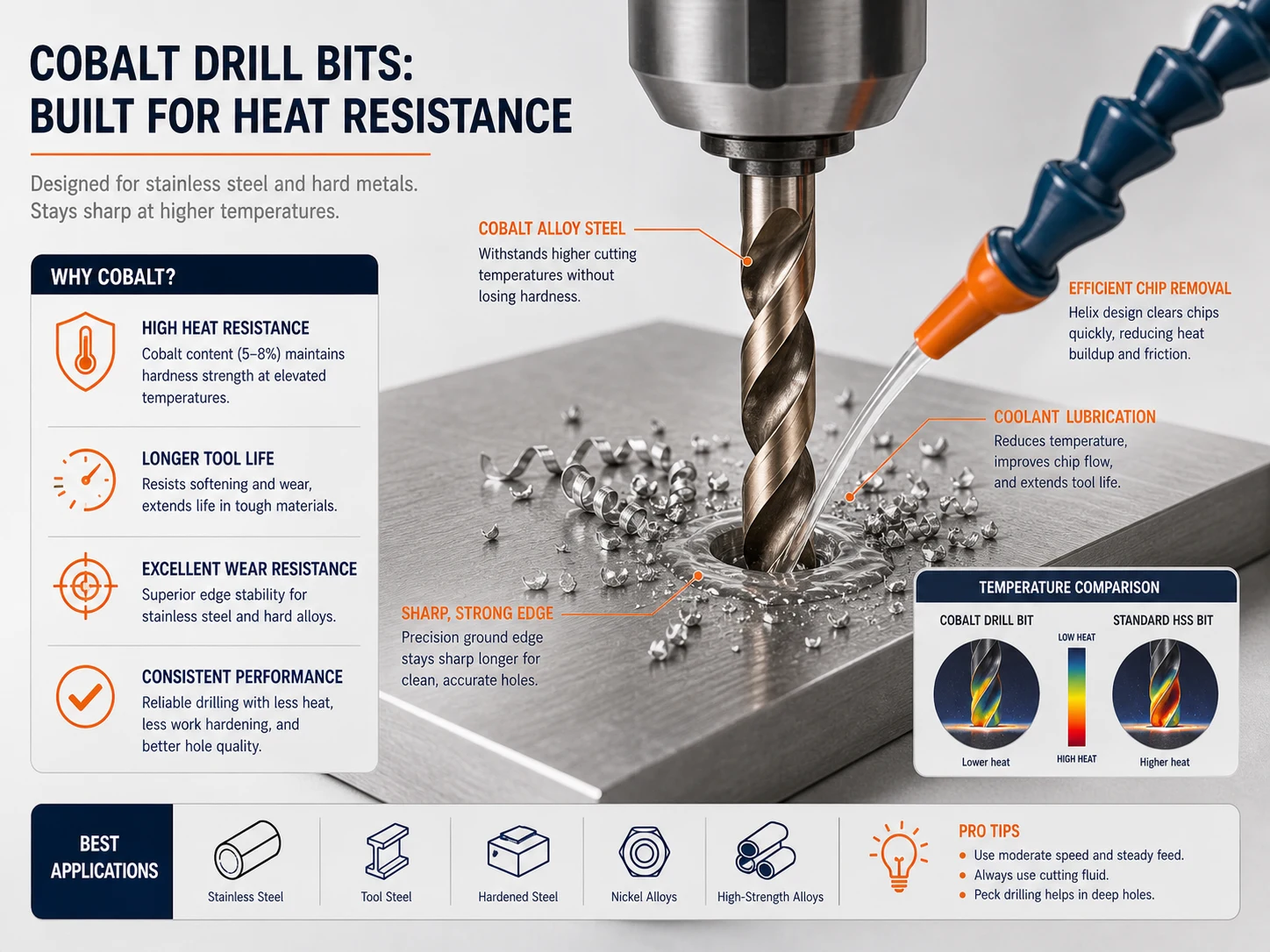
When to Choose Cobalt Drill Bits
Choose cobalt when:
- Stainless steel is your primary material — this is the #1 reason. If your customers are in food processing, chemical, marine, or medical equipment, cobalt is non-negotiable.
- You’re drilling tool steel or hardened alloys — anything above 30 HRC calls for at least M35.
- Production drilling where bit changes are costly — on a production line, the 30–50% longer tool life of cobalt easily pays for the higher upfront cost.
- Your market is industrial/professional — professional mechanics, metal fabricators, and maintenance teams know the difference and will pay for it.
- You’re sourcing for a premium brand — if your private-label brand positions itself as professional-grade, M42 cobalt should be in your catalog.
A practical note: M35 hits the sweet spot for most stainless steel applications. M42 is worth the premium when you’re drilling hardened steel above 35 HRC or when the workpiece simply cannot tolerate a stalled or damaged bit (e.g., aerospace components).
Pro Tip from the Factory Floor
30 years of production data, one clear pattern: In our factory, we’ve watched buyers evolve their drill bit purchases over time — and it’s remarkably consistent. A distributor in South Asia started with us ordering only HSS bits seven years ago. Small trial order, 100 pieces per size. As his market grew and his customers moved from basic fabrication into stainless steel work, he started requesting M35 cobalt bits alongside HSS. Today, his annual order includes roughly 60% HSS and 40% cobalt M35 — and he’s testing M42 for a new client in marine equipment.
This progression makes sense. Markets upgrade. End users start with general-purpose tools and discover they need specialist bits as their work gets more demanding. The smart move as a buyer is to stock both — HSS for the broad market, cobalt for the professionals — rather than trying to make one type cover everything.
Another observation from our production line: the failure mode is different for each type. HSS bits in tough materials typically fail by bluing (overheating) and edge rounding. Cobalt bits in tough materials fail by chipping or snapping if the operator applies too much side pressure or uses the wrong speed. Understanding the failure mode helps you give better advice to your customers.
How to Source Quality Drill Bits from China
Whether you need HSS or cobalt (or both), here’s what to look for in a Chinese drill bit supplier:
- Ask about the steel grade — a legitimate factory will tell you exactly what they use. If they say “HSS” without specifying M2, or “cobalt” without specifying M35/M42, ask again.
- Request hardness test reports — every batch should be tested. HSS should register HRC 63±1. M35 should be HRC 66±1. M42 should be HRC 68±1.
- Check the grinding quality — the chisel edge and cutting lips should be symmetrical. Poor grinding = wandering bits = oversized holes.
- Test with your actual material — not just the mild steel test block the supplier sends. If you’re drilling 304 stainless, test on 304 stainless.
- Verify the surface treatment — if you’re buying TiN-coated bits, the coating should be 2–3 microns thick. Cheap coatings flake off in one use.
At Wryno Global, we produce both HSS and cobalt drill bits across 10+ production lines. We accept trial orders from 100 pieces per specification — because we know you need to test before committing. Our factory has been running since 1994, and we’ve supplied distributors across Southeast and South Asia for decades.
Ready to discuss your drill bit requirements? Contact our factory team — we respond within 24 hours with specs, pricing, and lead times. You can also browse our full drill bit product range for specifications.
For heat-treated tool steel and hard alloy components, compare M35/M42 cobalt with solid carbide in our drill bit guide for hardened steel.
Compare entry behavior and edge support in our 118° vs 135° drill bit point-angle guide.
Match finish and PVD chemistry to the application with our drill bit coatings guide.
See how point, web, flute and margin design interact in our twist drill bit geometry guide.
For oversized or out-of-round holes, follow our drill runout measurement and correction guide.
Decide whether to restore or replace worn tools with our drill bit sharpening and regrinding guide.
For holes beyond normal flute evacuation limits, use our peck drilling and deep-hole coolant guide.
Frequently Asked Questions
Is cobalt always better than HSS?
No. Cobalt bits are more brittle and more expensive. For wood, plastic, and soft metals, HSS is the better choice — it’s tougher, cheaper, and performs equally well. Cobalt only shows its advantage when drilling hard or heat-resistant metals like stainless steel and cast iron.
Can I use HSS drill bits on stainless steel?
Technically yes, but it’s not recommended for production work. HSS will cut stainless steel for a few holes, but the cutting edge overheats rapidly, causing the bit to lose temper and dull. If you must use HSS on stainless, use very slow speed, heavy feed pressure, and cutting fluid. For any volume of stainless drilling, invest in at least M35 cobalt bits.
What does M35 and M42 mean on drill bits?
M35 and M42 are AISI/SAE designations for high-speed steel alloys containing cobalt. M35 contains 5% cobalt, and M42 contains 8% cobalt. The cobalt content improves the steel’s “red hardness” — its ability to maintain cutting hardness at elevated temperatures. M42 is the harder, more heat-resistant grade, but also more brittle and more expensive.
How do I know if a drill bit is truly cobalt?
Legitimate cobalt drill bits are typically marked with “Co 5%” or “Co 8%” on the shank, or with the grade designation (M35, M42). You can also verify by testing hardness — a cobalt bit should register at least HRC 65 (M35) or HRC 67 (M42). Some unscrupulous suppliers sell HSS bits as “cobalt” — always buy from a reputable manufacturer who provides material certifications.
Get full specifications for HSS, carbide, SDS, and step drill bits.
Download PDF Catalog