
If you’re buying hammer drill bits for concrete and masonry, you’ve probably encountered the terms SDS, SDS Plus, and SDS Max — and wondered what the differences actually mean for your work. These aren’t just marketing labels; they represent fundamentally different shank systems with different capabilities.
Our factory produces both SDS Plus and SDS Max hammer drill bits, and we’ve been shipping them to distributors across Southeast and South Asia for years. This guide explains each system clearly, helps you choose the right one, and clears up the most common misconceptions.
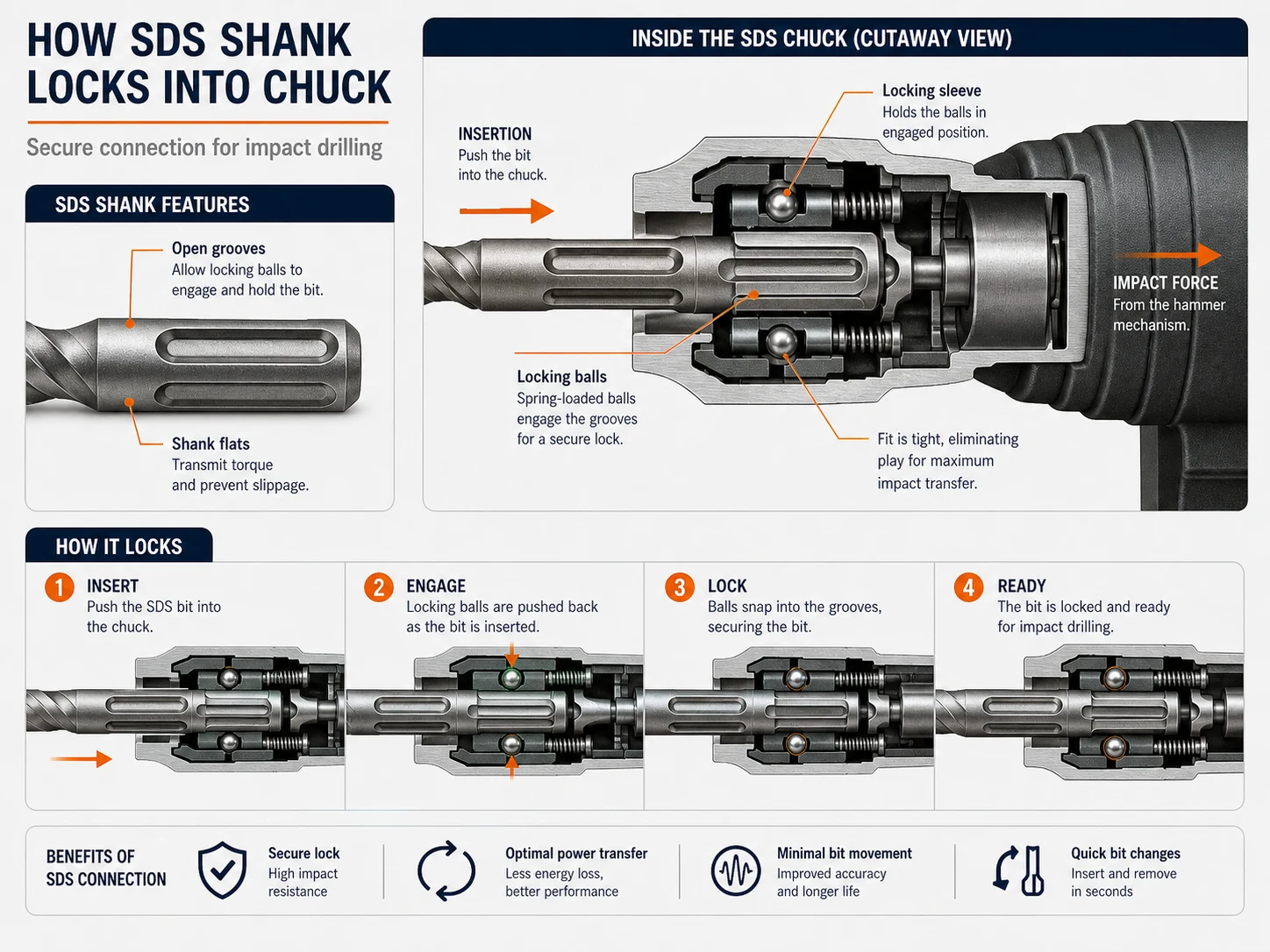
What Does SDS Stand For?
SDS stands for Slotted Drive System (sometimes called “Spanner Drills System” in older German documentation — it was developed by Bosch in the 1970s). The key innovation of the SDS system is how the bit connects to the drill:
- Traditional chuck: The drill chuck grips the round shank of the bit through friction (tightening three jaws). Under heavy hammering, the bit can slip or spin inside the chuck.
- SDS system: The bit’s shank has slots (grooves) that lock into matching segments inside the SDS chuck. The bit slides in and is held by a spring-loaded ball bearing that clicks into a groove on the shank. No tightening required — the bit is locked in by the slot mechanism.
This slot-and-ball design serves two critical purposes:
- Positive engagement: The bit cannot slip under hammering loads. The drive force is transmitted through the slots, not through friction.
- Free-floating shank: The bit can slide back and forth slightly within the chuck. This is essential — the hammer mechanism needs the bit to move freely to deliver the impact. In a traditional chuck, the bit is clamped tight and cannot float, which reduces hammer efficiency.
The original SDS system had a 10mm shank. It has since been superseded by SDS Plus and SDS Max for different applications.
SDS Plus Explained
SDS Plus is the most widely used SDS system today. Key specifications:
- Shank diameter: 10mm
- Shank length (insertion depth): 40mm
- Number of slots: 2 closed slots + 2 open slots
- Compatible drill diameter range: 4mm – 32mm (most common: 6mm–20mm)
- Impact energy rating: Typically 1.5–4.0 joules per blow
SDS Plus is designed for light to medium-duty hammer drilling:
- Drilling anchor holes in concrete
- Running electrical and plumbing conduit through masonry
- General construction and renovation work
- Hole sizes up to about 26mm in concrete (beyond this, SDS Max is more efficient)
Most cordless rotary hammers and compact corded models use SDS Plus. It’s the standard for tradesmen — electricians, plumbers, HVAC installers, and general contractors.
In our production, SDS Plus bits in the 6mm–16mm range account for roughly 70% of our hammer drill bit output. These sizes cover the vast majority of concrete anchoring applications.
SDS Max Explained
SDS Max is the heavy-duty counterpart. Key specifications:
- Shank diameter: 18mm
- Shank length (insertion depth): 90mm
- Number of slots: 5 open slots + 2 closed slots
- Compatible drill diameter range: 12mm – 52mm (most common: 16mm–40mm)
- Impact energy rating: Typically 5.0–20+ joules per blow
SDS Max is designed for heavy-duty applications:
- Core drilling in reinforced concrete
- Large-diameter anchor holes (27mm+)
- Chipping and demolition work (with SDS Max chisels)
- Heavy construction, bridge and tunnel work
- Industrial installation requiring deep, large holes
SDS Max rotary hammers are larger, heavier (typically 6–12kg), and significantly more powerful than SDS Plus tools. They’re designed to be used in a stand or with both hands — not overhead for extended periods.
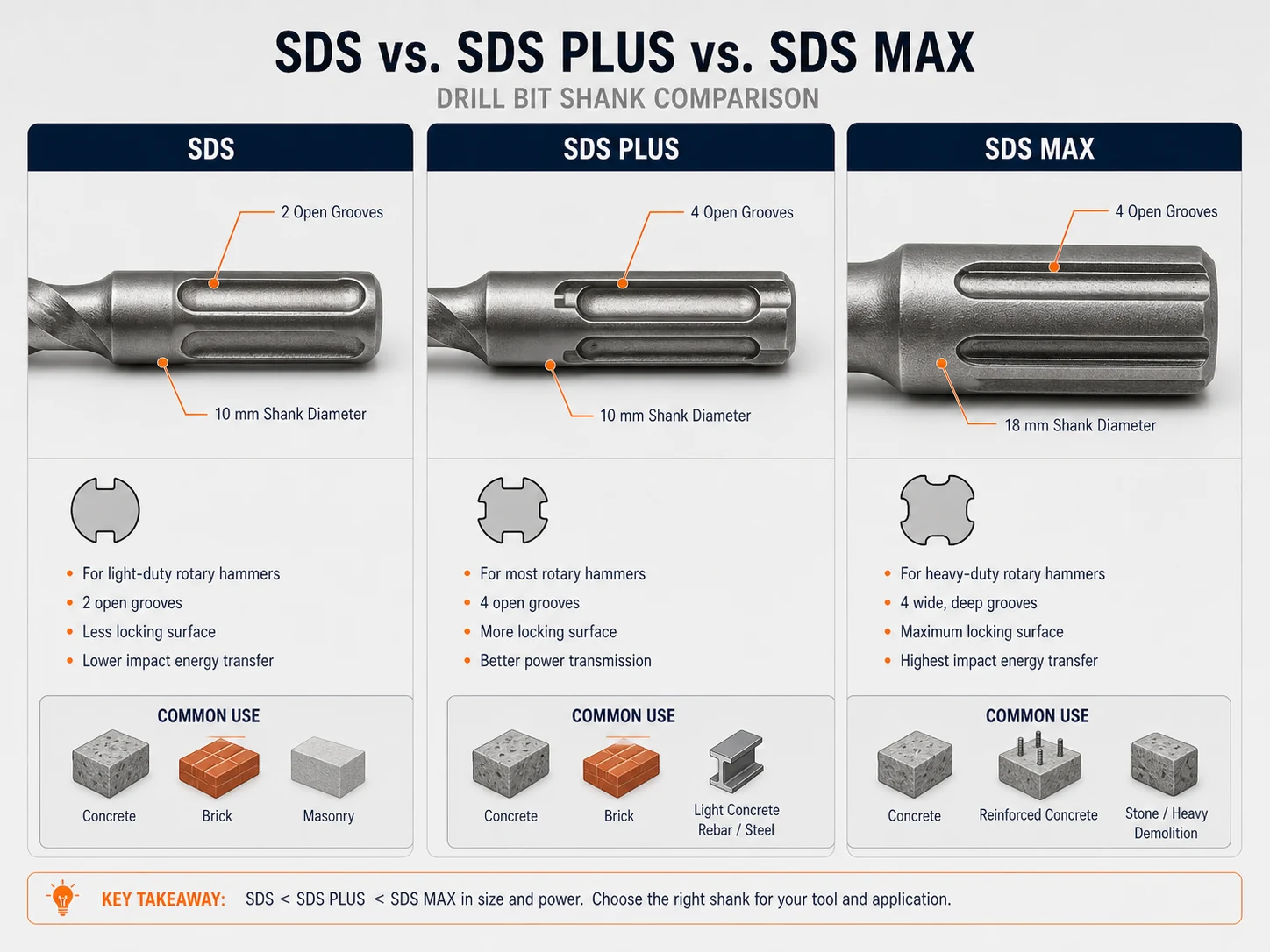
Comparison Table
| Specification | SDS (Original) | SDS Plus | SDS Max |
|---|---|---|---|
| Shank Diameter | 10mm | 10mm | 18mm |
| Shank Insertion Depth | 40mm | 40mm | 90mm |
| Slot Configuration | 2 closed + 2 open | 2 closed + 2 open | 5 open + 2 closed |
| Drill Diameter Range | 4–20mm | 4–32mm | 12–52mm |
| Impact Energy | 1.0–2.0 J | 1.5–4.0 J | 5.0–20+ J |
| Typical Tool Weight | 2–3 kg | 2–5 kg | 6–12+ kg |
| Typical Application | Light DIY | Trade/construction | Heavy construction |
| Market Availability | Limited (mostly legacy) | Widely available | Available (specialty) |
| Bit Cost (10mm) | — | Baseline | ~1.5–2x SDS Plus |
Which System Should You Choose?
The right choice depends entirely on the type of work and hole sizes you need:
Choose SDS Plus When:
- You’re drilling holes from 4mm to 26mm in concrete or masonry
- You need a lightweight, portable tool for overhead or wall-mounted work
- Your work involves anchor bolt installation, conduit runs, or general construction
- You want the widest selection of available bits and accessories
- You’re buying for electricians, plumbers, or general contractors
SDS Plus covers roughly 85% of all concrete drilling applications. For most buyers, it’s the right default choice.
Choose SDS Max When:
- You’re consistently drilling holes larger than 26mm in concrete
- You need to core drill through reinforced concrete
- Your work involves heavy demolition or chipping
- You’re buying for heavy construction, civil engineering, or mining applications
- Drilling speed in large diameters matters (SDS Max is 2–3x faster for holes above 26mm)
Need Both?
Many professional contractors own both an SDS Plus rotary hammer (for daily tasks) and an SDS Max breaker (for heavy work). As a distributor, stocking both systems covers the full range of customer needs.
Can You Use SDS Plus Bits in an SDS Max Drill?
No — not without an adapter, and we don’t recommend adapters for production work.
This is one of the most common questions we get. Here’s why they’re not interchangeable:
- Different shank diameters: SDS Plus is 10mm; SDS Max is 18mm. An SDS Plus bit will physically fall through an SDS Max chuck.
- Different slot patterns: The number and position of slots differ. The driving segments in the chuck won’t engage the slots on the wrong system.
- Different insertion depths: SDS Plus inserts 40mm; SDS Max inserts 90mm. The lock mechanism engages at different depths.
Adapters exist that convert SDS Max to SDS Plus, but they:
- Add length and wobble, reducing drilling accuracy
- Don’t transmit the full impact energy efficiently
- Can jam or get stuck in the chuck
- Are not designed for heavy or production use
Our advice: use the right bit for the right tool. If you have an SDS Plus drill, buy SDS Plus bits. If you have an SDS Max drill, buy SDS Max bits. It’s that simple.
Manufacturing Notes: Our Experience Producing Both Systems
Our factory produces both SDS Plus and SDS Max hammer drill bits, and the manufacturing differences are significant:
- Shank forming: SDS Plus shanks can be machined on standard CNC lathes. SDS Max shanks require heavier-duty machining due to the 18mm diameter and deeper slot profiles. The tolerances are tighter on SDS Max because the larger impact forces make any runout more damaging.
- Carbide tip specification: SDS Plus bits typically use YG8 or YG8C carbide (suitable for the moderate impact energy). SDS Max bits require YG11C or equivalent — a tougher, more impact-resistant grade designed to survive 10+ joule impacts without cracking.
- Brazing process: SDS Max bits need heavier brazing joints and longer soak times to ensure the carbide tip can withstand the significantly higher impact forces. A weak braze on an SDS Max bit is a safety hazard — the tip can detach under full hammer power.
- Quality control: We test every SDS Max bit for tip security (tap test), shank dimension (go/no-go gauge), and flute geometry. The failure rate is higher than SDS Plus during production because the manufacturing tolerances are tighter and the impact requirements are more demanding.
From our production data: SDS Plus bits in the 8mm–14mm range are by far our highest-volume hammer drill bit products, representing about 70% of our SDS output. SDS Max bits in 16mm–28mm account for most of the remaining 30%. For distributors in Southeast and South Asia, we recommend stocking SDS Plus as your core range and adding SDS Max as a specialty line for construction-sector customers.
Our full range of SDS hammer drill bits and other drill bit products are available with MOQ from 100 pieces per specification. Contact our factory team for pricing and specifications.
Frequently Asked Questions
What is the difference between SDS and SDS Plus?
The original SDS and SDS Plus share the same 10mm shank diameter and are physically compatible — an SDS Plus bit will fit in an original SDS chuck and vice versa. The difference is that “SDS Plus” is the modernized version with tighter manufacturing tolerances and updated slot geometry for better performance. In practice, “SDS” and “SDS Plus” are used interchangeably in the market today, as original SDS tools are largely discontinued.
Can I use SDS Plus bits in an SDS Max drill?
No, not directly. The shank diameters are different (10mm vs 18mm), and the slot patterns don’t match. Adapters exist but are not recommended for production work — they reduce impact transfer, add wobble, and can jam. Use the correct bit type for your tool.
What size drill bit do I need for concrete anchors?
Match the drill bit diameter to the anchor specification. Common sizes: M6 anchor → 6mm bit, M8 anchor → 8mm bit, M10 anchor → 10mm bit, M12 anchor → 12mm bit. Always use the exact diameter specified by the anchor manufacturer — an oversized hole means the anchor won’t grip properly. For most anchor work, SDS Plus bits cover the required range (6mm–16mm).
Is SDS Max worth it for occasional use?
Probably not. If you’re only occasionally drilling holes above 26mm, renting an SDS Max drill for those specific jobs is more cost-effective than buying one. SDS Plus with quality bits handles 95% of general construction drilling. Invest in SDS Max only if you regularly need large-diameter holes or heavy demolition capability.
How long do SDS hammer drill bits last?
It depends heavily on the concrete type and drilling technique. In standard concrete (C25/30), a quality SDS Plus bit typically lasts 150–300 holes of 80mm depth in the 8mm–12mm range. In reinforced concrete or very hard aggregate, expect 50–150 holes. Always withdraw the bit every 10–15 seconds to clear dust — trapped dust is the #1 cause of premature SDS bit wear.