
Many buyers start a saw blade inquiry with only one question:
"What is your price for this size?"
Price is important, but size alone is not enough to choose the right blade. Two saw blades can have the same diameter and tooth count, but perform very differently on different machines and materials.
The better first question is:
"What material will this blade cut, on what machine, and what cutting result do I need?"
This guide explains a simple way to choose a saw blade without getting lost in too many technical details.
1. Start With the Cutting Material
The cutting material decides the basic blade direction.
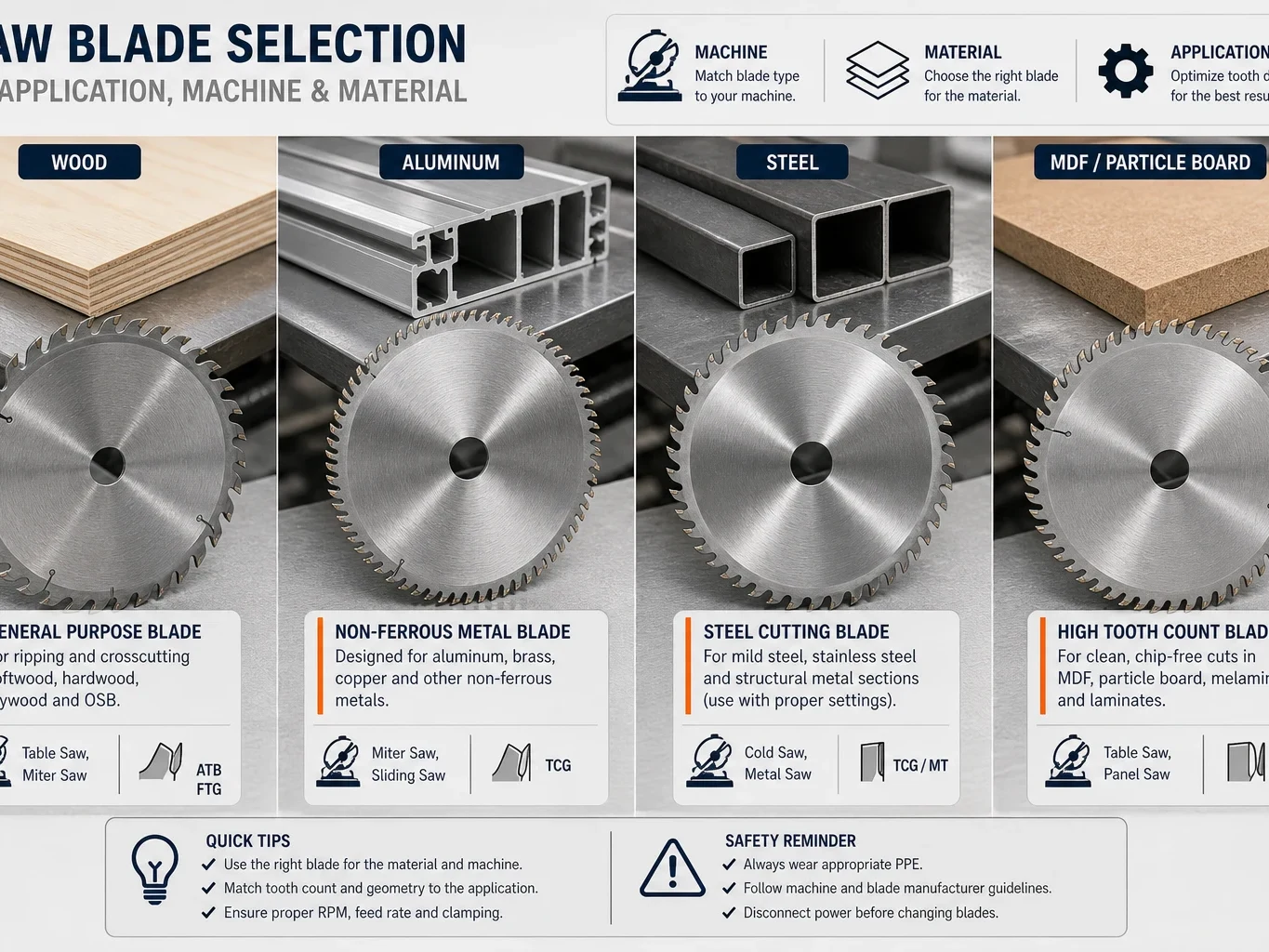
For wood cutting, buyers usually care about fast cutting, smooth surface, low burning and stable blade life. Common applications include softwood, hardwood, plywood, MDF, particle board and laminated panels.
For aluminum and other non-ferrous metals, the blade needs to reduce burrs and avoid material grabbing. Tooth geometry and clamping are very important.
For steel cutting, especially mild steel solid bar, tube or pipe, the blade is different from a normal woodworking TCT blade. A cold saw blade with carbide or cermet tips is usually required, and the machine speed must be suitable.
Before asking for a quotation, try to describe the material clearly:
- Wood, MDF, plywood or laminated board
- Aluminum profile, copper or brass
- Mild steel solid bar, pipe or tube
- Stainless steel
- Plastic, composite board or other special material
This one detail can prevent many wrong recommendations.
2. Confirm the Machine Type
The same blade may not be suitable for every machine.
A blade used on a table saw is not always the same as one used on a sliding table saw, cut-off saw, cordless saw or low RPM cold saw. Machine type affects blade diameter, bore, pin holes, tooth geometry, hook angle and safe cutting speed.
Common machine information to provide:
- Machine type
- Machine brand or model if available
- Blade rotation speed or RPM
- Current blade size
- Bore size
- Pin holes or bolt hole pattern
If you are not sure, a photo of the machine nameplate and the current blade hole pattern is usually enough for a supplier to check the basic direction.
3. Understand the Main Saw Blade Specification
A saw blade model often looks like this:
285 x 2.0 x 1.75 x 32 x 80T
This usually means:
- 285 mm: outside diameter
- 2.0 mm: kerf, or cutting width
- 1.75 mm: plate thickness
- 32 mm: bore, or center hole
- 80T: number of teeth
For industrial blades, pin holes or PCD may also be required. If the blade has extra holes around the center bore, the supplier needs to know:
- Number of pin holes
- Pin hole diameter
- Pitch circle diameter, also called PCD
- Any keyway or special screw holes
This is why photos of the current blade are very useful.
4. Choose Tooth Count Based on Material Thickness and Finish
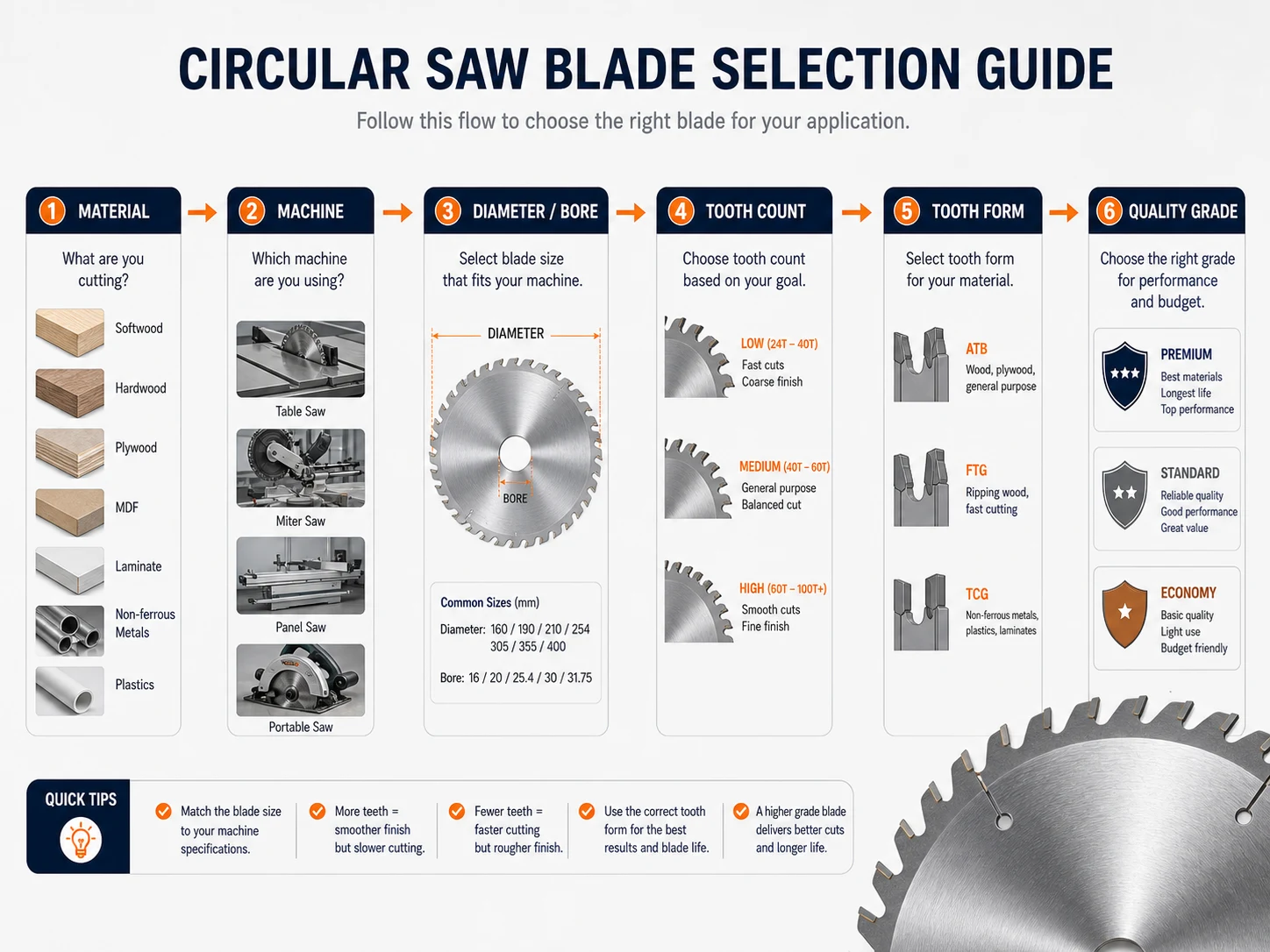
Tooth count affects cutting speed, surface finish and chip removal.
In simple terms:
- Fewer teeth usually cut faster and are better for thicker material or ripping.
- More teeth usually give a smoother finish, but need the right feed speed.
- Too many teeth can make the blade cut slowly or heat up.
- Too few teeth can leave a rougher surface.
For thin material, a smaller tooth pitch is usually better. For thicker material, a larger tooth pitch helps chip removal.
This is why a supplier should not recommend only by diameter. Material thickness and cutting result matter.
5. Match the Tooth Geometry to the Application
You do not need to memorize every tooth shape, but it helps to know the basic idea.
For wood and plywood, ATB-type tooth geometry is commonly used for general cutting and cleaner edges.
For MDF, laminated board and panel sizing, tooth geometry needs to reduce chipping on the top and bottom surface. Some panel saw applications also need a scoring blade.
For aluminum and non-ferrous metals, TCG-type tooth geometry is often used to improve cutting stability and reduce burrs.
For mild steel or stainless steel cutting, carbide or cermet cold saw blades need a different tooth design from normal wood blades.
If the wrong tooth geometry is used, the blade may still look correct by size, but the result can be poor.
6. Kerf and Plate Thickness Affect Stability and Cutting Load
Kerf is the cutting width. Plate thickness is the thickness of the blade body.
A thinner kerf can reduce cutting resistance and material waste. This is useful for cordless tools or when lower machine load is required.
A stronger plate can improve stability, especially for heavy-duty cutting or production use.
The best choice depends on the balance between:
- Cutting speed
- Machine power
- Material waste
- Blade stability
- Required surface finish
The cheapest thin blade is not always the best choice if the machine or material requires more stability.
7. A Real Inquiry Example: Mild Steel Solid Bar Cutting
Recently, we received an inquiry from an Indian buyer looking for a blade similar to:
285 x 2.0 x 1.75 x 32 x 80T
The buyer wanted to cut mild steel solid bar and planned to start with a small sample order before moving to larger monthly quantities.
At first, the size looked clear. But for this application, size was only part of the answer. We still needed to confirm:
- Whether the bore was 32 mm
- Whether there were pin holes around the center bore
- The machine type and RPM
- The solid bar diameter range
- Whether the buyer preferred carbide or cermet
- Whether the first goal was blade life, cutting surface or sample testing
Because the buyer was not sure about every detail, the best next step was not to push a random model. The better solution was to recommend a safe starting grade for sample testing, then adjust carbide/cermet grade and tooth geometry after the test result.
This is a common situation in real sourcing. A good supplier should help the buyer reduce risk, not only send a price list.
8. What Buyers Should Send Before Quotation
To get a more accurate quotation, send these details if possible:
- Target cutting material
- Material shape and thickness
- Machine photo or model
- Current blade photo
- Blade marking if visible
- Bore and pin hole photo
- Quantity for sample and regular order
- Required cutting result
If you do not know all the details, photos and short videos are often enough for the first check.
9. The Right Blade Should Reduce Total Cutting Cost
A lower blade price does not always mean lower cutting cost.
If the blade wears too fast, breaks teeth, leaves burrs, burns material or causes machine downtime, the buyer may lose more money than the saving from the blade price.
A suitable blade should help you:
- Reduce rejected cuts
- Improve cutting surface
- Lower machine load
- Extend blade life
- Reduce customer complaints
- Build repeat orders
For wholesalers and industrial buyers, the best blade is not always the cheapest blade. It is the blade that matches the application and helps your customer keep buying from you.
Final Recommendation
When choosing a saw blade, do not start with price only.
Start with:
- What material will be cut?
- What machine will be used?
- What result is required?
- What size, bore and pin holes are needed?
- Is this for sample testing or regular production?
Once these points are clear, the supplier can recommend a more reliable blade specification and quality level.
If you are not sure how to choose, you can use our Product Catalog to start from application and machine type, or contact us with your current blade photo and cutting material.
For TCT wood and aluminum cutting blades, visit our TCT Saw Blades page. For steel cutting applications, visit our Steel Cutting Cold Saw Blades page.
FAQ
How do I know which saw blade I need?
Start with the cutting material, machine type, current blade size and required cutting result. If you are not sure, send photos of the machine, current blade and material.
What does kerf mean on a saw blade?
Kerf is the cutting width made by the blade. A thinner kerf reduces cutting resistance and material waste, while a stronger blade body may be better for stable heavy-duty cutting.
Is more teeth always better?
No. More teeth can improve finish, but too many teeth may slow cutting or increase heat if the feed speed is not correct. Tooth count should match material thickness and cutting result.
What is the difference between a TCT saw blade and a cold saw blade?
A TCT saw blade is commonly used for wood, aluminum and non-ferrous cutting. A cold saw blade for steel cutting uses different carbide or cermet tips, tooth geometry and machine speed requirements.
Can one blade cut wood, aluminum and steel?
Usually no. Different materials require different tooth geometry, blade body design and cutting speed. Using one blade for the wrong material may shorten blade life or damage the teeth.