
“Drill bit” is a broad term. A buyer may ask for drill bits, but the correct product can be a twist drill, SDS hammer bit, step drill, masonry bit, hole saw or countersink. Each type is designed for a different material and machine.
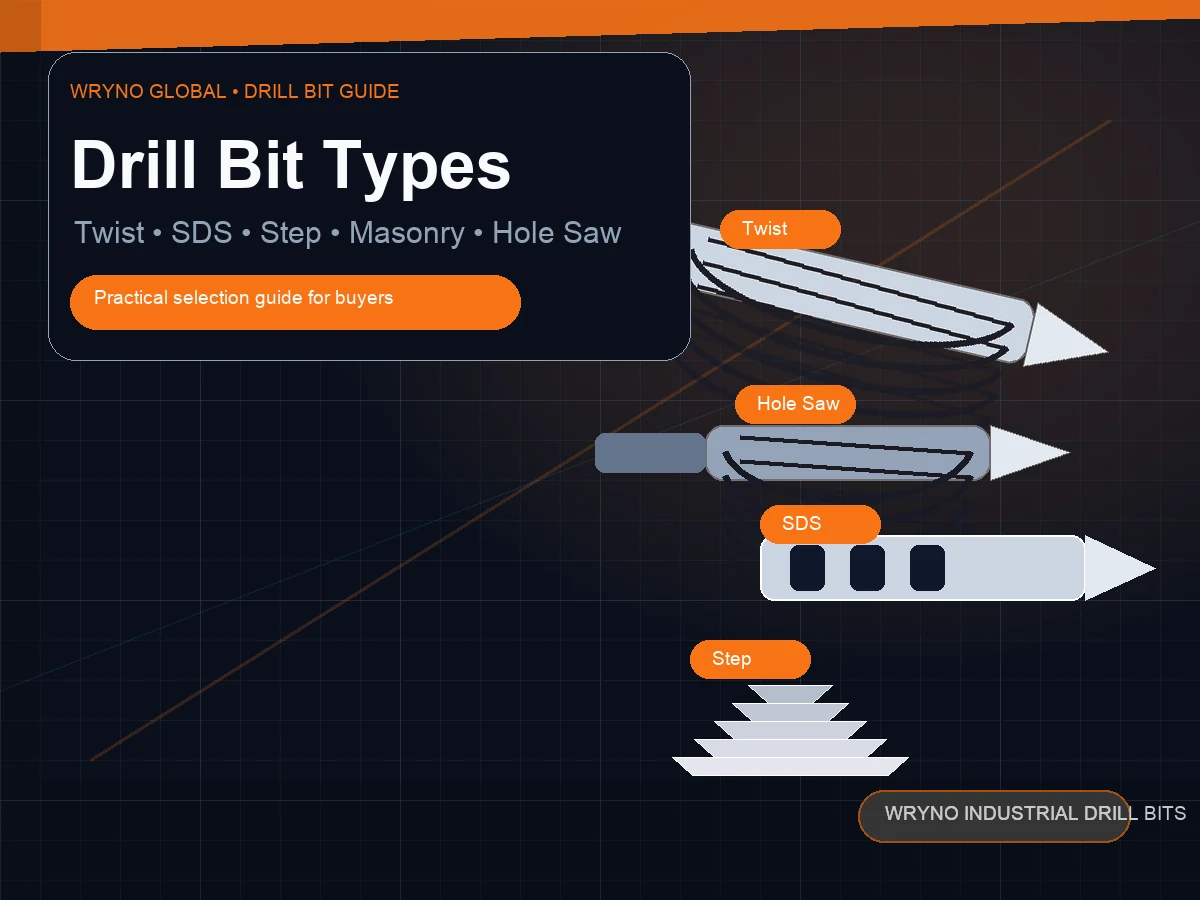
This guide gives importers, wholesalers and workshop buyers a practical map of the most common drill bit types.
Quick Comparison Table
| Drill bit type | Best-fit material | Typical machine | Main buying logic |
|---|---|---|---|
| HSS twist drill bit | Mild steel, aluminum, wood, plastic | Hand drill, bench drill, drill press | General-purpose, low cost, wide size range |
| Cobalt drill bit | Stainless steel, harder steel, heat-resistant alloys | Drill press, controlled handheld drilling | Better heat resistance than standard HSS |
| Solid carbide drill bit | Cast iron, abrasive material, CNC production drilling | CNC, rigid drill press | High precision and long life, but brittle |
| SDS hammer drill bit | Concrete, brick, stone, masonry | Rotary hammer | Impact drilling with SDS Plus or SDS Max shank |
| Step drill bit | Thin sheet metal, electrical box, panels | Hand drill, cordless drill | Multiple hole sizes with one bit |
| Hole saw | Wood, sheet metal, stainless sheet, plastic | Hand drill, magnetic drill, arbor system | Large diameter holes without removing full material volume |
| Countersink bit | Metal, wood, plastic | Hand drill, drill press | Chamfering and screw head seating |
1. Twist Drill Bits
Twist drill bits are the default choice for many holes. They have spiral flutes to remove chips and are available in HSS, cobalt HSS and carbide versions. For general mild steel and aluminum, HSS is normally enough. For stainless steel, cobalt is a safer upgrade. For production CNC drilling, carbide may be the best option.
Related reading: HSS drill bit for mild steel and drill bit for stainless steel.
2. SDS Hammer Drill Bits
SDS bits are designed for rotary hammers. Unlike normal round-shank bits, the SDS shank locks into the hammer mechanism and transfers impact energy efficiently. SDS Plus is common for small and medium holes. SDS Max is used for larger concrete holes and heavier machines.
If the customer is drilling reinforced concrete, tip design and brazing quality become more important than price alone.
3. Step Drill Bits
A step drill bit can make several hole diameters with one tool. It is useful for thin sheet metal, control cabinets, electrical panels and HVAC work. The limitation is depth: it is not designed for thick solid bar or deep holes.
4. Masonry Bits
Masonry drill bits use carbide tips to break and scrape hard mineral material. Round-shank masonry bits can work with hammer drills for light jobs. SDS masonry bits are better for construction use because the machine transfers impact more effectively.
5. Hole Saws and Annular Cutters
For large holes, a hole saw or annular cutter often makes more sense than a giant twist drill. Instead of removing the entire circle as chips, the tool cuts around the perimeter. This saves time and power.
6. Countersink and Chamfer Bits
Countersink bits are not mainly for drilling deep holes. They create chamfers and screw-head seats. In metal fabrication and furniture assembly, they help prevent burrs and improve the finished appearance.
For heat-treated tool steel and hard alloy components, compare M35/M42 cobalt with solid carbide in our drill bit guide for hardened steel.
Compare entry behavior and edge support in our 118° vs 135° drill bit point-angle guide.
See how point, web, flute and margin design interact in our twist drill bit geometry guide.
For oversized or out-of-round holes, follow our drill runout measurement and correction guide.
Decide whether to restore or replace worn tools with our drill bit sharpening and regrinding guide.
For holes beyond normal flute evacuation limits, use our peck drilling and deep-hole coolant guide.
Buyer Takeaway
The correct drill bit type depends on the material, hole size, machine and finish requirement. If a customer only says “drill bit,” ask: what material, what hole diameter, what machine, and how many holes per day?
ENGINEERING KNOWLEDGE
Related guide: HSS vs Cobalt vs Carbide Drill Bits for Metal: Buyer Selection Guide adds a practical buyer checklist for HSS vs cobalt vs carbide drill bits.
Related guide: Drill Bit Coating Color Guide: Black Oxide, TiN, TiAlN and Bright Finish adds a practical buyer checklist for drill bit coating color guide.
Drill Bit Engineering Guides
Continue from product type into geometry, coating, hole quality, regrinding and deep-hole process control.