
The cutting part of a drill bit gets most of the attention, but the shank decides whether the bit fits the machine. A good drill bit with the wrong shank is still the wrong product.
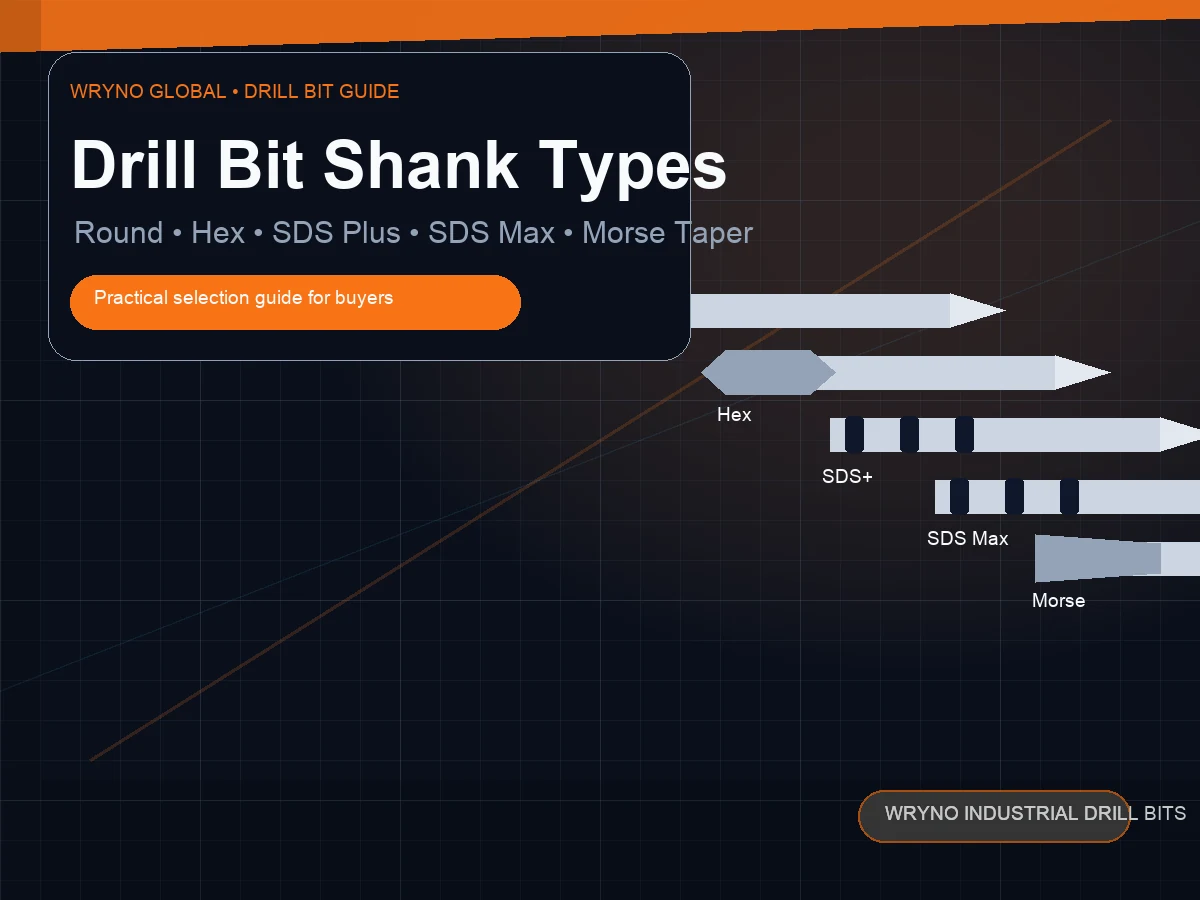
This guide explains the shank types that buyers most often see in industrial, construction and hardware markets.
Quick Shank Selection Table
| Shank type | Where it fits | Best use | Common caution |
|---|---|---|---|
| Round shank | Standard drill chuck | General HSS twist drilling | Can slip if the chuck is weak or oily |
| Hex shank | Quick-change holder, cordless driver | Fast bit changes, light metal, wood, plastic | Not always ideal for precision deep holes |
| SDS Plus | SDS Plus rotary hammer | Concrete and masonry holes, common sizes | Not compatible with normal drill chucks |
| SDS Max | SDS Max rotary hammer | Large concrete holes, heavy-duty work | Too large for SDS Plus machines |
| Reduced shank | Smaller chuck with larger cutting diameter | Large holes with common drill chuck sizes | Machine power and rigidity must be enough |
| Morse taper | Industrial drill press, lathe tailstock | Large industrial twist drills | Must match the machine taper size |
Round Shank
Round shank bits are the standard choice for common twist drill bits. They are easy to produce, available in many sizes and fit most keyed or keyless chucks. For HSS drill bits sold through hardware channels, round shank is the default.
Hex Shank
Hex shank bits are useful when the user wants quick changes. The six-sided shank also reduces slipping compared with a smooth round shank. They are common in cordless driver sets, mixed drill-and-screwdriver kits and light-duty jobsite applications.
For precision drilling in metal, however, a normal drill press and round shank may still be better because runout control is easier.
SDS Plus and SDS Max
SDS shanks are for rotary hammers. The bit can move back and forth under hammer impact while still transmitting rotation. This makes concrete drilling much more efficient than a normal chuck.
SDS Plus is the most common construction size for medium-duty concrete holes. SDS Max is larger and used for heavy-duty concrete drilling and demolition accessories.
Related reading: SDS vs SDS Plus vs SDS Max.
Reduced Shank
Reduced shank bits have a cutting diameter larger than the shank diameter. For example, a large bit may have a 1/2 inch shank so it fits a common chuck. This can be useful, but buyers must confirm the machine has enough torque and rigidity.
Morse Taper
Morse taper shank bits are used in industrial machines such as drill presses and lathes. They provide strong alignment and torque transfer for larger drilling work. The buyer must confirm the taper number, not only the drill diameter.
Buyer Takeaway
When quoting drill bits, always confirm the machine chuck or holder. Diameter and material are not enough. The shank type must match the customer’s equipment.