
If you’ve ever stared at a drill bit package covered in fractions, decimals, and letters — and wondered which one fits the hole you need — you’re not alone. Drill bit sizing is one of the most confusing topics for beginners, and even experienced buyers sometimes mix up wire gauge numbers with millimeter measurements.
At our Hangzhou factory, we produce drill bits in metric, imperial, and wire gauge sizes for export to over 20 countries. We see the confusion firsthand when buyers order the wrong size. This guide will give you a clear, practical system for reading any drill bit size chart — no engineering degree required.
Why Drill Bit Sizes Are So Confusing
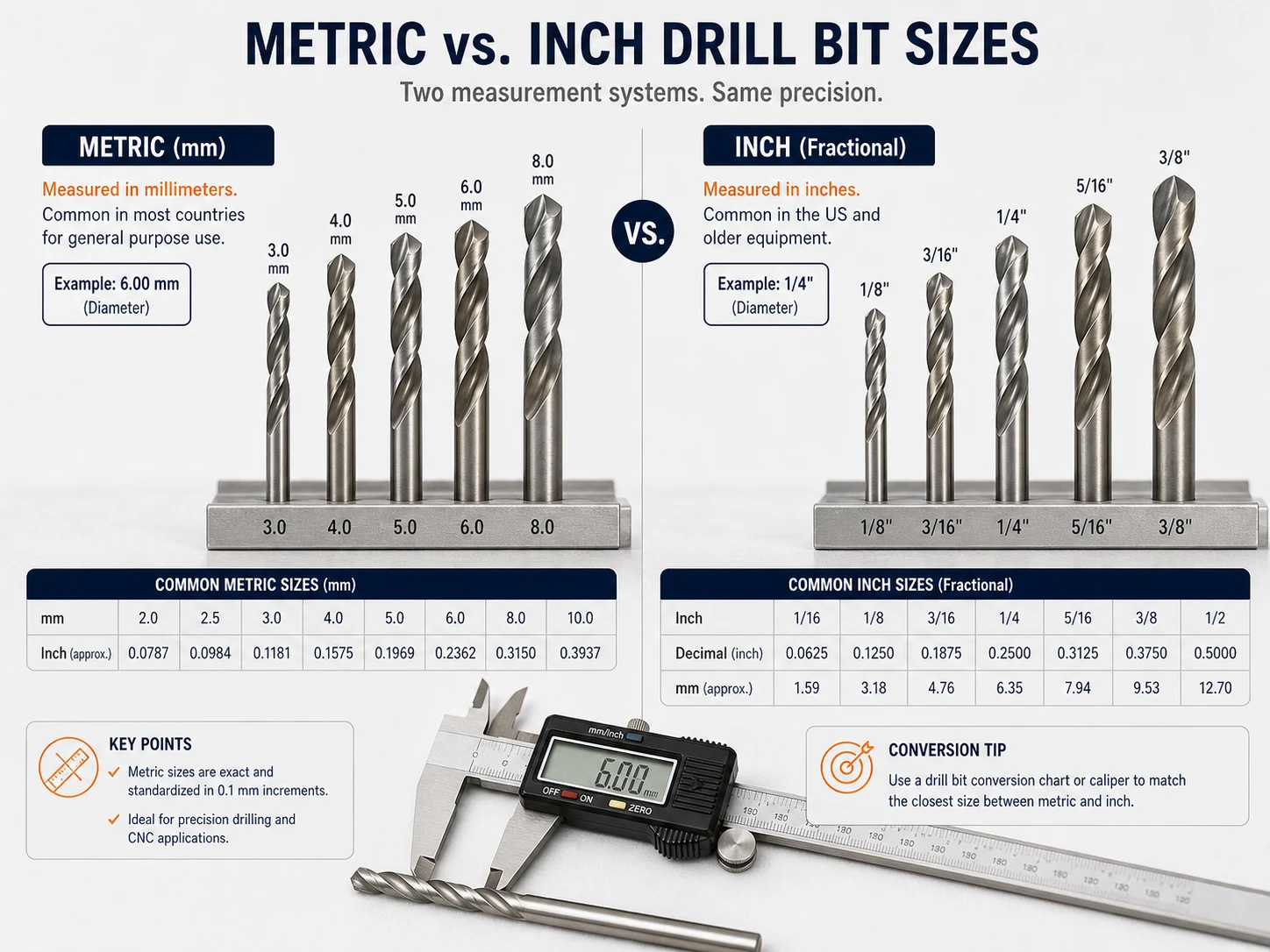
Three different numbering systems are used worldwide for drill bits, and they don’t align neatly with each other:
- Metric (millimeters): Used in Europe, Asia, and most of the world. Straightforward — a 6mm bit drills a 6mm hole.
- Fractional inch: Used primarily in North America. Common sizes like 1/16″, 1/8″, 1/4″ — but the fractions get awkward fast (what’s 7/32″ in decimal?).
- Wire gauge / letter & number: An old system where smaller numbers mean larger bits. #1 is 0.2280″, #60 is 0.0400″. Letter sizes (A through Z) sit between the number and fractional ranges.
The problem? These three systems overlap. A 5mm bit is close to — but not exactly — a #8 wire gauge or a 13/64″ fractional bit. When precision matters (like tapping holes), “close” isn’t good enough.
The Three Sizing Systems Explained
1. Metric Sizes (Millimeters)
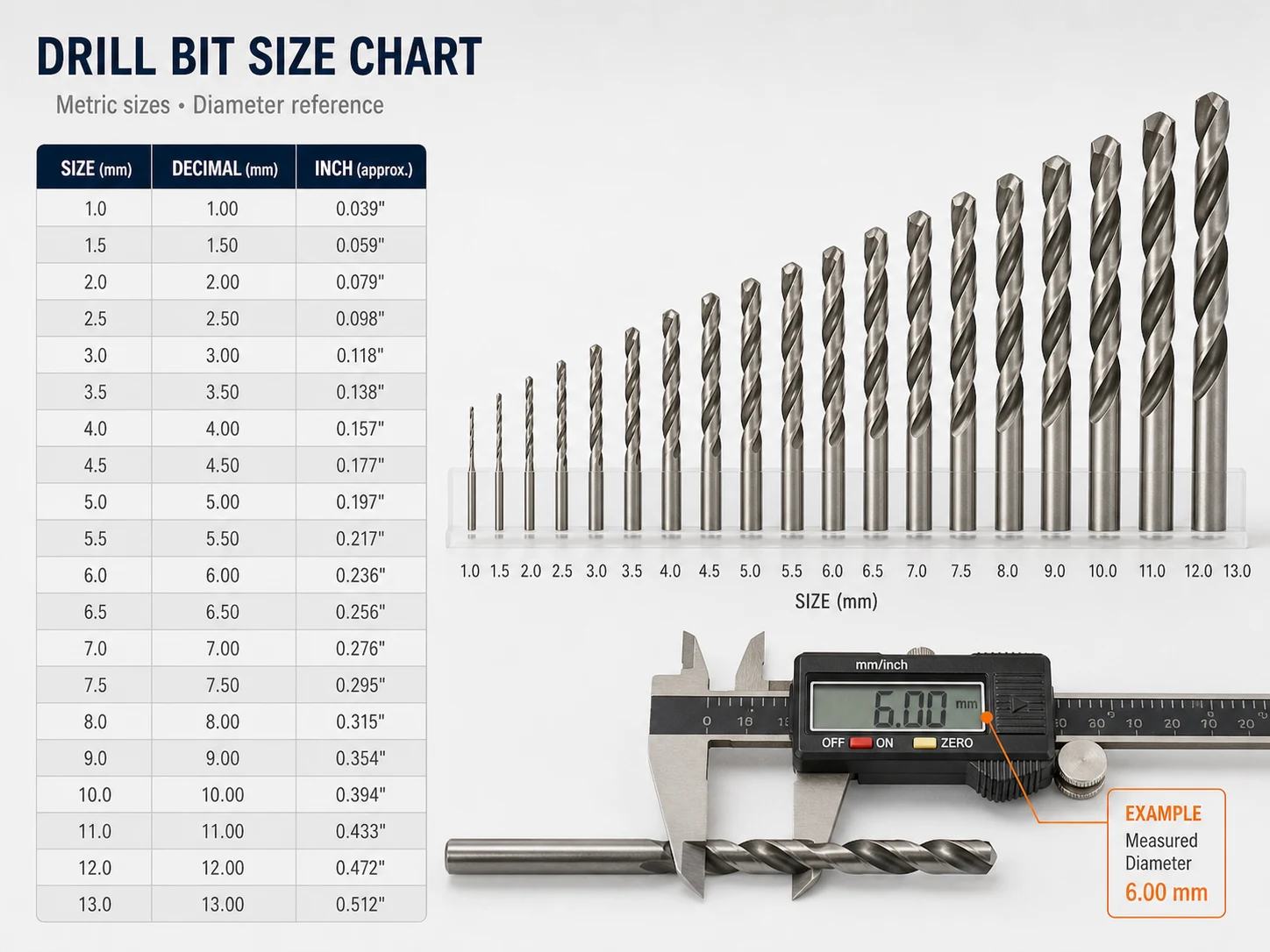
Metric is the simplest system. The size printed on the bit is the hole diameter it produces. Common metric sizes and their applications:
| Metric Size | Decimal Inch | Common Application |
|---|---|---|
| 1.0mm | 0.0394″ | Jewelry, electronics, pilot holes |
| 2.0mm | 0.0787″ | Small pilot holes, sheet metal |
| 3.0mm | 0.1181″ | M3 tap hole, general DIY |
| 4.0mm | 0.1575″ | M4 tap hole, cable pass-through |
| 5.0mm | 0.1969″ | M5 tap hole, furniture assembly |
| 6.0mm | 0.2362″ | M6 tap hole, standard anchor holes |
| 8.0mm | 0.3150″ | M8 tap hole, mechanical fasteners |
| 10.0mm | 0.3937″ | M10 tap hole, heavy-duty anchors |
| 12.0mm | 0.4724″ | M12 tap hole, structural bolts |
Metric bits typically increase in 0.1mm increments below 3mm, 0.5mm increments from 3–10mm, and 1mm increments above 10mm. For tap-specific sizes, see our drill bit sizes for tap holes guide.
2. Fractional Inch Sizes
Fractional inch bits are listed in 1/64″ increments in most charts. The most commonly used sizes:
- 1/16″ (1.59mm): Pilot holes, small screws
- 5/64″ (1.98mm): #4 screw pilot
- 3/32″ (2.38mm): #6 screw pilot
- 1/8″ (3.18mm): One of the most popular sizes — general purpose
- 5/32″ (3.97mm): #10 screw pilot
- 3/16″ (4.76mm): #12 and 1/4″ screw pilot
- 1/4″ (6.35mm): Standard anchor holes, dowels
- 3/8″ (9.53mm): Larger anchor holes
- 1/2″ (12.70mm): Large through-holes, conduit
Quick conversion tip: To convert a fraction to decimal, divide the numerator by the denominator. 7/32″ = 7 ÷ 32 = 0.21875″ ≈ 5.56mm.
3. Wire Gauge (Number and Letter) Sizes
This is where most beginners get lost. The wire gauge system runs in reverse — larger numbers mean smaller bits.
- Number sizes (#1–#80): #80 is the smallest (0.0135″ / 0.34mm), #1 is the largest (0.2280″ / 5.79mm). These fill the gap below 1/4″.
- Letter sizes (A–Z): A is 0.235″ (5.97mm), Z is 0.413″ (10.49mm). These fill the gap between the largest number size and 1/2″.
The wire gauge system exists primarily for tap drill sizes in North American manufacturing. If you’re not tapping threads, you’ll rarely need these. But if you are — they’re essential, because metric equivalents are approximate, not exact.
How to Identify Bit Sizes on Packaging
Drill bit packaging varies by market and manufacturer. Here’s what to look for:
- Metric packaging: Size is usually displayed prominently in millimeters (e.g., “Ø6.0” or “6mm”). Sometimes the fractional inch equivalent is shown in smaller text.
- Imperial packaging: Fractional inch is primary (e.g., “1/4″”). Metric equivalent may appear in parentheses.
- Combination sets: Often show all three systems. The bit tray has the size marked next to each slot — don’t mix up the numbers.
- Engraved markings: Individual bits often have the size laser-etched or rolled into the shank. On small bits, the marking can be hard to read — use a magnifier or caliper.
Factory tip: In our export business, we’ve found that about 15% of reorder requests come from buyers who ordered the wrong size the first time. The most common mistake is confusing a #8 wire gauge bit (0.199″ / 5.05mm) with an 8mm bit — a 2.95mm difference. Always double-check whether the “8” refers to wire gauge or millimeters.
Measuring Bits with Calipers
When the marking is worn off or you need to verify a size, a vernier caliper or digital caliper is your best tool:
- Measure the cutting diameter, not the shank. On reduced-shank bits, the shank is smaller than the cutting diameter.
- Measure across the flutes at the widest point. The cutting edges are the widest part of the bit.
- Take 2–3 measurements at different points and average them. Bits can have slight ovality from grinding.
- Digital calipers are faster and less error-prone than vernier calipers for this task. A $15–$30 digital caliper is accurate to ±0.02mm — more than sufficient for drill bit verification.
Don’t use a ruler or tape measure. Even a good ruler is only accurate to about 0.5mm, which means you could confuse a 4.5mm bit with a 5.0mm bit — and that 0.5mm difference is the gap between a properly tapped thread and a stripped one.
Quick Reference: Most-Used Sizes
| Application | Metric | Fractional | Wire Gauge |
|---|---|---|---|
| M3 tap hole | 2.5mm | ~3/32″ | #40 |
| M4 tap hole | 3.3mm | ~1/8″ | #30 |
| M5 tap hole | 4.2mm | ~5/32″ | #19 |
| M6 tap hole | 5.0mm | ~7/32″ | #8 |
| M8 tap hole | 6.8mm | ~17/64″ | J |
| M10 tap hole | 8.5mm | ~11/32″ | S |
| Wall anchor (standard) | 6.0mm | 15/64″ | #8 |
| Wall anchor (heavy) | 8.0mm | 5/16″ | O |
| General pilot (wood) | 3.0mm | 1/8″ | #30 |
| Dowel hole (standard) | 6.0mm | ~1/4″ | #8 |
For a complete tap drill reference, check our dedicated drill bit size chart page. And for selecting the right HSS bit material, see our HSS twist drill bits guide.
Frequently Asked Questions
Is a bigger gauge number a bigger drill bit?
No — it’s the opposite. In the wire gauge system, larger numbers mean smaller bits. A #60 bit is tiny (0.040″ / 1.02mm), while a #1 bit is much larger (0.228″ / 5.79mm). This reverse numbering is the #1 source of confusion for beginners.
How do I convert mm to inches for drill bits?
Divide the millimeter measurement by 25.4. For example, 6mm ÷ 25.4 = 0.236″ (closest fractional: 15/64″ = 0.234″). For quick field estimates, remember that 1mm ≈ 0.040″ and 25mm ≈ 1″.
What size drill bit do I need for a wall anchor?
Match the drill bit to the anchor’s specified hole size, not the screw size. Most standard plastic anchors need a 6mm or 8mm hole. The anchor packaging should state the required bit size. If not, use a bit that matches the outside diameter of the anchor body (not the expanding legs).
Can I use a slightly smaller bit and force the screw?
We strongly advise against it. Undersized pilot holes increase driving torque, risk splitting the material, and can break the screw. For wood, use a pilot bit that matches the screw’s core diameter (the solid shaft inside the threads). For metal, the hole must match the tap size exactly.
Why do some bits have the same mm and inch markings?
They don’t — but close equivalents are often listed together for convenience. A 6.0mm bit is 0.236″, while 1/4″ is 6.35mm. They’re close but not the same. For clearance holes (where the bolt passes through freely), either works. For tapped holes, the 0.35mm difference matters enormously — use the exact size specified in the tap drill chart.