
Indexable gun drills promise to separate the replaceable cutting head from the reusable body, while conventional brazed tools offer an integrated geometry that can be serviced by specialist regrinding. Neither architecture wins automatically. Small-diameter deep-hole performance is dominated by alignment, entry support, coolant and chip evacuation as well as tool construction.
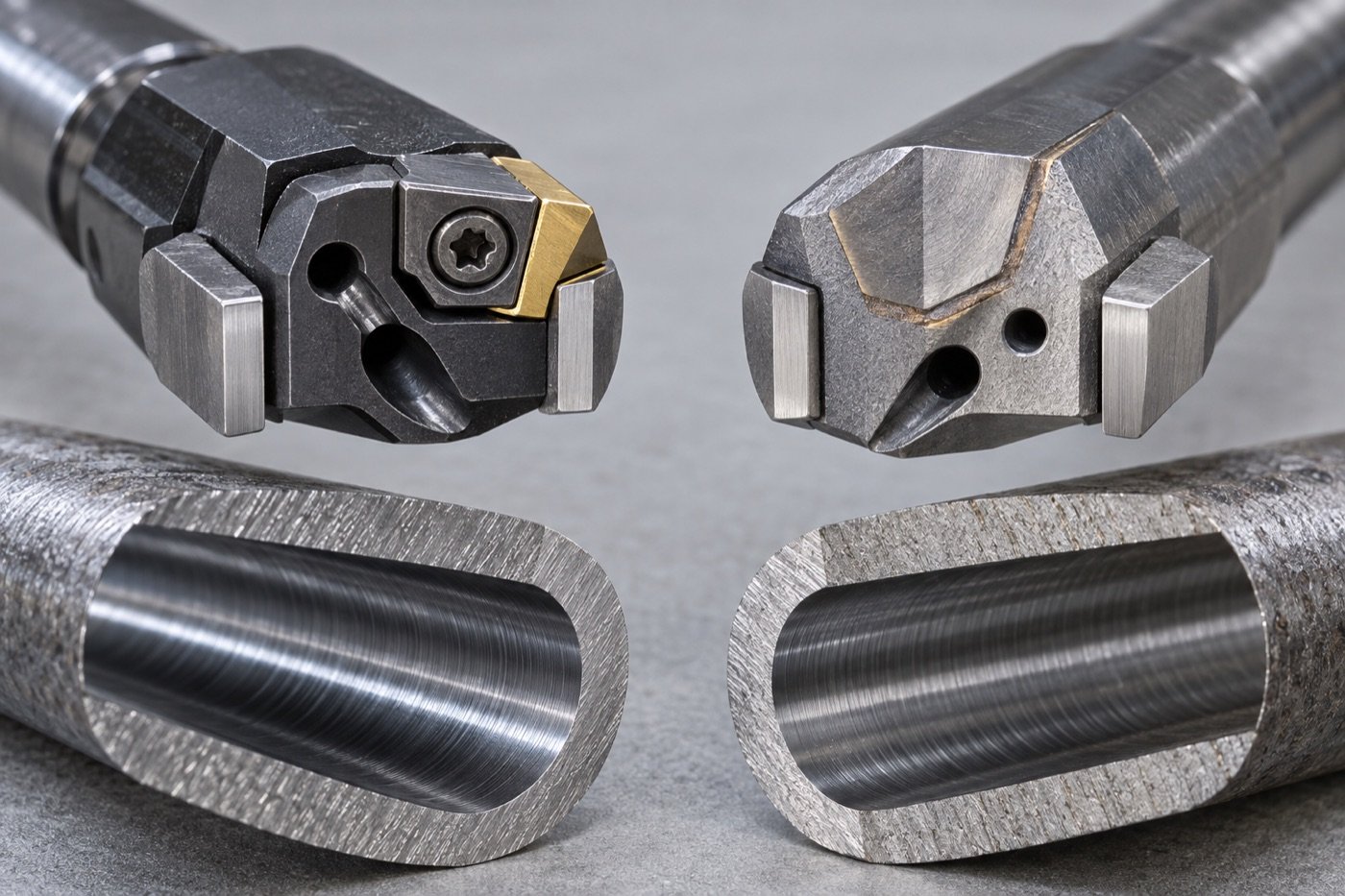
Architecture comparison
| Factor | Indexable gun drill | Brazed gun drill |
|---|---|---|
| Cutting element | Replaceable head or insert system | Cutting tip brazed to tool body |
| Carbide use | Potentially lower per replacement | Depends on head design and service route |
| Restoration | Replace head; inspect reusable body/interface | Regrind and sometimes retip through qualified service |
| Repeatability risk | Head seating and interface condition | Regrinding geometry and body history |
Start with the diameter and hole requirement
Confirm the supplier’s actual system range at the required L/D ratio. Small diameters leave limited chip and coolant area, so nominal availability does not prove capability in the buyer’s material, tolerance and depth. Ask whether the tool starts from a guide bush, pilot hole or other entry system.
Head-change repeatability
An exchangeable head can reduce setup compared with sending a brazed tool for regrinding, but repeatability depends on a clean, undamaged and correctly seated interface. The acceptance plan should measure assembled runout, head seating and the first holes after every change.
Brazed-tool service loop
Brazed gun drills can be viable where the buyer has a stable specialist regrinding and recoating route. Record original geometry, number of regrinds, diameter change, lead time and final retirement reason. Mixing bodies with unknown service history makes cost comparisons unreliable.
Body life is not infinite
For either system, inspect the body, coolant passage, guide pads, interface and drive connection. A replaceable head does not make a bent, worn or damaged body reusable. Define inspection and discard limits with the supplier.
Write the measurement contract before the trial
State who measures diameter, straightness, cylindricity, surface finish and entry or exit condition; identify the instruments, sampling rate and temperature assumptions. Include a rule for interrupted tests, chip jams and emergency tool withdrawal. Without this agreement, suppliers may report the best holes while production counts every hole, setup minute and recovery event. The purchasing comparison should use the same acceptance definition and measurement method for both architectures.
Coolant and machine conditions
Require pressure, flow, filtration, viscosity and cleanliness ranges for the exact diameter. Verify spindle/toolholder runout, alignment and guide condition. A head-life comparison made with unstable coolant or entry support mostly measures the machine problem.
Cost-per-hole model
| Indexable-system cost | Brazed-system cost |
|---|---|
| Body amortisation + heads + change time + body inspection | Tool purchase + regrinds/retips + logistics + spare rotation |
| Add machine time, coolant, guide wear, inspection, rejects and unplanned recovery to both | |
Qualification sequence
- Measure new tools and interfaces before cutting.
- Run matched holes on the same material and machine.
- Track hole size, straightness, finish, cycle, chips and coolant condition.
- Repeat after head change or regrind.
- Continue long enough to expose body and service-loop effects.