
Drill-bit color is not a reliable quality grade by itself. A coating
can reduce friction, delay heat damage or improve wear resistance, but
it cannot correct poor steel, soft heat treatment, inaccurate grinding
or excessive runout. Buyers should specify the substrate, coating
process, thickness range and application together.
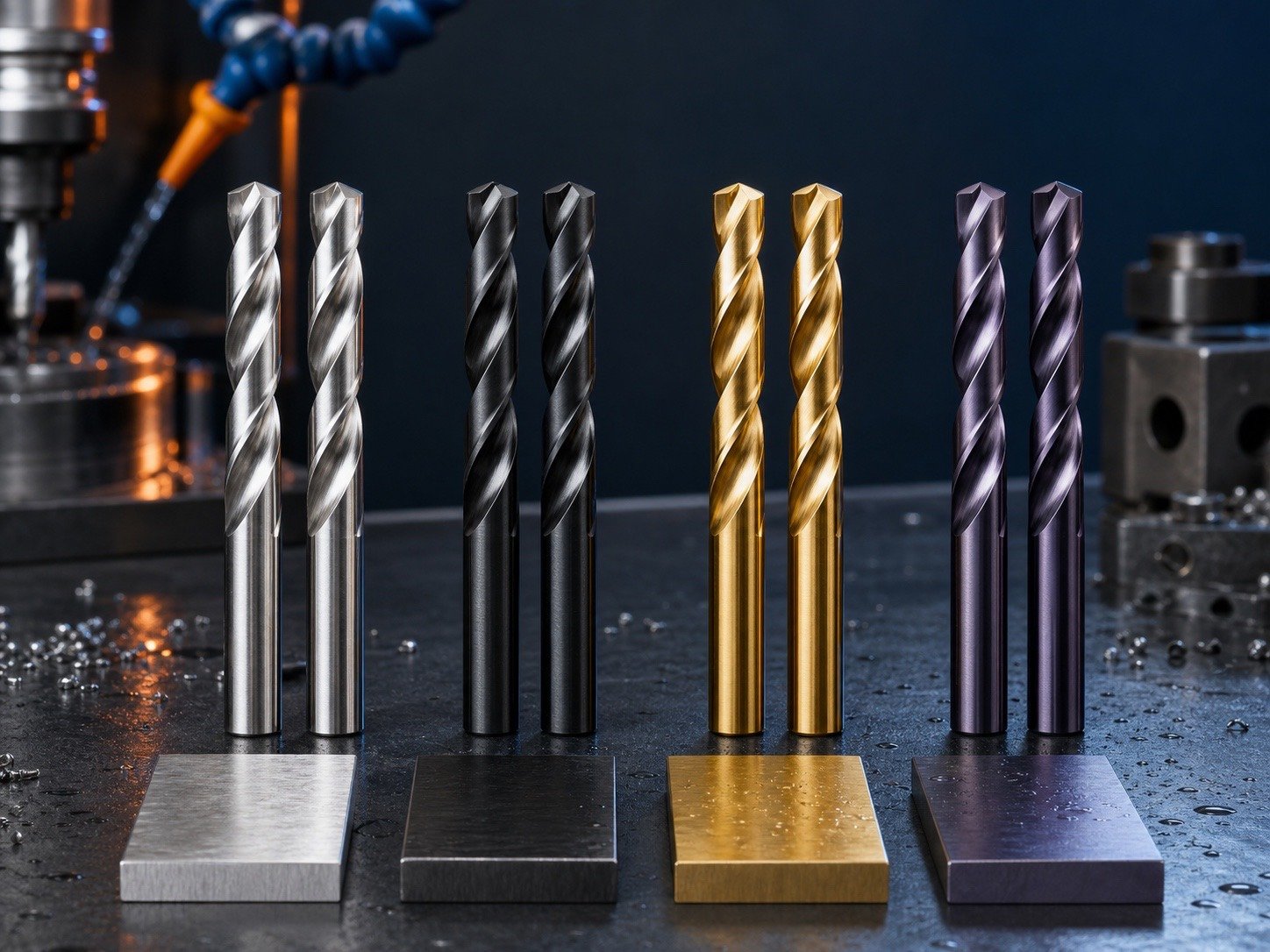
Quick coating selection
table
| Finish or coating | Typical strength | Practical limitation | Common starting use |
|---|---|---|---|
| Bright/uncoated | Sharp edge, easy inspection and regrinding | Lower hot hardness and wear protection | Aluminum, plastics, general low-volume work |
| Black oxide | Oil retention and modest corrosion protection | Not a high-performance hard coating | General ferrous drilling with lubricant |
| TiN | Lower friction, recognizable general-purpose PVD coating | Limited at very high temperature | Production HSS/cobalt in steels and mixed work |
| TiCN | Higher hardness and wear resistance than TiN | Can be less suitable for high-heat dry cutting | Abrasive steels with controlled coolant |
| TiAlN/AlTiN | Strong hot-hardness and oxidation resistance | Aluminum content can promote adhesion in aluminum work | Alloy steel, stainless and higher-temperature CNC work |
Start with the drill
substrate
Coating is thin; the drill body carries torque and supports the
cutting edge. HSS, M35 cobalt, M42 cobalt and carbide have different hot
hardness and toughness. Applying a premium PVD coating to a poorly
heat-treated drill creates a visually attractive tool that still bends,
wears or chips early.
| Substrate | Coating role | Buyer caution |
|---|---|---|
| HSS | Extends general wear life | Verify hardness and decarburization control |
| M35/M42 cobalt | Supports harder and hotter metal cutting | Confirm actual chemistry, not only surface color |
| Carbide | Adds heat/wear protection in rigid production | Edge preparation and coating adhesion are critical |
Bright finish drills
Bright drills are ground or polished without a dark conversion
finish. They can provide a sharp edge and smooth flute, which is useful
in aluminum and other materials prone to chip welding. Because there is
no dark coating to hide grinding marks, visual inspection is
straightforward.
Bright does not mean low quality. For aluminum, a polished uncoated
or purpose-coated flute may outperform a rough, dark drill by evacuating
chips more reliably.
Black oxide finish
Black oxide is a conversion finish rather than a thick wear-resistant
PVD layer. It can improve oil retention and corrosion resistance. It is
common on general-purpose HSS drills for ferrous materials. Its
performance still depends heavily on heat treatment, point grinding and
lubricant.
If a “black” drill has uneven color, heavy scale or soft edges, the
appearance may be masking process inconsistency. Confirm hardness and
trial-hole results.
TiN coating
Titanium nitride is a general-purpose gold-colored PVD coating. It
can reduce friction and improve wear resistance when adhesion and
thickness are controlled. TiN is widely used on HSS and cobalt drills
for steel production.
Gold color alone does not prove TiN. Decorative treatments can
resemble a functional coating. Ask for the coating process, thickness
target, adhesion method and batch certificate when performance
matters.
TiCN coating
Titanium carbonitride generally provides higher hardness and
abrasive-wear resistance than TiN. It can be useful for alloy steels and
difficult applications where edge temperature remains controlled.
Because it is not always the best choice for very hot dry cutting, the
coolant strategy must be considered.
TiAlN and AlTiN coatings
These aluminum-containing PVD coatings are designed for
higher-temperature cutting. They form a protective oxide layer during
use and are common on carbide and premium cobalt tools for alloy and
stainless steels.
They are not the first recommendation for aluminum workpieces because
aluminum-bearing coatings can have greater affinity with aluminum chips.
Polished flutes or aluminum-specific coatings are usually preferred.
Coating by workpiece
| Workpiece | Practical starting finish | Why |
|---|---|---|
| Aluminum extrusion/sheet | Bright polished or aluminum-specific | Reduce chip welding and built-up edge |
| Mild steel | Black oxide, TiN or bright with oil | Choose by volume and cost target |
| Stainless steel | TiAlN/AlTiN or suitable TiN on cobalt/carbide | Heat and wear control |
| Hardened steel | Application-specific coated carbide | Requires rigidity and verified hardness |
| Cast iron | Wear-resistant coating or carbide | Abrasive dust and interrupted structure |
| Plastic | Sharp bright edge | Avoid heat and melting |
Coolant and coating
compatibility
Coatings do not eliminate the need for a stable thermal strategy.
Intermittent coolant can thermally shock carbide. In stainless drilling,
insufficient flow may trap hot chips in the flute. In aluminum, coolant
should reduce adhesion without leaving a residue that disrupts the next
process.
Regrinding and recoating
Regrinding removes coating from the cutting faces. A reground drill
can still work, but it no longer has the original coated edge unless it
is stripped, prepared and recoated. For large or expensive tools,
recoating may be economical. For small commodity drills, replacement may
cost less than validated reconditioning.
| Tool | Typical reconditioning decision |
|---|---|
| Small HSS jobber drill | Replace or batch regrind if volume justifies it |
| Large cobalt drill | Regrind, inspect geometry, optionally recoat |
| Solid-carbide drill | Professional regrind and coating restoration |
Coating quality checks
Inspect color consistency only as a first step. More useful checks
include coating thickness, adhesion, edge buildup, pinholes, flaking
after trial drilling and wear pattern under magnification. Compare
coated and uncoated control samples using the same machine, holder,
workpiece batch, feed, speed and coolant.
Common purchasing mistakes
| Mistake | Consequence | Better specification |
|---|---|---|
| Buying by color | Decorative finish mistaken for PVD | State coating chemistry and process |
| Ignoring substrate | Coating fails with soft or brittle drill | Specify steel grade and hardness |
| One coating for every material | Adhesion, heat or wear problems | Define workpiece families |
| No edge-prep requirement | Variable chipping or high thrust | Approve edge geometry and sample holes |
RFQ checklist
Provide drill type and dimensions, substrate grade, coating
chemistry, target thickness if controlled, point and flute geometry,
workpiece material/hardness, hole depth, coolant method, machine type,
required tool life and packaging/marking. Request traceable samples
before a large order.
FAQ
Is gold always TiN?
No. Color is not proof of chemistry or coating performance. Use
supplier documentation and controlled testing.
Which coating is best for
aluminum?
Often a bright polished flute or an aluminum-specific low-adhesion
coating. Conventional TiAlN/AlTiN is usually not the first choice.
Can coated drills be
sharpened?
Yes, but sharpening removes coating at the cutting edge. Recoating
may be needed for original performance.
Is black oxide a hard
coating?
No. It is mainly a conversion finish for oil retention and corrosion
resistance, not a thick PVD wear layer.
ENGINEERING KNOWLEDGE
Related guide: Aluminum Drilling Problems: Chip Welding, Oversized Holes and Burrs covers practical checks for aluminum drilling chip welding.
Related guide: Drill Bit Coating Color Guide: Black Oxide, TiN, TiAlN and Bright Finish adds a practical buyer checklist for drill bit coating color guide.
Related Drill Bit Engineering Guides
Continue from product type into geometry, coating, hole quality, regrinding and deep-hole process control.