
Sharpening is valuable only when it restores the drill’s original
functional geometry. Grinding two visibly sharp faces is not enough: lip
length, point angle, relief, chisel position, web thickness and edge
condition all affect hole size and tool life. This guide explains when
professional regrinding is economical and how buyers should evaluate a
reconditioning service.
Regrind or replace: quick
decision
| Tool condition | Recommended action |
|---|---|
| Small commodity HSS drill, severe wear | Replace unless batch automation makes regrinding economical |
| Large HSS/M35/M42 drill, normal flank wear | Regrind and inspect |
| Solid-carbide drill with intact body | Professional regrind and, if needed, recoat |
| Chipped corner but damage within grind allowance | Evaluate regrind length and diameter change |
| Bent shank, cracked body or heavy heat checking | Scrap/replace |
| Worn coating only, geometry still good | Continue to limit or recoat if economics justify it |
What sharpening must restore
A functional regrind restores equal cutting lips, the specified point
angle, correct relief behind each lip, a centered chisel edge and smooth
cutting corners. Split points and four-facet points require dedicated
fixtures or CNC grinders.
| Feature | Why it matters |
|---|---|
| Equal lip length | Prevents oversize holes and one-sided wear |
| Point angle | Matches edge support and entry behavior |
| Lip relief | Prevents rubbing while supporting the edge |
| Chisel centering | Controls thrust and self-centering |
| Corner integrity | Avoids early chipping |
Inspect before grinding
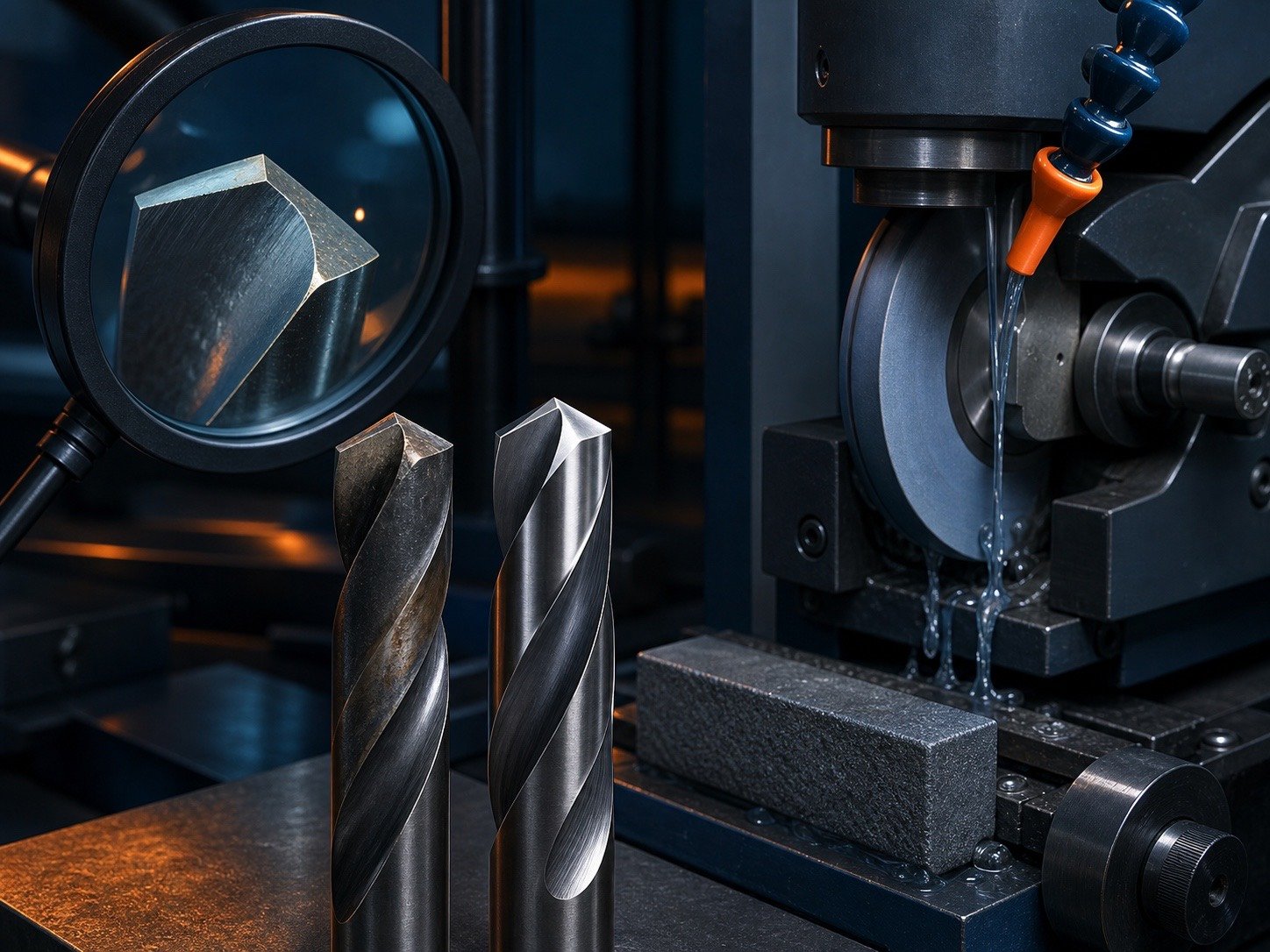
Clean the tool and examine it under magnification. Look for cracks,
burnt edges, plastic deformation, flute galling, margin wear, shank
damage and bending. Measure remaining flute length and verify that a
shorter reconditioned tool still fits the application.
HSS and cobalt drill
regrinding
HSS and cobalt drills are relatively tough and can often be reground
multiple times. Control grinding heat; overheating can temper the edge
and create a soft zone. Use the correct abrasive, wheel condition and
coolant practice. M42 is harder and may require a different wheel and
cycle than standard HSS.
Solid-carbide drill
regrinding
Carbide needs rigid precision grinding with a suitable diamond wheel.
Edge chipping, microcracks and flute damage must be assessed carefully.
A hand grinder is not appropriate for high-value carbide tools where
hole tolerance and repeatability matter.
| Substrate | Typical grinding control |
|---|---|
| HSS | Aluminum-oxide/appropriate wheel, heat control |
| Cobalt HSS | Sharper wheel and controlled heat |
| Carbide | Diamond grinding, rigid fixture, microscopic inspection |
Point angle, relief and lip
equality
After grinding, verify the point on an optical comparator or tool
presetter. Both lips should meet the drawing requirement. Excessive
relief makes the edge fragile; insufficient relief makes it rub. The
point may look symmetrical to the eye while still producing an oversize
hole.
Web thinning and
split-point restoration
Every regrind moves the point toward a thicker part of the web. If
the web is not thinned again, thrust rises with each sharpening. Restore
the original split-point or thinning style consistently, but do not
weaken the core beyond the approved geometry.
Coating after regrinding
Grinding removes coating from cutting faces. A reground coated drill
can still cut, but its performance may differ from a new tool. Recoating
involves cleaning or stripping, edge preparation, coating and final
inspection. Ensure coating buildup does not round a sharp edge or block
coolant holes.
| Option | Advantage | Limitation |
|---|---|---|
| Regrind only | Lowest reconditioning cost | Cutting edge becomes partly uncoated |
| Regrind + recoat | Closer to original wear protection | More cost and lead time |
| Replace | New geometry and full coating | Higher material cost for large tools |
Quality control after
sharpening
Measure point angle, lip length, chisel position, diameter and
runout. Inspect edges under magnification and verify coolant holes. Then
drill a reference workpiece using a recorded process and check hole
diameter, roundness, burr, surface and tool wear.
Common regrinding failures
| Symptom | Regrinding cause | Corrective action |
|---|---|---|
| Drill walks | Chisel off center or unequal lips | Regrind symmetrically |
| High thrust | Web not thinned, low relief | Restore point/web geometry |
| One corner chips | Unequal load or overheated edge | Inspect relief, runout and burn |
| Hole oversize | Lip inequality or body runout | Measure geometry and TIR |
| Short life after recoat | Poor edge prep or adhesion | Review coating cycle and edge radius |
Regrind economics
Compare the reconditioning cost with the value of the tool, number of
remaining regrinds, transport, sorting, downtime and risk of rejected
holes. The right metric is cost per acceptable hole, not regrind price
alone.
Service specification
and traceability
Tag each tool or batch with original part number, diameter, point
geometry, coating, number of prior regrinds and removal allowance.
Require before/after inspection records for critical tools. Keep mixed
customer batches separated.
Operator checklist
| Stage | Check |
|---|---|
| Before | Clean, inspect cracks, measure remaining length |
| Grind | Correct wheel, fixture, heat control and allowance |
| Geometry | Angle, relief, lips, chisel and web thinning |
| Finish | Edge condition, coating, coolant holes |
| Release | Runout and controlled sample holes |
FAQ
How many times can a
drill be sharpened?
It depends on flute length, web growth, damage and application. Track
actual material removal rather than using a universal number.
Can I sharpen a
split-point drill by hand?
It is difficult to restore a precise split point consistently by
hand. A fixture or CNC grinder is preferred for production tools.
Should a coated drill be
recoated?
For large or high-value tools, often yes if the economics and
performance justify it. Small tools may be cheaper to replace.
When must a drill be
scrapped?
Scrap drills with cracks, severe bending, damaged shanks, deep flute
damage or insufficient remaining geometry allowance.
ENGINEERING KNOWLEDGE
Related Drill Bit Engineering Guides
Continue from product type into geometry, coating, hole quality, regrinding and deep-hole process control.