
If you’ve ever tried drilling into stainless steel with a standard HSS bit, you already know the frustration: the bit skates on the surface, overheats within seconds, turns blue, and goes dull after just a few holes. Stainless steel fights back — hard.
After producing drill bits for over 30 years at our Hangzhou factory, we’ve shipped millions of bits specifically for stainless steel applications across Southeast and South Asia. We know which ones work, which ones don’t, and — most importantly — why. This guide will help you choose the right drill bit for stainless steel and use it correctly.
Why Stainless Steel Is Challenging to Drill
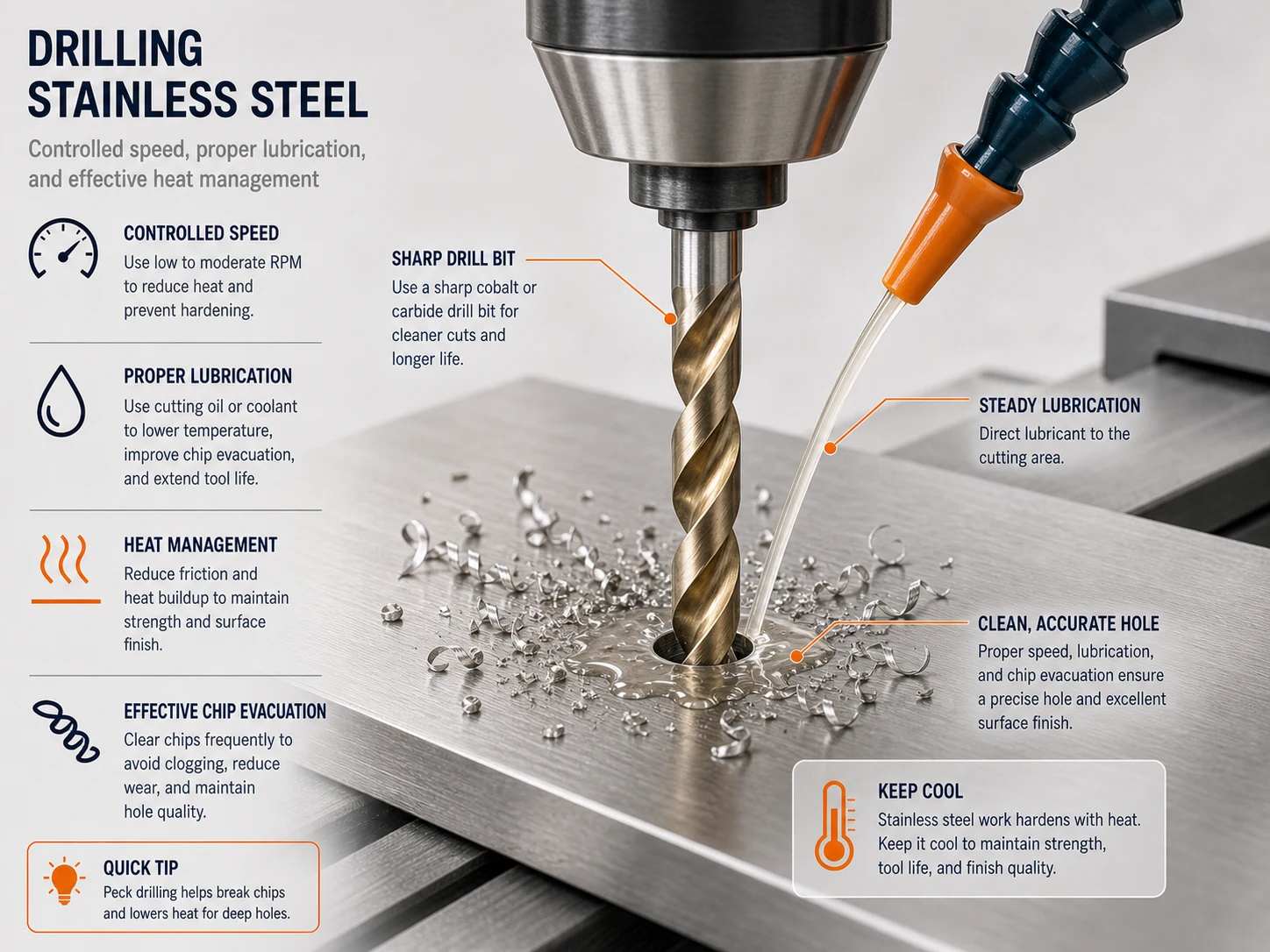
Stainless steel isn’t just hard — it’s work-hardening. That means the act of drilling actually makes the material harder at the cutting point. Here’s what happens physically:
- Work hardening: As the drill bit deforms the metal, the austenitic structure (in 304 and 316 stainless) strain-hardens. The surface hardness can increase by 15–20 HRC in the cut zone. Each revolution makes the next one harder.
- Poor thermal conductivity: Stainless steel conducts heat at roughly one-third the rate of carbon steel. The heat concentrates at the cutting edge instead of dissipating into the workpiece. Your drill bit essentially cooks itself.
- Toughness and ductility: Stainless chips don’t break cleanly — they string out and wrap around the bit, causing clogging and further heat buildup.
- Galling tendency: Stainless has a tendency to weld itself to the cutting edge under pressure and heat, especially with standard HSS bits.
This is why the wrong bit doesn’t just perform poorly — it gets destroyed quickly and can damage the workpiece in the process.
Best Drill Bit Types for Stainless Steel
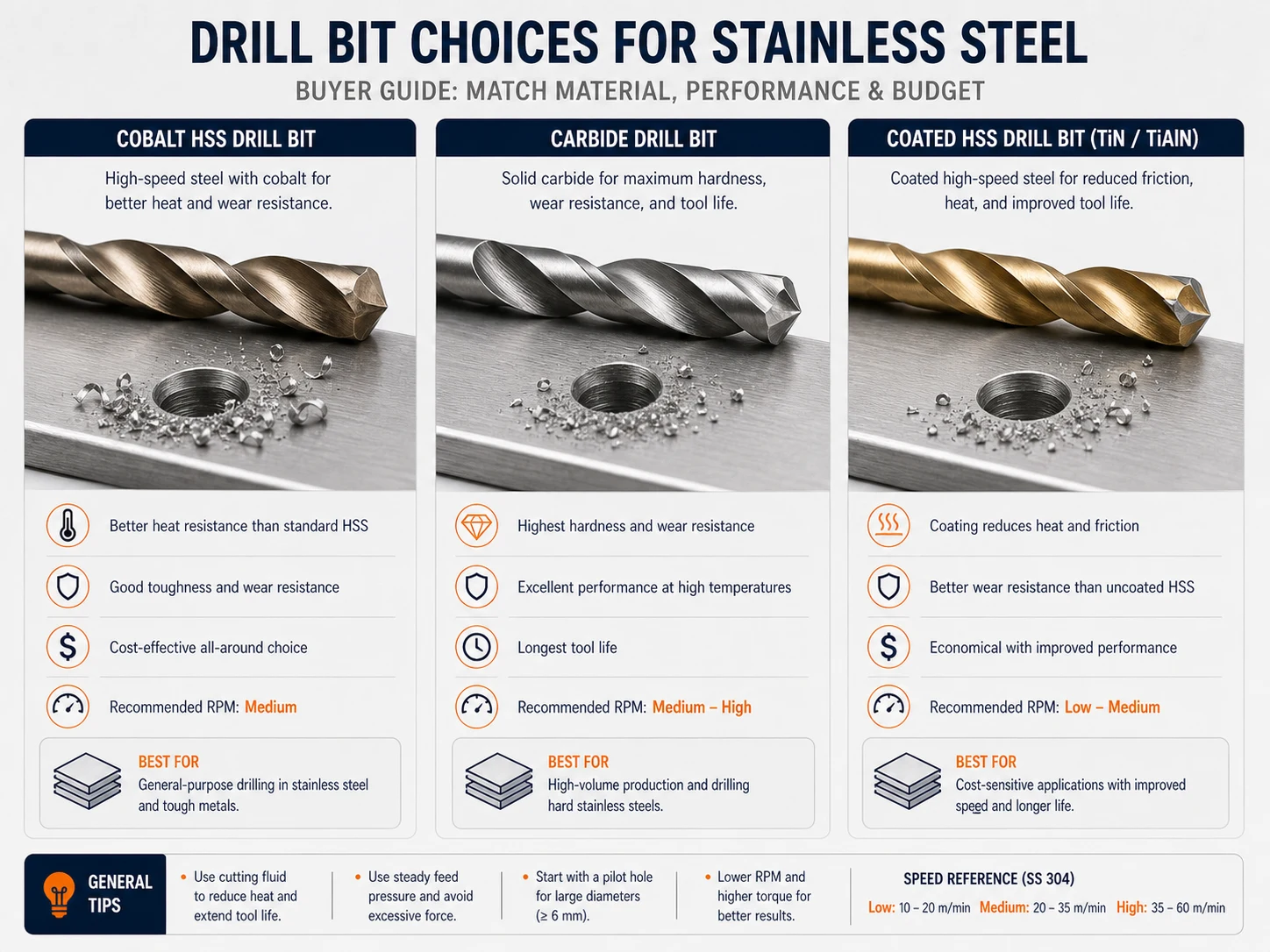
Not all “drill bits for metal” are equal when it comes to stainless. Here’s our ranking based on decades of production and customer feedback:
1. Cobalt M35 (5% Cobalt) — The Best All-Rounder
M35 cobalt bits contain 5% cobalt added to an HSS matrix, achieving a working hardness of HRC 65–67. The cobalt dramatically improves “red hardness” — the ability to maintain cutting hardness at temperatures up to 650°C.
This is our top recommendation for most stainless steel drilling. In our factory’s production output, M35 cobalt accounts for roughly 35% of all cobalt bit orders — and nearly all of those are specifically for stainless steel applications.
Best for: 304 stainless, 316 stainless, general-purpose stainless drilling in workshop and production environments.
2. Cobalt M42 (8% Cobalt) — The Premium Option
M42 pushes cobalt content to 8%, achieving HRC 67–69 and maintaining hardness up to 700°C+. It stays sharp longer in the most demanding stainless applications.
The trade-off is increased brittleness. M42 bits are more prone to snapping if you apply side pressure or use them in a handheld drill without proper technique. They also cost 40–60% more than M35.
Best for: Repeated production drilling in thick stainless, hardened stainless (above 30 HRC), and applications where bit changes are extremely costly.
3. Solid Carbide — Maximum Performance
Solid carbide drill bits offer the highest hardness (HRA 90+) and the best wear resistance for stainless steel. They run faster, last longer, and produce more accurate holes than any HSS-based option.
However, carbide is extremely brittle. It requires a rigid setup (drill press or CNC — never a handheld drill), stable clamping, and absolutely no vibration. Carbide bits also cost 3–5x more than cobalt.
Best for: CNC production drilling, high-volume stainless steel fabrication, precision hole requirements (±0.02mm).
What About Standard HSS?
Standard M2 HSS twist drill bits can technically drill stainless — but only a few holes before the cutting edge deforms. We’ve seen HSS bits blue and lose temper after as few as 3–5 holes in 5mm 304 stainless. They’re simply not designed for the heat and hardness. Don’t use them for stainless if you can avoid it.
Recommended Speeds and Feeds
Using the right speed is just as important as using the right bit. Too fast and you overheat; too slow and you work-harden the material. Here’s our reference chart based on real production data:
| Drill Bit Type | Bit Diameter | Speed (RPM) | Feed Rate | Cutting Fluid |
|---|---|---|---|---|
| Cobalt M35 | 3mm (1/8″) | 800–1200 | 0.04–0.08 mm/rev | Required |
| 6mm (1/4″) | 500–800 | 0.08–0.15 mm/rev | Required | |
| 10mm (3/8″) | 300–500 | 0.10–0.20 mm/rev | Required | |
| Cobalt M42 | 3mm (1/8″) | 1000–1500 | 0.05–0.10 mm/rev | Required |
| 6mm (1/4″) | 600–1000 | 0.08–0.15 mm/rev | Required | |
| 10mm (3/8″) | 350–600 | 0.12–0.22 mm/rev | Required | |
| Solid Carbide | 3mm (1/8″) | 2000–3500 | 0.05–0.10 mm/rev | Required (flood) |
| 6mm (1/4″) | 1200–2500 | 0.10–0.20 mm/rev | Required (flood) | |
| 10mm (3/8″) | 800–1500 | 0.15–0.25 mm/rev | Required (flood) |
Key rule: Always err on the slow side for speed and the heavy side for feed. Stainless steel punishes high speed + light feed — that’s the fastest way to work-harden the hole and destroy your bit.
Step-by-Step Drilling Guide for Stainless Steel
- Mark and center-punch the hole location. Stainless is slippery — a bit will skate across the surface without a pilot mark. Use a center punch to create a small indent. For precision work, use a spring-loaded center punch.
- Clamp the workpiece firmly. Never hold stainless steel by hand while drilling. The bit can grab and spin the workpiece — this is a safety hazard and it ruins your hole position. Use a vise or C-clamps.
- Apply cutting fluid BEFORE you start. Don’t wait until the bit gets hot. Apply a generous amount of cutting fluid (tapping fluid, sulfur-based oil, or even WD-40 as a minimum) to the drilling point before the bit touches the metal.
- Start slow and push firmly. Set your drill to the correct RPM (see the chart above). Apply steady, firm pressure. You want the bit to CUT the metal, not rub against it. Light pressure causes rubbing → heat → work hardening → bit destruction.
- Don’t stop mid-hole. If you pause while drilling through stainless, the material work-hardens at the pause point. When you resume, the bit hits hardened metal and can snag or break. Maintain steady pressure all the way through.
- Clear chips regularly. Stainless produces long, stringy chips that wrap around the bit. Every 2–3 seconds, back the bit out slightly to break the chip and allow cutting fluid into the hole.
- Reapply cutting fluid frequently. For holes deeper than 6mm, add fluid every few seconds. The deeper the hole, the less heat can escape and the more critical lubrication becomes.
- Deburr the exit side. Stainless almost always leaves a burr on the bottom of the hole. Use a countersink or deburring tool to clean it up.
Common Mistakes (From Our Factory’s Customer Feedback)
From our export team’s records: Over the years, we’ve tracked the most common problems reported by buyers who drill stainless steel. These mistakes account for 90% of the “my drill bit failed” complaints we receive:
- Running the bit too fast. This is the #1 mistake. Operators who are used to drilling mild steel carry over the same RPM. Stainless requires 40–60% slower speeds. When in doubt, slow down.
- Not using cutting fluid. We’ve had buyers claim their cobalt bits “went dull after 10 holes.” When we ask about cutting fluid, the answer is usually “we didn’t have any on hand.” Cobalt resists heat — it doesn’t eliminate it. Without fluid, even M42 will fail prematurely.
- Letting the bit rub instead of cut. Light feed pressure means the bit skids across the metal surface, generating friction without removing material. This work-hardens the surface and destroys the bit’s cutting edge.
- Using a handheld drill for production work. Handheld drills can’t deliver consistent pressure or speed. For anything beyond a few holes, use a drill press. Your bits will last 3–5x longer.
- Not clearing chips. Long stainless chips wrap around the bit, trap heat, and can score the hole wall. Peck drilling (backing out every 2–3 seconds) solves this.
Our Recommendation
For most buyers sourcing drill bits for stainless steel applications, here’s what we recommend:
- General workshop and maintenance: M35 cobalt drill bits. They offer the best balance of performance, durability, and price. Start with a set of the most common sizes (3mm, 4mm, 5mm, 6mm, 8mm, 10mm).
- Production drilling in stainless: M42 cobalt for manual and semi-automatic machines. Solid carbide for CNC applications. The higher upfront cost is recovered through longer tool life and fewer bit changes.
- For your customers who are professionals: Stock both M35 and M42. Professional users know the difference and will buy the grade that matches their specific application.
At our factory, we produce cobalt drill bits in both M35 and M42 grades across the full metric range (1mm–25mm) and fractional sizes. Every batch is hardness-tested and inspected for grinding accuracy before shipment. We accept trial orders from 100 pieces per specification — so you can test our bits on your actual stainless workpieces before committing.
Browse our complete drill bit product range, or contact our factory team for specifications, pricing, and lead times. We respond within 24 hours.
For heat-treated tool steel and hard alloy components, compare M35/M42 cobalt with solid carbide in our drill bit guide for hardened steel.
Compare entry behavior and edge support in our 118° vs 135° drill bit point-angle guide.
Match finish and PVD chemistry to the application with our drill bit coatings guide.
See how point, web, flute and margin design interact in our twist drill bit geometry guide.
For oversized or out-of-round holes, follow our drill runout measurement and correction guide.
For holes beyond normal flute evacuation limits, use our peck drilling and deep-hole coolant guide.
Frequently Asked Questions
Can I use a regular HSS drill bit on stainless steel?
Technically yes, but it’s not recommended. Standard M2 HSS bits will drill 3–5 holes in thin stainless before overheating, bluing, and losing their temper. For any volume of stainless drilling, you need at least M35 cobalt bits. The cost difference is small; the performance difference is enormous.
What is the best drill bit for 304 stainless steel?
M35 cobalt (5% Co) is the best all-around choice for 304 stainless. It provides sufficient heat resistance at a reasonable price. If you’re doing high-volume production drilling, step up to M42 cobalt or solid carbide for longer tool life.
Do I really need cutting fluid for stainless steel?
Yes. Stainless steel’s low thermal conductivity means heat builds up rapidly at the cutting edge. Cutting fluid serves three purposes: it reduces friction, carries away heat, and helps break chips. Without it, even premium cobalt bits will fail prematurely. For best results, use a sulfur-based cutting oil or a dedicated tapping fluid.
Why does my drill bit walk on stainless steel?
Stainless steel’s surface is hard and smooth, which causes drill bits to skate instead of bite. Always use a center punch to create a starting indentation. For precision work, use a spot drill or a short, rigid pilot bit to start the hole before switching to your full-size bit.
What speed should I drill stainless steel at?
As a general rule, use 40–60% of the speed you’d use for mild steel. For a 6mm cobalt bit in 304 stainless: 500–800 RPM on a drill press, 400–600 RPM with a handheld drill. When in doubt, slow down. Speed kills drill bits in stainless — slow and firm is the winning formula.