
Every buyer sourcing drill bits faces this question: should I stock carbide or HSS? The answer isn’t one or the other — it’s understanding when each material wins, what the real cost difference looks like over time, and how to build a mixed inventory that serves your customers best.
Our factory in Hangzhou produces both carbide and HSS drill bits across dozens of specifications. We’ve shipped both types to markets worldwide, and we’ve seen how buyers make — and sometimes waste — money on the wrong choice. This guide breaks down the decision from a factory perspective.
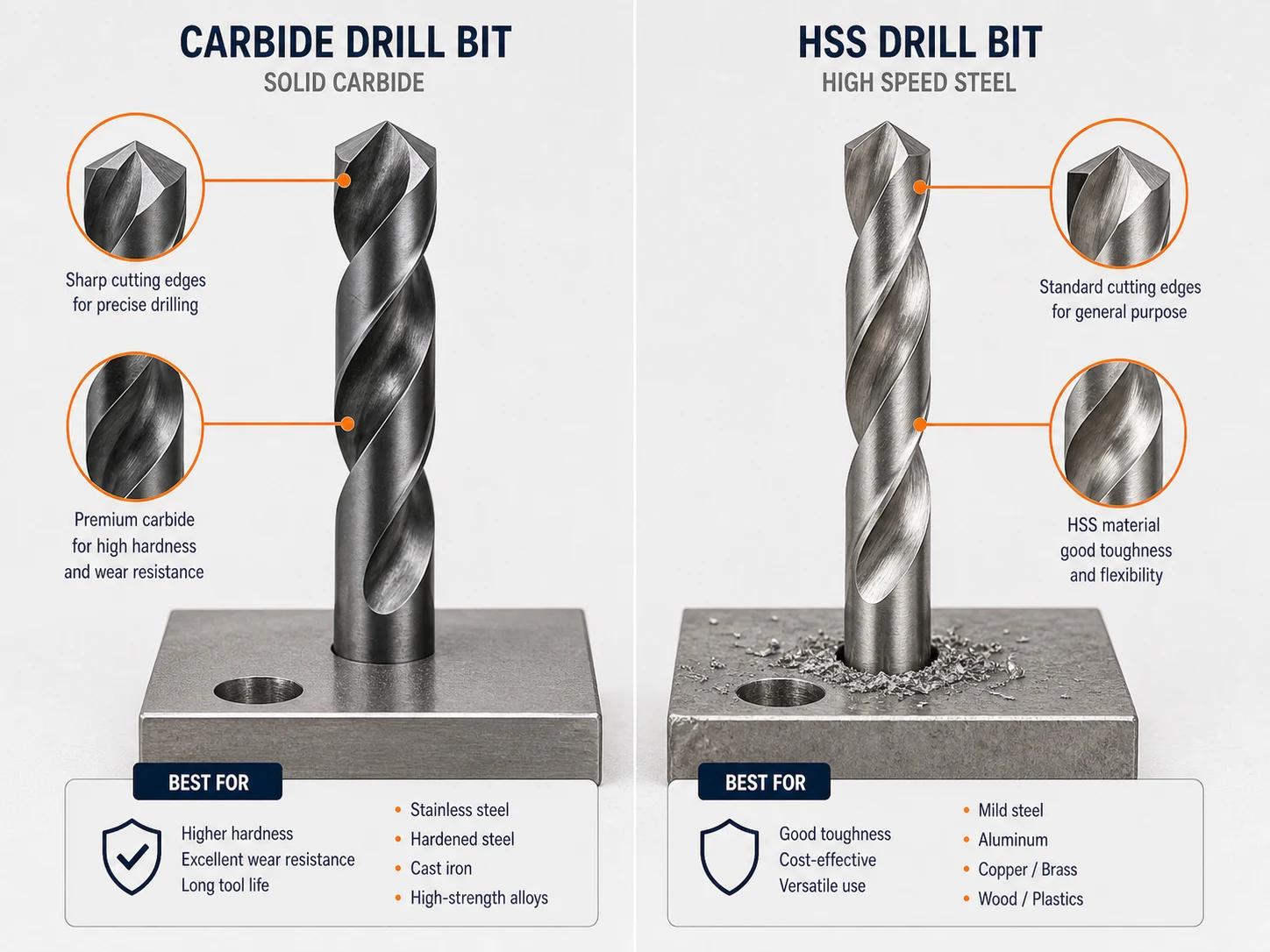
Material Composition: What’s Actually in the Bit?
HSS (High-Speed Steel)
HSS drill bits are made from tool steel alloys containing tungsten, molybdenum, chromium, and vanadium. The most common grades are:
- M2 HSS: The standard. Contains 6% tungsten, 5% molybdenum, 4% chromium, 2% vanadium. Working hardness HRC 63–65. Good general-purpose performance.
- M35 HSS (5% Cobalt): M2 with 5% cobalt added. Working hardness HRC 65–67. Better red hardness — maintains cutting ability at higher temperatures.
- M42 HSS (8% Cobalt): Higher cobalt content (8%) plus higher vanadium. Working hardness HRC 67–69. Maximum heat resistance among HSS grades.
The cobalt in M35 and M42 isn’t just marketing — it fundamentally changes how the steel behaves under heat. Standard M2 starts losing hardness around 550°C. M35 holds up to 650°C. M42 maintains performance to 700°C+.
Solid Carbide
“Carbide” in drill bits means tungsten carbide (WC) — a ceramic-metal composite made of tungsten carbide particles (typically 88–94%) bonded together with cobalt (6–12%). The result:
- Hardness: HRA 90–92 (equivalent to HRC 75+). Far harder than any HSS grade.
- Wear resistance: 10–20× better than HSS in abrasive materials.
- Heat resistance: Carbide maintains hardness up to 1,000°C. It doesn’t “red harden” — it just stays hard.
- Brittleness: This is the trade-off. Carbide has much lower toughness than HSS. It chips and cracks under impact, vibration, or side loading.
Performance Comparison
| Property | M2 HSS | M35 HSS (5% Co) | M42 HSS (8% Co) | Solid Carbide |
|---|---|---|---|---|
| Hardness (HRC) | 63–65 | 65–67 | 67–69 | 75+ (HRA 90+) |
| Red hardness limit | ~550°C | ~650°C | ~700°C | ~1,000°C |
| Toughness | High | Good | Moderate | Low |
| Wear resistance | Standard | 1.5–2× M2 | 2–3× M2 | 10–20× M2 |
| Best speed (vs M2) | 1.0× | 1.2–1.4× | 1.4–1.6× | 3–5× |
| Can resharpen? | Yes, easily | Yes, easily | Yes, with care | Yes, diamond wheel |
| Relative price | 1.0× | 1.5–2.0× | 2.5–3.5× | 5–10× |
Cost Analysis: Price Per Hole, Not Price Per Bit
This is where most buyers make their mistake. They look at the unit price and choose HSS because it’s cheaper. But the right metric is cost per hole drilled.
Here’s a real-world example from our production data, drilling 304 stainless steel with a 6mm bit:
- M2 HSS: $0.50 per bit, drills 10–15 holes → $0.033–$0.050 per hole
- M35 Cobalt: $0.90 per bit, drills 40–60 holes → $0.015–$0.023 per hole
- M42 Cobalt: $1.60 per bit, drills 80–120 holes → $0.013–$0.020 per hole
- Solid Carbide: $4.50 per bit, drills 500–800 holes → $0.006–$0.009 per hole
In stainless steel, carbide is actually the cheapest option per hole — by a wide margin. The upfront cost is higher, but the total cost of ownership is lower for high-volume applications.
However, in mild steel or wood, the math changes:
- Mild steel: M2 HSS already drills 200+ holes. The extra life of carbide doesn’t justify the 10× price premium unless you’re running a CNC center with automated tool changes.
- Wood / plastic: M2 HSS is typically the best value. Carbide offers no meaningful advantage in soft materials and is more likely to chip if it hits a nail or knot.
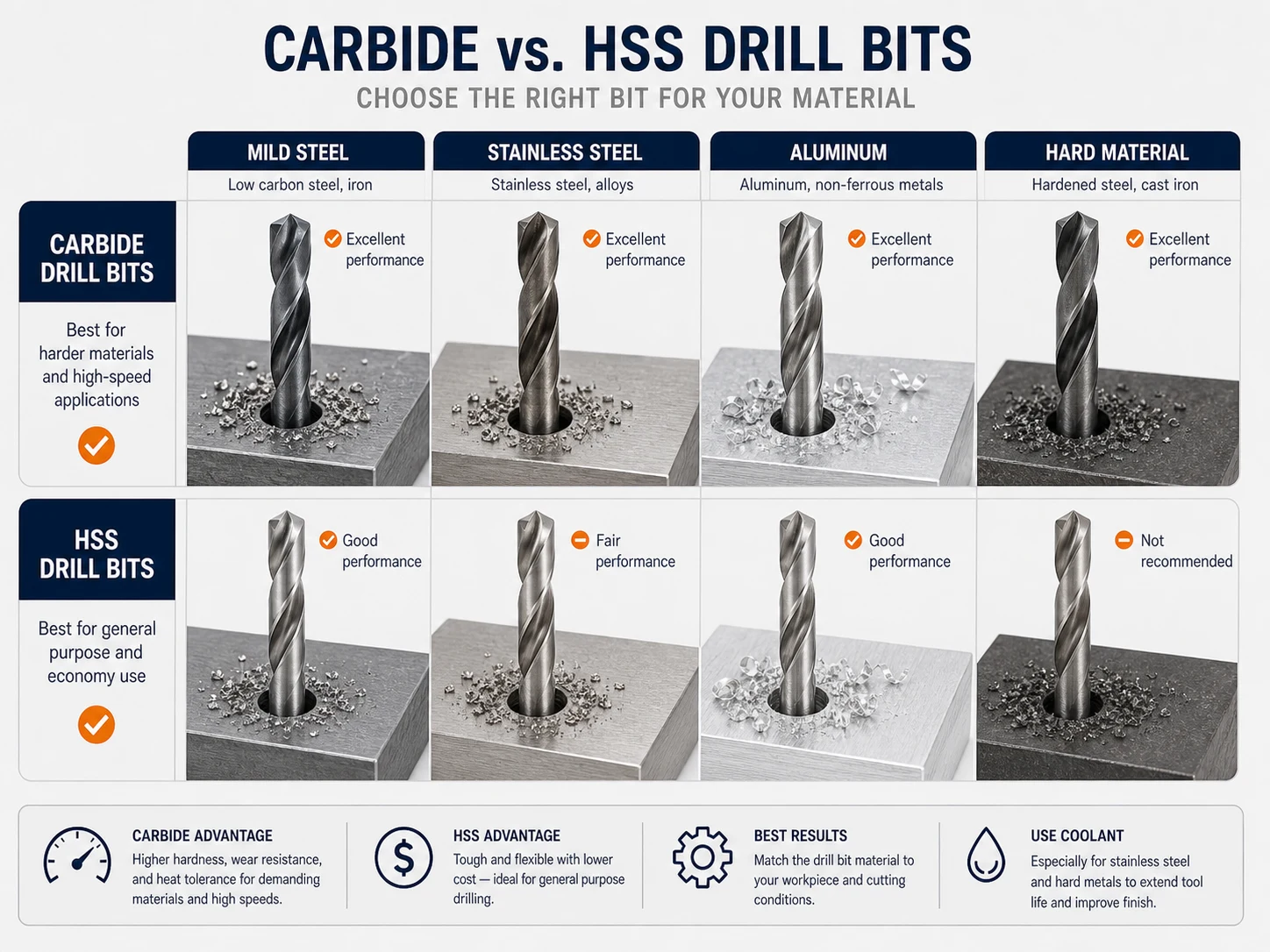
Application Recommendations
When to Choose HSS
- General-purpose workshop use: Wood, plastic, mild steel, aluminum. M2 HSS handles all of these at the best price point.
- Handheld drilling: Cordless drills and handheld electric drills generate vibration and side loads. HSS tolerates this; carbide breaks.
- Applications where bits are frequently lost or damaged: Construction sites, schools, rental shops. The lower replacement cost matters more than maximum tool life.
- Users who resharpen their own bits: HSS resharpening is straightforward on a standard tool grinder. Carbide requires diamond wheels and specialized equipment.
When to Choose Carbide
- Hardened steel (>45 HRC): Carbide is one of the few materials that can cut hardened tool steel and heat-treated alloys.
- Stainless steel production: For CNC or production drilling in 304/316 stainless, carbide runs faster and lasts longer than any HSS option.
- Cast iron: The abrasive nature of cast iron wears HSS quickly. Carbide handles it well.
- Fiberglass and composites: Abrasive materials that destroy HSS. Carbide is the standard choice.
- Titanium and superalloys: These materials work-harden rapidly and demand carbide or coated carbide.
- CNC production with rigid setups: Carbide requires stable, vibration-free machining. If you have a CNC machining center with through-coolant and rigid workholding, carbide will outperform HSS dramatically.
For stainless steel drilling guidance, see our detailed article on what drill bit to use for stainless steel.
The Mixed Inventory Strategy (What Our Best Customers Do)
Our most successful distributor customers don’t choose carbide OR HSS — they stock both, in the right ratios. Here’s a typical inventory split that works:
| Product Line | Recommended Mix | Sizes to Stock | Target Customer |
|---|---|---|---|
| M2 HSS twist drills | 50% of inventory value | 1–13mm full range | General workshops, DIY, construction |
| M35 Cobalt drills | 25% of inventory value | 3–10mm (most popular sizes) | Stainless steel workshops, professional users |
| M42 Cobalt drills | 10% of inventory value | 3–10mm | High-end professionals, production shops |
| Solid carbide drills | 15% of inventory value | 3–12mm (common CNC sizes) | CNC shops, aerospace, medical manufacturing |
This 50/25/10/15 split covers the full customer spectrum from hobbyists to industrial users. It also maximizes your inventory turns — HSS moves fastest, carbide has the highest margin per unit.
From our sales data: A distributor in India who adopted this mixed strategy increased his drill bit revenue by 35% in the first year. The key insight: his previous all-HSS inventory was losing high-end customers to competitors who stocked cobalt and carbide. By adding the premium lines, he captured customers at every price point.
View our carbide drill bit product range and HSS twist drill bit collection for full specifications and pricing.
Frequently Asked Questions
Is carbide always better than HSS?
No. Carbide is harder and more wear-resistant, but it’s also more brittle and significantly more expensive. For general-purpose drilling in wood, plastic, and mild steel, HSS (especially M35 cobalt) offers the best value. Carbide shines in hardened materials, stainless steel production, and CNC applications where tool life directly impacts profitability.
Can I use carbide bits in a handheld drill?
We don’t recommend it. Carbide is brittle and requires a rigid, vibration-free setup. Handheld drills generate side loads and chatter that will chip or snap carbide bits. Use carbide only in drill presses, milling machines, or CNC centers with stable workholding and controlled feed rates.
How many times can a carbide drill bit be resharpened?
A quality solid carbide drill bit can be resharpened 3–5 times if done correctly on a diamond wheel. However, each resharpening shortens the overall length and changes the point geometry slightly. For precision applications, most shops retire carbide bits after 2–3 resharpenings. HSS bits can be resharpened 5–10+ times on standard equipment.
What’s the price difference between M2, M35, and M42?
As a rough factory-direct guide: M35 costs 1.5–2× M2. M42 costs 2.5–3.5× M2. Solid carbide costs 5–10× M2, depending on diameter and geometry. These ratios hold fairly steady across sizes. The value proposition improves with diameter — a 12mm M42 bit is only 2× an M2, while a 3mm M42 might be 3.5× due to manufacturing complexity.
Which grade should I stock if I can only choose one?
For a general hardware or tooling distributor: M2 HSS in the full size range (1–13mm) plus M35 cobalt in the most common sizes (3, 4, 5, 6, 8, 10mm). This covers 90% of customer needs. Add carbide later once you understand your market’s demand for high-performance drilling.
Get full specifications for HSS, carbide, SDS, and step drill bits.
Download PDF Catalog