
Furniture manufacturing demands precision cuts — clean edges on MDF panels, chip-free finishes on laminated boards, and smooth crosscuts on hardwood. The wrong saw blade turns a $200 sheet of material into scrap, slows your production line, and creates rework that eats into your margins.
We’ve been producing TCT saw blades in our Hangzhou factory since 1994, and furniture manufacturers — particularly in Southeast and South Asia — are among our longest-standing clients. This buying guide distills what we’ve learned about matching blade specifications to furniture production needs.
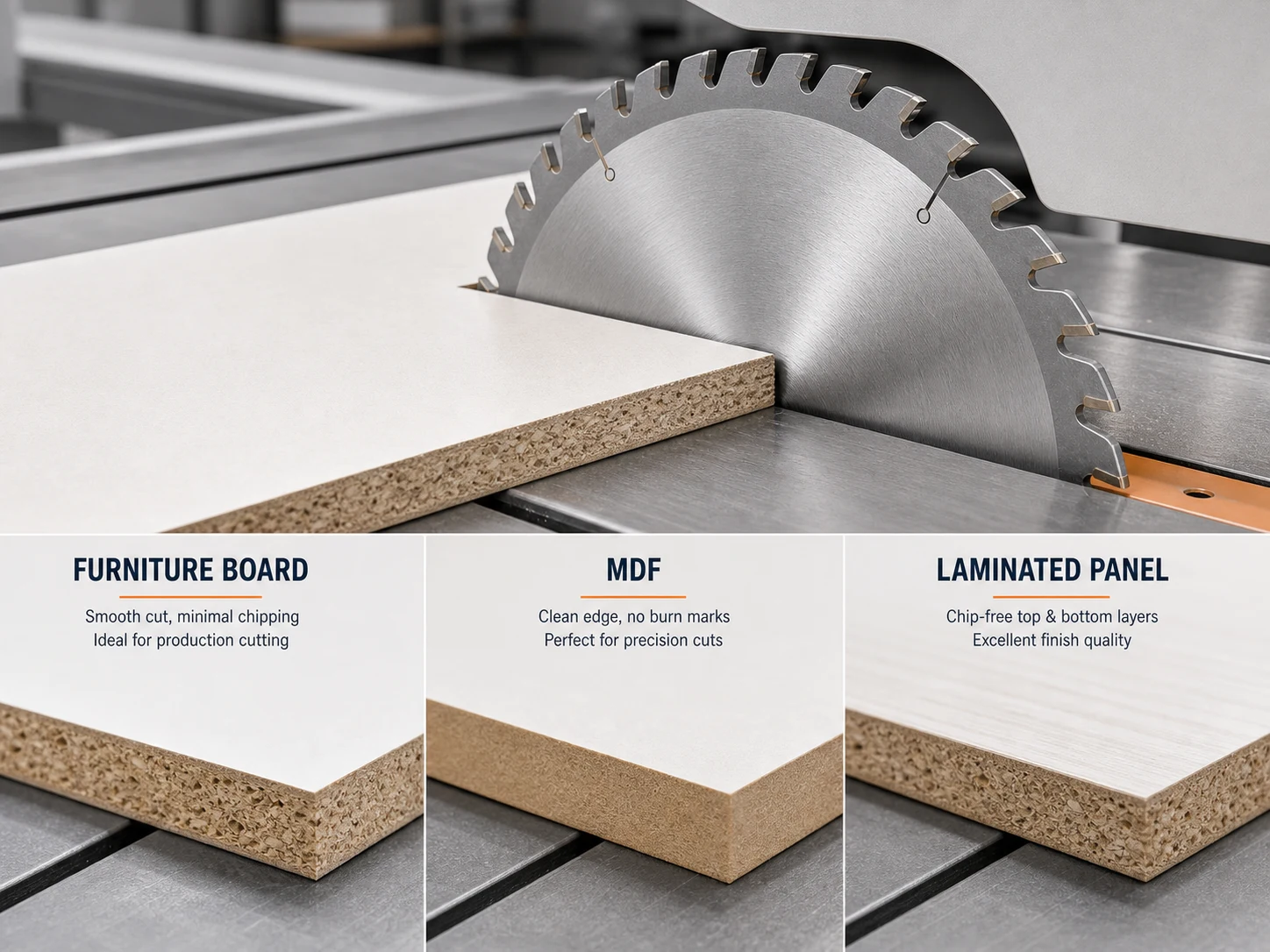
Why Choosing the Right Blade Matters for Furniture Production
In furniture manufacturing, the saw blade isn’t just a consumable — it’s a quality gate. Here’s what the wrong blade costs you:
- Material waste: Chipping on laminated panels means the piece goes to scrap. On a CNC nesting machine processing 50+ sheets per day, even a 2% reject rate adds up to thousands of dollars monthly.
- Secondary operations: Rough cuts need sanding, edge banding adjustments, or manual finishing — each one adding labor cost and production time.
- Downtime: A blade that dulls quickly requires more frequent changes. On a beam saw or sliding table saw, each blade change costs 15–20 minutes of production time.
- Machine wear: A dull blade forces the motor to work harder, accelerating bearing wear and reducing machine life.
The right blade pays for itself many times over in reduced waste, fewer changeovers, and better product quality.
Understanding TCT Saw Blade Specifications
Before you can choose the right blade, you need to understand how each specification affects cutting performance:
Tooth Count (Number of Teeth)
Tooth count is the single most important specification for furniture work:
- Fewer teeth (e.g., 40T on a 250mm blade): Larger gullets between teeth carry more chips. Cuts faster but leaves a rougher finish. Best for ripping solid wood.
- More teeth (e.g., 80T–120T on a 300mm blade): Smaller, more frequent cuts. Slower feed rate but significantly cleaner finish. Essential for laminated panels and MDF where chipping is unacceptable.
- Rule of thumb: For every material, there’s a tooth count range that delivers acceptable cut quality without sacrificing feed speed. Going above that range wastes money on unnecessary tooth count; going below costs you in finish quality.
Diameter
The blade diameter must match your machine’s arbor size and cutting depth requirement:
| Diameter | Typical Machine | Max Cutting Depth | Common Bore |
|---|---|---|---|
| 190mm | Portable circular saw | ~60mm | Φ20, Φ25.4 |
| 230mm | Sliding table saw (compact) | ~75mm | Φ30 |
| 254mm (10″) | Sliding table saw | ~85mm | Φ30 |
| 300mm (12″) | Sliding table saw, beam saw | ~105mm | Φ30 |
| 350mm | Beam saw, panel saw | ~120mm | Φ30 |
| 400mm | Large beam saw | ~140mm | Φ30, Φ50 |
Bore Size (Arbor Hole)
The bore must match your machine’s arbor exactly. Common sizes: Φ20mm, Φ25.4mm (1 inch), Φ30mm, Φ50mm. If your machine has a Φ30 arbor, don’t use a Φ25.4 blade with a reducer ring — it creates runout and vibration that degrades cut quality. Custom bore sizes are available from our factory with MOQ from 100 pieces.
Kerf Width (Saw Line Thickness)
Kerf width affects both material yield and cutting stability:
- Thin kerf (≈1.5–2.0mm): Less material waste — important when cutting expensive hardwoods or optimizing panel nesting. Requires more stable machine setup; thin-plate blades flex more.
- Standard kerf (≈2.5–3.5mm): More stable, less vibration, easier on the machine. The default for most furniture production.
- Impact on CNC nesting: On a CNC router processing 50 sheets of 18mm MDF per day, switching from a 3.2mm kerf blade to a 2.2mm thin-kerf blade can save 3–5% in material. That’s real money at scale.
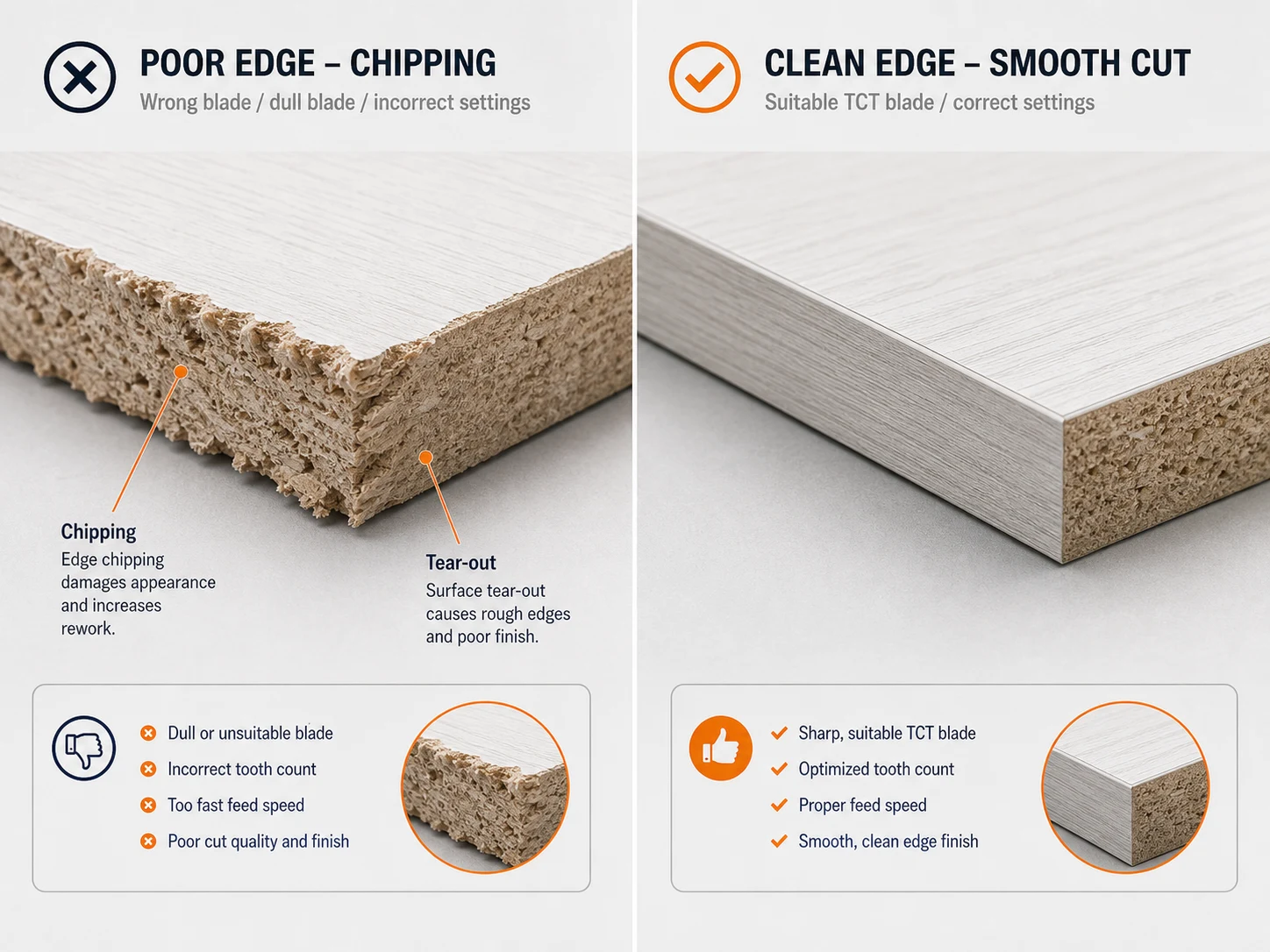
Blade Selection by Material
This is the section furniture manufacturers ask for most often. Here are our recommendations based on 30+ years of production and feedback from furniture factories across Asia:
| Material | Typical Blade | Tooth Count (300mm) | Tooth Configuration | Key Requirement |
|---|---|---|---|---|
| Solid Wood (hardwood) | 250–300mm | 40T–60T | ATB | Clean crosscut, minimal tear-out |
| Solid Wood (softwood) | 250–300mm | 40T–60T | ATB or ATB+R | Smooth finish, fast feed |
| MDF | 254–300mm | 80T–120T | ATB or TCG | Chip-free edges, no fuzzing |
| Particle Board | 254–300mm | 60T–80T | TCG | Resist abrasion, clean edges |
| Plywood / Multi-ply | 254–300mm | 60T–80T | ATB or TCG | No delamination at plies |
| Laminated / Melamine Board | 254–300mm | 80T–120T | TCG (high ATB) | Zero chipping on both sides |
Tooth configuration key: ATB = Alternate Top Bevel (general-purpose, clean cuts in wood). TCG = Triple Chip Grind (for abrasive materials — MDF, particle board, laminates). ATB+R = ATB with raker tooth (rip + crosscut combination).
Quality Grade Guide
Not all TCT saw blades are created equal — even with the same specs on paper. Our factory produces blades across multiple quality tiers, and we always tell furniture manufacturers: invest in at least the J grade or above.
| Grade | Steel Body | Carbide Tip | Tolerance | Recommended For |
|---|---|---|---|---|
| P (Premium Export) | 75Cr1 | YG6X / K20 | Runout ≤0.05mm | Industrial furniture lines, CNC machines |
| B (Standard Export) | 75Cr1 / 50# | YG6A / K30 | Runout ≤0.08mm | Furniture workshops, mid-scale production |
| J (Professional) | 50# | YG6A / K30 | Runout ≤0.10mm | General furniture production, recommended minimum |
| Z (Standard) | 50# | YG8 / K40 | Runout ≤0.12mm | Construction, rough cutting |
| G / C (Economy) | 50# | YG8 / K40 | Runout ≤0.15mm | Price-sensitive markets, non-critical cuts |
For furniture production, we recommend J grade or above for two reasons: (1) the tighter runout tolerance means cleaner cuts and less post-processing, and (2) the YG6A carbide tips hold their edge significantly longer in MDF and particle board — both of which are highly abrasive and wear down YG8 tips quickly.
A furniture factory switching from Z grade to B grade typically sees 40–60% longer blade life and a noticeable reduction in edge chipping on laminated panels. The price difference is typically 15–25% — it pays for itself within the first few production runs.
How to Extend Blade Life
Blade life in furniture production depends as much on how you use and maintain the blade as on the blade itself. Here are the practices our longest-running furniture clients follow:
- Clean the blade regularly. Resin buildup from MDF and particle board increases friction and heat. Clean blades every 4–8 hours of cutting time using a dedicated blade cleaning solution or warm soapy water with a brass brush.
- Use the correct feed rate. Pushing too slowly burns the tips; pushing too fast overloads them. Match your feed rate to the tooth count and material — more teeth means slower feed for the same RPM.
- Keep the blade sharp. Don’t run a blade until it’s obviously dull — by then, you’ve already damaged the carbide tips excessively. Sharpen at the first sign of declining cut quality. A properly resharpened blade can be restored 3–5 times before replacement.
- Use blade stiffeners. On sliding table saws and beam saws, flange collars (stiffeners) reduce vibration and improve cut quality. They’re especially important for thin-kerf blades.
- Store blades properly. Hang blades on a peg or store them flat with cardboard separators. Don’t stack them directly against each other — the carbide tips will chip.
From our clients: A furniture manufacturer in Vietnam told us that simply cleaning his 300mm 96T blades every shift (instead of every few days) extended blade life from approximately 80,000 linear meters to 120,000 linear meters of MDF cutting — a 50% improvement from a 5-minute maintenance routine.
Case Study: Southeast Asian Furniture Factory
In 2019, a mid-size furniture manufacturer in Southeast Asia contacted us about persistent chipping issues on their melamine-faced panels. They were using locally sourced 300mm blades with 80T ATB configuration.
We reviewed their setup and recommended three changes:
- Switch to TCG tooth configuration. ATB teeth tend to chip the bottom surface of melamine boards because the alternating bevel acts like a chisel. TCG (triple chip grind) has a flat-topped raker tooth that scores the surface before the chamfered teeth remove material — dramatically reducing chipping.
- Increase to 96T. More teeth means each tooth takes a smaller bite, reducing the force that causes chipping. The feed rate decrease was minimal (about 10%) but the chipping rate dropped by over 80%.
- Upgrade to B grade. The tighter runout tolerance (≤0.08mm vs their previous ≤0.15mm) meant less vibration during the cut, which further reduced chipping.
The result: their panel rejection rate dropped from 4.2% to under 0.5%, saving approximately $3,500 per month in material waste. The upgraded blades cost about 20% more per piece, but the total cost of ownership dropped significantly.
They’ve been ordering from us consistently since then — now including both TCT saw blades and drill bits from our expanded product line.
How to Order Custom Specifications
Every furniture factory has slightly different needs — different machines, different materials, different quality expectations. Custom blades are our specialty:
- Custom bore sizes: Non-standard arbor holes are available. We’ve produced blades with bores from Φ15mm to Φ60mm.
- Custom tooth configurations: If you need a specific grind that’s not in our standard catalog, our engineers can design and produce it.
- Custom carbide grades: For specialized applications, we can source specific carbide grades — including European-imported tips for premium orders.
- OEM branding: Laser engraving, custom printing, and branded packaging are available with no minimum order surcharge for orders above 500 pieces.
- MOQ: Trial orders from 100 pieces per specification. Standard production orders from 500 pieces.
The process is straightforward: send us your specifications (diameter, bore, tooth count, material to be cut, machine type), and we’ll recommend the optimal configuration. We respond within 24 hours with a detailed quotation including material specs and expected lead time.
Visit our product catalog for our standard range, or contact us directly for custom specifications.
Frequently Asked Questions
What is the best TCT saw blade for cutting MDF?
For MDF, use a 300mm blade with 96T–120T in TCG (Triple Chip Grind) configuration. MDF is highly abrasive, so choose at least YG6A (K30) carbide tips. TCG tooth geometry scores the surface cleanly and resists the abrasive nature of MDF better than ATB. Our B grade with YG6A tips is the most popular choice for MDF furniture production.
How many teeth should a saw blade have for furniture making?
It depends on the material. For solid wood crosscutting: 60T–80T on a 300mm blade. For MDF and particle board: 80T–120T. For melamine/laminated panels: 96T–120T with TCG grind. More teeth produce cleaner cuts but require slower feed rates. When in doubt, choose more teeth for furniture — cut quality matters more than speed.
What is the difference between ATB and TCG tooth configurations?
ATB (Alternate Top Bevel) has alternating left-right angled teeth that slice cleanly through wood fibers. Best for solid wood and plywood. TCG (Triple Chip Grind) alternates between a flat-topped raker tooth and a chamfered tooth. The raker scores the surface first, preventing chipping. Best for MDF, particle board, laminates, and other abrasive or coated materials.
How long does a TCT saw blade last in furniture production?
It varies significantly by material and grade. As a rough guide: in MDF cutting, a B-grade 300mm 96T blade typically lasts 80,000–150,000 linear meters before needing resharpening. In solid hardwood, expect 30,000–60,000 meters. Proper cleaning and maintenance can extend this by 30–50%. A blade can typically be resharpened 3–5 times before replacement.
Can I use the same blade for solid wood and MDF?
You can, but it’s not optimal. Solid wood benefits from ATB teeth (cleaner crosscut), while MDF performs best with TCG teeth (less chipping, better wear resistance). If you must use one blade for both, choose an 80T ATB blade as a compromise — it will do an acceptable job on both materials but won’t excel at either. For serious furniture production, dedicated blades per material type is the professional approach.
What is the minimum order quantity for custom TCT saw blades?
Our MOQ for custom specifications is 100 pieces per specification for trial orders, and 500 pieces for standard production orders. We accept small trial orders because we believe in letting the product prove itself before you commit to larger volumes. Contact us with your specifications and we’ll provide a quotation within 24 hours.
Get full specifications, quality grades, and OEM options.
Download PDF Catalog