
If you work with power tools or industrial cutting equipment, you’ve encountered TCT saw blades. They’re the most widely used blade type in professional woodworking, metal fabrication, and construction — but what exactly does “TCT” mean, and why are these blades so dominant?
At our Hangzhou factory, TCT saw blades have been our core product since 1994. We produce over 500,000 blades annually across five quality grades for markets worldwide. This guide explains what TCT saw blades are, how they’re constructed, and how to choose the right one for your application.
What Does TCT Mean?
TCT stands for Tungsten Carbide Tipped. A TCT saw blade consists of a steel body (the plate) with small pieces of tungsten carbide brazed onto the tips of the teeth. The carbide tips do the cutting; the steel body provides the structural support and vibration damping.
This combination gives TCT blades a unique advantage: the cutting edges are extremely hard and wear-resistant (thanks to the carbide), while the blade body remains tough and flexible (thanks to the steel). It’s the best of both materials in one tool.
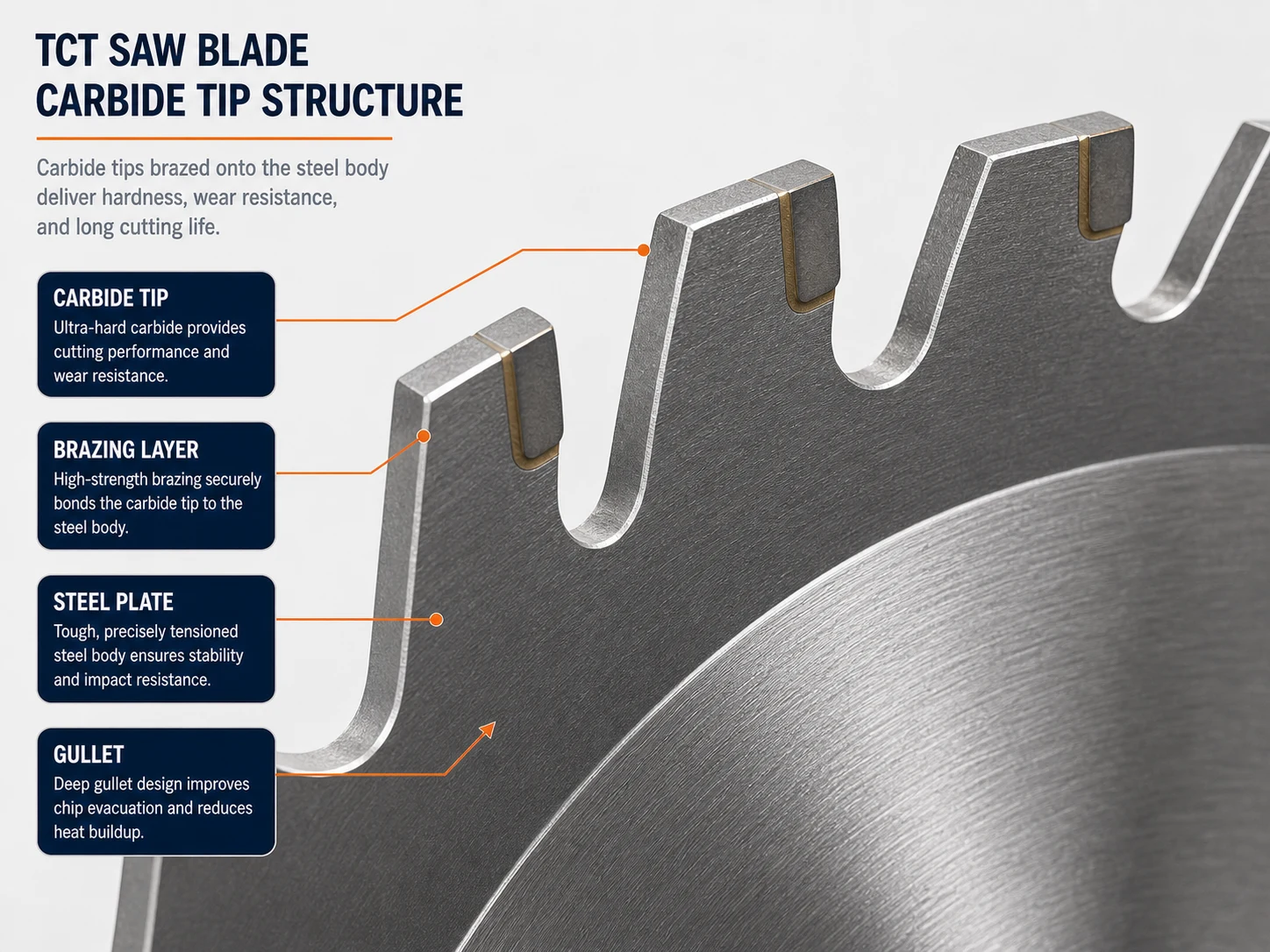
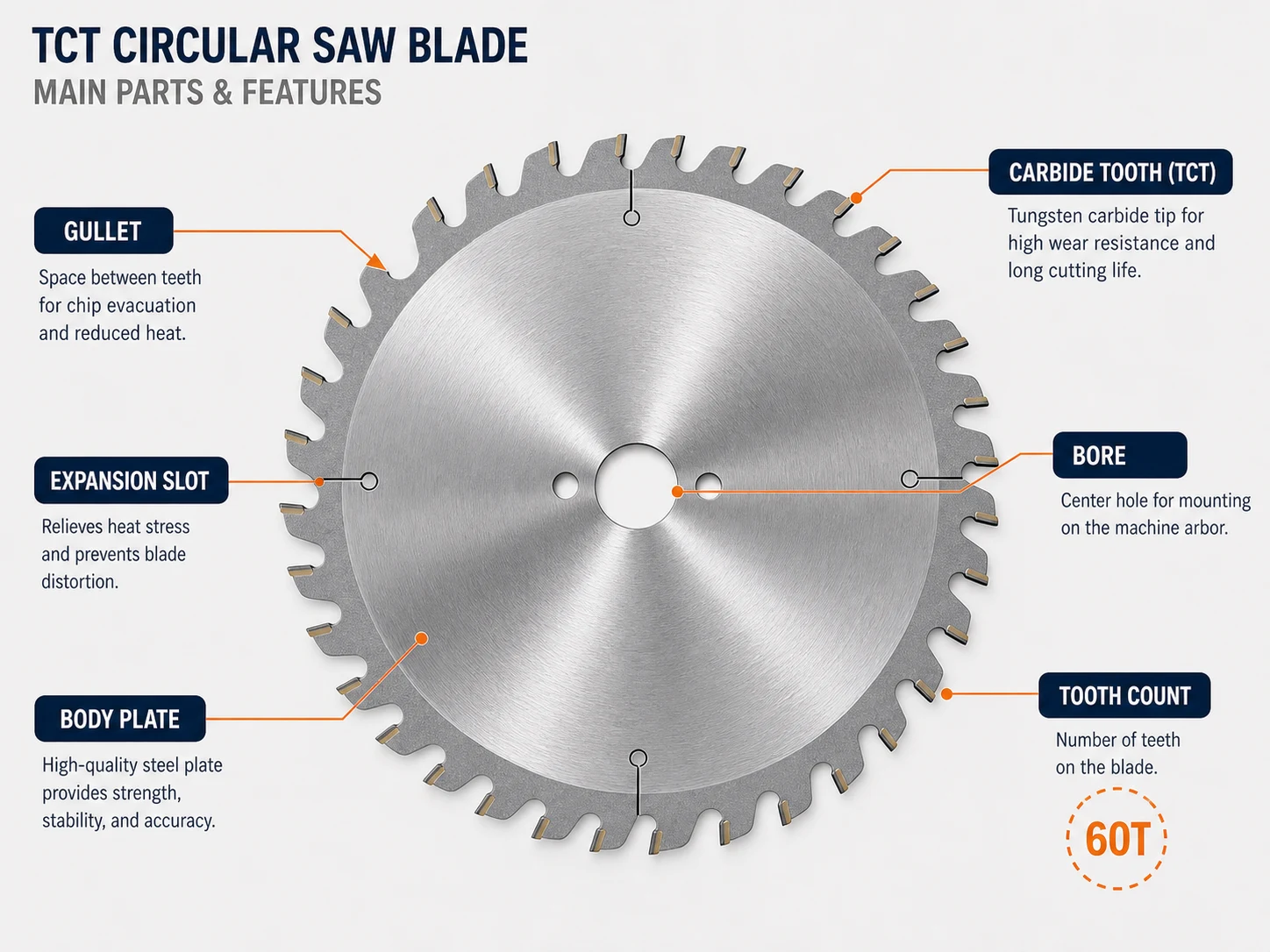
Anatomy of a TCT Saw Blade
Understanding the construction helps you evaluate quality and choose the right blade:
Steel Body (Plate)
The plate is typically made from one of two materials:
- 50# carbon steel: Used in economy-grade blades. Adequate stiffness, lower cost. More prone to warping under heavy use.
- 75Cr1 spring steel: Used in professional-grade blades. Higher yield strength, better fatigue resistance, more stable under sustained cutting. This is our standard for export-quality blades.
Plate thickness typically ranges from 1.5mm (thin kerf) to 3.2mm (full kerf). Thicker plates resist deflection but require more cutting power.
Carbide Tips
The carbide tips are the business end of the blade. They’re made from tungsten carbide powder mixed with cobalt binder, sintered at 1,400°C, then ground to the final tooth profile. Key factors:
- Carbide grade: Determines hardness vs. toughness trade-off. Harder grades (K10/K20) wear slower but chip easier. Tougher grades (K30/K40) resist impact but wear faster.
- Tip size: Larger carbide tips allow more resharpenings. Economy blades may have 2.5mm tip height; professional blades have 4–6mm, allowing 5–8 resharpenings.
- Brazing method: Silver brazing (our standard) provides strong, reliable joints. Some low-cost blades use copper brazing, which is weaker at high temperatures.
Expansion Slots and Dampening
Most TCT blades feature laser-cut expansion slots around the rim. These serve two purposes:
- Allow the plate to expand slightly from cutting heat without warping
- Reduce noise and vibration during cutting
Higher-quality blades may have copper or polymer inserts in the expansion slots for additional noise dampening.
TCT vs HSS Saw Blades: Key Differences
| Property | TCT Saw Blade | HSS Saw Blade |
|---|---|---|
| Cutting material | Tungsten carbide tips on steel body | Single piece of high-speed steel |
| Hardness | HRA 89–92 (carbide tips) | HRC 63–67 |
| Wear resistance | 10–20× better than HSS | Standard |
| Cut quality | Cleaner, less sanding needed | Acceptable, may need finishing |
| Blade life | 800–3,000+ linear meters | 100–500 linear meters |
| Materials cut | Wood, MDF, plywood, aluminum, steel, plastics | |
| Resharpening | 5–8 times (with sufficient tip height) | Multiple times |
| Relative price | 2–5× HSS upfront | Baseline |
| Cost per cut | Lower over blade lifetime | Higher due to frequent replacement |
The bottom line: HSS blades still have a place in low-volume, general-purpose cutting. But for any production environment, TCT blades deliver lower total cost despite higher upfront pricing.
Materials TCT Blades Can Cut
One of TCT’s biggest advantages is versatility. With the right tooth geometry and carbide grade, TCT blades handle an impressive range of materials:
Wood and Wood Products
- Softwood and hardwood (ripping and crosscutting)
- Plywood, MDF, particle board, chipboard
- Laminate, melamine, veneered panels
Non-Ferrous Metals
- Aluminum profiles and extrusions
- Copper, brass, and bronze
- Lead and zinc
Ferrous Metals
- Mild steel (tube, angle, flat bar)
- Stainless steel (with appropriate carbide grade and low speed)
Other Materials
- Plastics (PVC, acrylic, composite)
- Fiberglass and composite panels
- Insulation materials
The key is matching the tooth geometry, hook angle, and carbide grade to the material. A TCT blade designed for wood will perform poorly — and potentially dangerously — on aluminum, and vice versa.
Quality Grades: Our Factory’s 6-Level System
At our factory, we categorize TCT blades into six quality grades to help buyers match the blade to their application and market:
| Grade | Steel Body | Carbide | Runout | Best For |
|---|---|---|---|---|
| Economy (P) | 50# carbon | YG8 (K40) | ≤0.15mm | DIY, price-sensitive markets |
| Standard (B) | 50#/75Cr1 | YG6A (K30) | ≤0.12mm | General contractor use |
| Premium (J) | 75Cr1 | YG6A (K30) | ≤0.08mm | Export, resellers |
| Professional (G) | 75Cr1 | YG6X (K20) | ≤0.06mm | Production woodworking |
| Renovation (C) | 75Cr1 | JC05AC (K10) | ≤0.06mm | Laminate, high-gloss panels |
| Industrial (D) | 75Cr1 | JC05AC (K10) | ≤0.04mm | Panel saws, beam saws |
The difference between Economy and Industrial isn’t just material cost — it’s manufacturing process. Professional and Industrial grades go through additional grinding passes, dynamic balancing, and 100% inspection. Economy grades are spot-checked. For a furniture factory running 8-hour shifts, the Professional grade pays for itself in fewer rejected panels and less downtime.
Browse our full TCT saw blade product range or explore the complete product catalog. For detailed tooth geometry guidance, see our saw blade teeth guide.
Frequently Asked Questions
What does TCT mean on a saw blade?
TCT stands for Tungsten Carbide Tipped. It means the blade has a steel body with tungsten carbide tips brazed onto the cutting teeth. The carbide tips provide extreme hardness and wear resistance, while the steel body provides toughness and flexibility. TCT blades last 10–20 times longer than HSS blades in most applications.
Is a TCT blade the same as a carbide blade?
Essentially yes — in common usage, “TCT blade” and “carbide blade” refer to the same thing. Technically, “TCT” specifically means carbide tips are brazed onto a steel body, while “solid carbide” would mean the entire blade is made from carbide (rare for circular saw blades). When most people say “carbide blade,” they mean TCT.
Can a TCT blade cut steel?
Yes, but it must be a TCT blade specifically designed for steel cutting. These blades use negative hook angles, tougher carbide grades (YG8 or harder), and special tooth geometry. Never use a wood-cutting TCT blade on steel — the positive hook angle will cause kickback, and the carbide grade will chip on contact with hard steel. Always match the blade to the material.
How long does a TCT saw blade last?
It depends heavily on the material and grade. A Professional-grade TCT blade cutting softwood can last 1,500–3,000 linear meters. The same blade on MDF might last 500–800 meters. An Economy-grade blade might achieve only one-third of those figures. With proper resharpening (5–8 cycles), a quality TCT blade can deliver years of productive life.