
Scope: the tapping examples below concern cutting taps. Forming taps require a different pre-hole specification. Always follow the drawing and tool manufacturer’s recommendation.
Many buyers search for a drill bit size chart because they need one simple answer: “What size hole should I drill?”
The practical answer depends on the job. A hole for a screw to pass through is not the same as a hole prepared for tapping. The two most common hole types are tap drill holes and clearance holes, and confusing them is one of the easiest ways to order the wrong drill size.
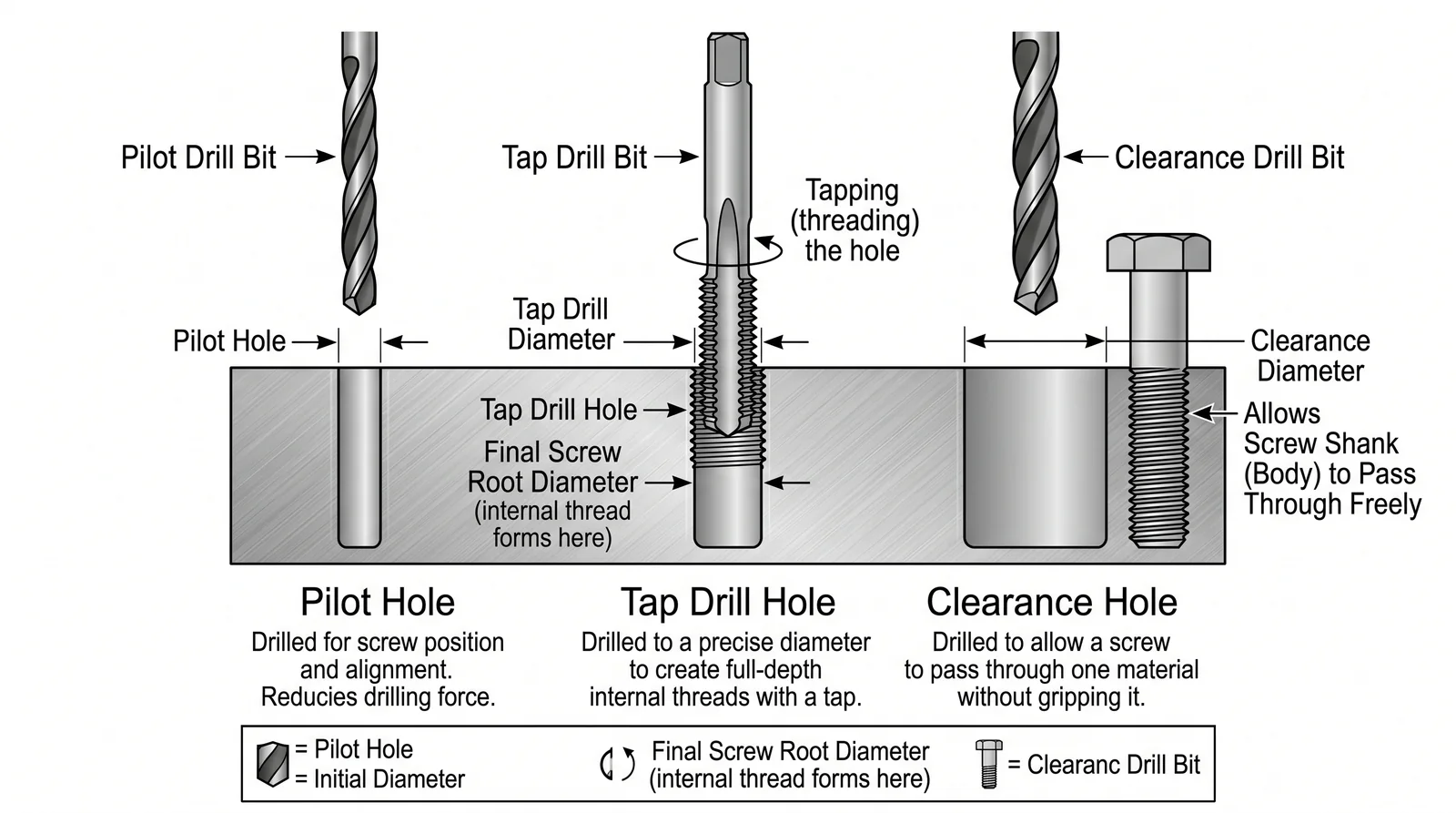
Short answer: A tap drill hole is smaller than the screw size because material must remain for the tap to cut internal threads. A clearance hole is larger than the screw size because the screw must pass through freely.
Specify the hole before selecting the drill
A clearance hole and a tapped hole serve different purposes. Confirm thread, tolerance and through/blind condition on the drawing before requesting the drill size; forming taps require their own toolmaker recommendations.
Tap Drill Hole vs Clearance Hole: What Is the Difference?
| Item | Tap Drill Hole | Clearance Hole |
|---|---|---|
| Purpose | Prepare a hole before cutting internal threads. | Allow a bolt or screw to pass through one part freely. |
| Size direction | Smaller than the screw/thread major diameter. | Larger than the screw/bolt nominal diameter. |
| Used with | Taps, threaded holes, threaded inserts, machined parts. | Bolted assemblies, cover plates, brackets, fixtures. |
| Example for M6 | About 5.0mm for M6 × 1.0 coarse thread. | About 6.4–7.0mm depending on fit requirement. |
| Common mistake | Drilling too large: threads become weak. | Drilling too small: screw cannot pass or assembly misaligns. |
Example: M6 Screw
An M6 screw has a nominal diameter of 6mm. But the correct drill size changes depending on whether you want to make a thread or let the screw pass through.
- For tapping: M6 × 1.0 usually uses a 5.0mm tap drill.
- For clearance: M6 commonly uses about 6.4mm, 6.6mm or 7.0mm depending on close, normal or loose fit.
So if a customer says “M6 hole” without explaining the function, you still do not have enough information. You must ask whether the hole is for tapping or clearance.
How to Estimate Tap Drill Size
For many metric coarse threads, a useful workshop rule is:
For example:
- M6 × 1.0 → 6.0 − 1.0 = 5.0mm
- M8 × 1.25 → 8.0 − 1.25 = 6.75mm, commonly rounded to 6.8mm
- M10 × 1.5 → 10.0 − 1.5 = 8.5mm
This formula is a practical starting point, not a replacement for the customer drawing or required standard. Material, thread engagement length, tap type, coating, machine rigidity and required thread strength can all affect the final drill size.
Common Metric Tap Drill Size Chart
The following table gives common starting sizes for ISO metric coarse threads. These are widely used workshop values for general machining.
| Thread | Pitch | Common Tap Drill Size | Typical Use |
|---|---|---|---|
| M3 | 0.5 | 2.5mm | Small brackets, electronics, light fixtures |
| M4 | 0.7 | 3.3mm | Machine guards, light metal parts |
| M5 | 0.8 | 4.2mm | General equipment assembly |
| M6 | 1.0 | 5.0mm | Frames, covers, fixtures |
| M8 | 1.25 | 6.8mm | Machine bases, brackets, structural parts |
| M10 | 1.5 | 8.5mm | Heavier assemblies, jigs and fixtures |
| M12 | 1.75 | 10.2mm or 10.25mm | Heavy-duty machinery and structural fastening |
Metric Clearance Hole Size Chart
Clearance holes are usually selected by fit. A close fit gives better location control but requires more accurate hole position. A normal fit is common for general assembly. A loose fit allows more assembly tolerance.
| Screw Size | Close Fit | Normal Fit | Loose Fit |
|---|---|---|---|
| M3 | 3.2mm | 3.4mm | 3.6mm |
| M4 | 4.3mm | 4.5mm | 4.8mm |
| M5 | 5.3mm | 5.5mm | 5.8mm |
| M6 | 6.4mm | 6.6mm | 7.0mm |
| M8 | 8.4mm | 9.0mm | 10.0mm |
| M10 | 10.5mm | 11.0mm | 12.0mm |
| M12 | 13.0mm | 13.5mm | 14.5mm |
For importers and distributors, this is where many quotation mistakes happen. A buyer may ask for “M8 drill bits,” but the actual need may be a 6.8mm tap drill, an 8.4mm close clearance hole, or a 9.0mm normal clearance hole.
Tap Drill Percentage: Why Bigger Is Not Always Bad
Many beginners assume that a smaller tap drill hole always creates a stronger thread. In reality, too small a hole increases tapping torque, tool wear and tap breakage. In production, many shops prefer a practical thread percentage rather than maximum theoretical thread height.
| Thread Percentage | Meaning | Typical Result |
|---|---|---|
| High thread percentage | Smaller tap drill hole, more material left for tapping. | Stronger thread form but higher torque and greater tap breakage risk. |
| Medium thread percentage | Balanced hole size for common machining. | Often the best starting point for steel, aluminum and general production. |
| Low thread percentage | Larger tap drill hole. | Easier tapping, lower torque, but less thread engagement. |
For hard materials, blind holes, small taps and manual tapping, choosing an overly small tap drill can cause more problems than benefits. The correct choice depends on required strength and production stability.
Clearance Hole Is Not the Same as Pilot Hole
A pilot hole is a starting or guiding hole. It may be used before drilling a larger hole, before tapping, or before driving some screws. A pilot hole does not automatically mean tap drill size or clearance size.
- Pilot hole: a guide hole or first-stage hole.
- Tap drill hole: a hole prepared for cutting internal threads.
- Clearance hole: a hole that allows a fastener to pass through freely.
- Countersink/counterbore: a secondary feature for screw heads or bolt heads.
Material Matters: Steel, Stainless Steel and Aluminum
The nominal hole size is only part of the decision. The drill bit material and cutting condition also matter.
| Workpiece | Common Issue | Drill Bit Recommendation |
|---|---|---|
| Aluminum | Chip welding, oversized holes, burrs. | Sharp HSS or polished flute drill; use correct speed and chip evacuation. |
| Mild steel | General wear, poor hole finish if speed is wrong. | HSS, cobalt or coated drill depending on batch size and machine. |
| Stainless steel | Work hardening and heat buildup. | Cobalt drill bits, lower speed, stable feed and coolant. |
| Hardened material | Rapid wear or drill failure. | Carbide drill bits may be needed, with rigid machine setup. |
Related guides: drill bit types explained, drill speed chart, and best drill bits for aluminum.
How to Specify Drill Bits When Ordering
If you are buying drill bits for production, do not only send the screw size. Send the hole function and workpiece information as well.
| Information to Confirm | Example | Why It Matters |
|---|---|---|
| Hole function | Tap drill, clearance hole, pilot hole, countersink | Determines actual drill diameter. |
| Thread size and pitch | M6 × 1.0, M8 × 1.25, 1/4-20 UNC | Pitch changes tap drill size. |
| Fit requirement | Close, normal or loose clearance | Determines clearance hole diameter. |
| Material | Aluminum, mild steel, stainless steel | Affects drill material, coating and cutting speed. |
| Machine | CNC, drill press, magnetic drill, hand drill | Affects rigidity and tool choice. |
| Hole depth | Through hole or blind hole | Affects flute length, chip evacuation and tap type. |
Common Mistakes
- Using tap drill size as clearance size. Example: drilling 5.0mm for an M6 screw that should pass through.
- Ignoring pitch. M8 × 1.25 and M8 × 1.0 do not use the same tap drill size.
- Choosing close clearance for rough assemblies. If the hole positions are not precise, close clearance may make assembly difficult.
- Trying to get 100% thread engagement. This can greatly increase tapping torque without giving practical benefit in many applications.
- Not considering coating and material. Stainless steel, aluminum and mild steel need different drilling conditions.
Quick Decision Guide
| Your Situation | Choose This Hole Type | Example |
|---|---|---|
| You will cut internal threads with a tap. | Tap drill hole | M6 × 1.0 → 5.0mm |
| A bolt passes through one plate and threads into another part. | Clearance hole in the first plate; tapped hole in the second part. | M6 cover plate → 6.6mm clearance; base part → 5.0mm tap drill |
| You need easier assembly with tolerance. | Normal or loose clearance hole | M8 → 9.0mm normal or 10.0mm loose |
| You need accurate locating. | Close clearance or dowel pin design | M6 → 6.4mm close fit, depending on drawing |
Final Recommendation
If you only remember one rule, remember this:
Tap drill holes are for making threads. Clearance holes are for letting fasteners pass through.
For purchasing, always confirm the screw size, thread pitch, hole function, workpiece material and fit requirement before ordering drill bits. This prevents wrong hole sizes, weak threads, broken taps and assembly problems.
Need Help Choosing Drill Bits?
Send us your screw size, material, hole type and machine information. Wryno Global can help recommend HSS, cobalt, carbide, SDS or step drill bit options for your application.