
Coolant is not simply a liquid added to make a sawing operation look
safer. In circular sawing, the fluid system must control heat, reduce
friction and material adhesion, and help remove chips from the
tooth-workpiece engagement zone. The correct choice depends on the
workpiece, blade construction, machine, downstream process and
production target.
This guide helps buyers and production teams choose between flood
coolant, minimum-quantity lubrication (MQL), neat oil and designed dry
cutting for aluminum, mild steel and stainless steel. It also explains
nozzle placement, concentration control, maintenance and the information
a blade or machine supplier needs before making a recommendation.
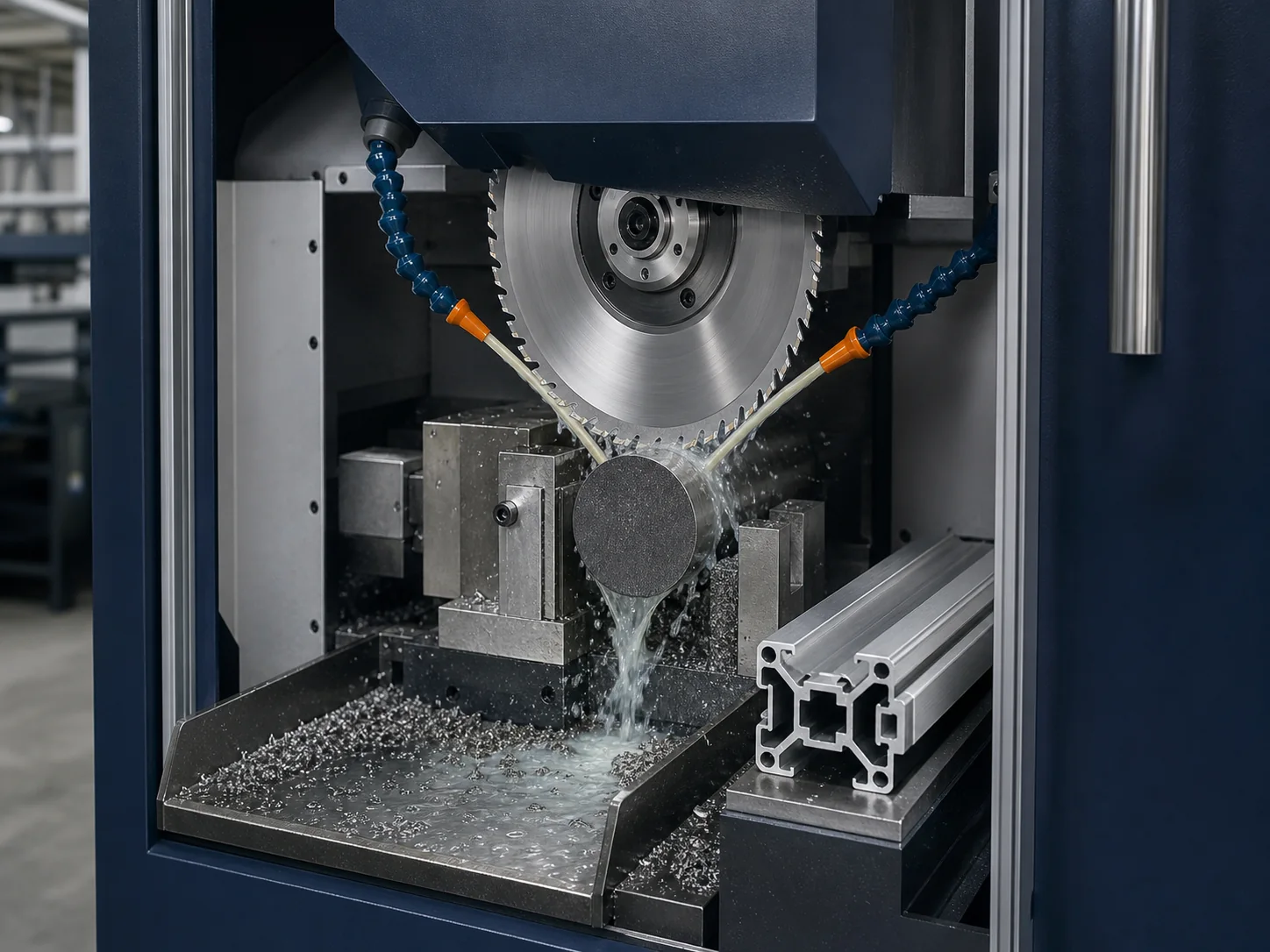
Quick Selection Table
| Workpiece and operation | Common starting method | Main objective | Confirm before production |
|---|---|---|---|
| Aluminum extrusion or thin non-ferrous profile | MQL, fine mist or a compatible light-duty fluid, when the machine permits |
Reduce aluminum pickup and keep the edge clean | Staining, residue, nozzle coverage and downstream finishing |
| Solid aluminum bar | Controlled lubrication with strong chip evacuation; flood or MQL depends on machine and section |
Control adhesion, heat and packed gullets | Bar diameter, silicon content, cycle time and chip load |
| High-silicon or abrasive aluminum | Stable, application-approved lubrication/cooling and excellent chip removal |
Limit edge wear and material welding | PCD/TCT compatibility, filtration and surface requirement |
| Mild-steel tube on a cold saw | Recirculating flood emulsion or the machine supplier’s approved system |
Cool the engagement zone and flush chips | Wall thickness, tooth count, concentration and flow |
| Mild-steel solid bar | Consistent flood delivery is a common starting point | Manage higher sustained heat and chip volume | Bar diameter, cut time, pump capacity and filtration |
| Stainless-steel tube or bar | Stable high-coverage coolant delivery with a suitable fluid | Limit heat, friction and work hardening | Alloy, wall/section, feed stability and fluid suitability |
| Wood, MDF or laminate | Normally dry cutting with effective dust extraction | Remove dust without wet contamination | Resin buildup, extraction and blade cleaning |
There is no universal coolant percentage or flow rate for every saw.
Use the blade, machine and fluid supplier’s approved operating window,
then validate it with controlled production trials.
Cooling,
Lubrication and Chip Evacuation Are Different Jobs
A successful system performs three related but different
functions:
- Cooling carries heat away from the cutting zone,
blade and workpiece. - Lubrication reduces friction and limits material
welding to the cutting edge and blade sides. - Chip evacuation moves chips out of the gullet
before the tooth re-enters the workpiece.
A fluid can provide good cooling but poor lubricity, or good
lubricity but insufficient chip flushing. A large coolant stream aimed
at the blade center may wet the machine without reaching the active
teeth. Diagnose the function that is missing instead of increasing
concentration or pump pressure blindly.
Flood Coolant, MQL,
Neat Oil or Dry Cutting?
| Method | Strengths | Limitations | Typical fit |
|---|---|---|---|
| Flood emulsion or solution | Strong heat removal, broad coverage and chip flushing | Requires tank, pump, filtration, concentration and biological control |
Steel and stainless cold sawing; sustained solid-section cuts |
| MQL or controlled mist | Low fluid consumption and less wet residue; good point lubrication when accurately aimed |
Limited bulk cooling and highly dependent on nozzle position | Aluminum profiles and selected short-cycle operations |
| Neat cutting oil | High lubricity and corrosion protection with no water dilution | Lower heat capacity, oil carry-off, mist/fire and housekeeping considerations |
Machine- and application-specific cold sawing |
| Designed dry cutting | Simple fluid management and no wet downstream cleaning | Demands compatible blade, machine, material and chip extraction | Wood/panels and specially engineered metal processes |
Do not change from flood coolant to MQL or dry cutting only to reduce
fluid cost. The saving can disappear through shorter blade life, slower
cycle time, stained workpieces or higher reject rates.
Aluminum Cutting:
Control Adhesion First
Aluminum conducts heat well, but its tendency to adhere to the
cutting edge can still produce built-up edge, packed gullets, burrs and
a rough surface. The system should keep the tooth face and side
clearance clean without staining the workpiece.
For profiles and hollow sections, accurately delivered MQL can be
effective because the tooth engagement is intermittent and the liquid
can reach the contact zone. Solid bars create a longer engagement and
more chips, so the required cooling and flushing capacity may be higher.
High-silicon aluminum is more abrasive and should be evaluated with the
blade material, carbide or PCD geometry, chip load and fluid
compatibility as one system.
Check the finished part after drying. Some fluids leave residues that
interfere with anodizing, painting, bonding or welding. A visually clean
cut immediately after sawing is not enough.
Mild Steel
and Stainless Steel Need Stable Delivery
Cold sawing steel generates concentrated heat at the edge and large
chip loads, especially in solid sections. Recirculating flood coolant is
a common starting method because it combines cooling and chip
flushing.
Stainless steel has low thermal conductivity relative to many common
steels and can work harden when the tool rubs instead of cutting. The
blade still needs correct feed and tooth engagement; coolant cannot
compensate for a tooth count or feed rate that causes rubbing. Avoid
weak, intermittent delivery that disappears as the blade enters the
workpiece.
For tube, confirm how many teeth are engaged through the wall. For
solid bar, confirm pump capacity and whether the return system can
handle the higher chip volume without recirculating abrasive fines.
Match the Fluid
to the Entire Production Chain
Before approving a coolant, review:
- workpiece alloy, hardness, coating and surface-finish
requirement; - blade type, carbide/cermet/PCD grade, brazing and coating;
- machine seals, hoses, pump and tank materials;
- concentration range and local make-up water;
- corrosion and staining risk during storage;
- downstream washing, welding, anodizing, painting or bonding;
- operator exposure, mist collection and disposal requirements;
- customer restrictions and local environmental rules.
Do not assume that a fluid approved for machining is automatically
approved for the blade’s coating, braze, machine elastomers or the
buyer’s downstream process.
Nozzle
Position Is More Important Than Appearance
Aim coolant at the tooth-workpiece engagement zone, just before or as
the teeth enter the material. The stream should remain on target through
the complete stroke rather than hitting a guard, clamp or the blade
hub.
A practical nozzle check includes:
- stop and isolate the machine before adjustment;
- confirm nozzle rigidity and unobstructed openings;
- position coverage for both tooth face and chip path when the machine
design permits; - run a guarded low-risk test and observe whether the stream is
deflected; - inspect the first chips, cut surface and blade after the trial.
Two smaller, stable nozzles can provide better coverage than one
large stream, but only when both reach the active zone. Follow the
machine manufacturer’s guarding and safety instructions.
Flow Must Be
Consistent, Not Merely High
More flow is useful only when it reaches the cut and returns through
a system able to filter it. Check pressure and flow under real cutting
conditions, not only with the blade stopped. Long hoses, blocked
screens, clogged nozzles, low tank level and a worn pump can reduce
delivery.
Monitor the process for:
- coolant reaching the entry zone throughout the cut;
- chips leaving the gullet instead of being recut;
- stable fluid temperature during a production batch;
- no excessive foam, splashing or aerosol;
- no dry interval caused by a moving head or rotating guard.
If the process was designed for dry cutting, adding a weak occasional
spray may create thermal cycling without delivering sufficient cooling
or lubrication. Obtain supplier approval before changing the method.
Concentration and Water
Quality Control
Water-miscible fluids work only inside their specified concentration
range. Too lean can reduce lubricity and corrosion protection. Too rich
can increase residue, foam, cost and skin exposure without improving the
cut.
Use a clean, calibrated refractometer and the fluid supplier’s
correction factor:
Actual concentration = refractometer reading ×
product-specific factor
For a planned new mix, a simple purchasing estimate is:
Concentrate volume = final mixed volume × target
concentration
The real mixing procedure, correction factor and acceptable range
must come from the fluid supplier. Record source-water hardness, pH or
conductivity when inconsistent water is suspected. Always follow the
supplier’s mixing order and safety data sheet.
MQL: When It Works and
When It Does Not
MQL applies a very small, controlled quantity of lubricant close to
the engagement zone. It can reduce liquid carry-off and cleanup for
aluminum profiles and selected metal sawing operations.
MQL is not a miniature flood system. It works best when:
- the machine and blade are approved for it;
- the nozzle remains precisely aimed;
- chips can leave without a liquid flushing stream;
- the cut is not generating more heat than the small fluid quantity
can manage; - mist extraction and operator controls are suitable.
It is a poor shortcut when a deep solid cut needs substantial cooling
and chip transport, or when nozzles cannot reach the tooth entry
zone.
Tank, Filtration and Chip
Separation
A recirculating system should prevent chips from returning to the
cut. The system may include settling zones, screens, magnetic separation
for ferrous chips and finer filtration where the pump or finish
requirement demands it.
Check whether mixed aluminum and steel production contaminates the
tank. Cross-contamination can affect corrosion, staining, filtration and
waste handling. Dedicated systems or disciplined cleaning may be
necessary when materials and downstream requirements differ.
| Component | Failure mode | Cutting symptom |
|---|---|---|
| Tank level | Air drawn into pump or inadequate return volume | Intermittent stream, foam, rising temperature |
| Screen/filter | Blocked or bypassed | Low flow or abrasive fines returning to cut |
| Pump | Wear, cavitation or incorrect capacity | Pressure fluctuation and poor nozzle coverage |
| Nozzle | Misalignment or chip blockage | One-sided heat, adhesion or localized wear |
| Return path | Chips and sludge obstruct flow | Overflow, dirty coolant and unstable level |
Coolant Maintenance Schedule
Use the machine and fluid supplier’s schedule as the controlling
document. A workable internal routine is:
| Frequency | Checks |
|---|---|
| Start of shift/daily | Tank level, nozzle aim, visible flow, leaks, foam, odor and chip accumulation |
| Weekly or by production volume | Concentration, pH if specified, filter/screens, tramp oil and fluid appearance |
| Periodic | Tank sludge, pump delivery, hose condition, microbial control and calibration records |
| Planned shutdown | Drain/clean only as required, inspect return channels, verify safe disposal and recharge with documented mix |
BEHRINGER’s maintenance guidance, for example, calls for daily
coolant-level checks and scheduled tank/screen cleaning. Treat this as
evidence that fluid maintenance belongs in machine maintenance—not as a
universal interval for every saw.
Troubleshooting
Coolant-Related Cutting Problems
| Symptom | Possible fluid-system cause | Also inspect |
|---|---|---|
| Aluminum pickup on teeth | Poor nozzle aim, insufficient lubricity, blocked gullet flushing |
Tooth geometry, feed and dirty blade |
| Blue chips or heat discoloration in steel | Inadequate delivery, low tank level or poor heat removal | Feed, speed, tooth engagement and blade sharpness |
| Burrs increase through a batch | Concentration drift, rising fluid temperature or clogged filter | Runout, clamping and edge wear |
| Foam | Air leak, return turbulence, unsuitable water or excess concentration |
Tank level and fluid compatibility |
| Rust after cutting | Concentration too low, contamination or poor drying/storage | Workpiece condition and corrosion-control procedure |
| Aluminum stains | Fluid incompatibility, excessive dwell or contaminated tank | Alloy, rinse and downstream process |
| Odor or unstable pH | Biological contamination, tramp oil or neglected sump | Maintenance records and supplier treatment plan |
| Short blade life despite heavy coolant | Stream misses the cut or wrong blade/feed specification | Tooth count, chip load, runout and sharpening condition |
A Controlled Trial Plan
Change one variable at a time. Record the original setup before
adjusting fluid type, concentration, nozzle position or flow.
- Confirm blade, workpiece, RPM, feed and clamping.
- Measure current concentration and document water source.
- Photograph nozzle position and verify guarded coverage.
- Run a defined number of cuts with the same batch of material.
- Record cycle time, motor load, burr, surface finish, temperature
trend and chip form. - Inspect the blade for pickup, edge wear and packed gullets.
- Calculate accepted cuts, fluid consumption and cleanup time.
- Approve the change only after downstream finishing and corrosion
checks.
Coolant Cost per Accepted
Cut
Fluid price alone is not the correct purchasing metric.
Coolant system cost per accepted cut = (concentrate + water
treatment + filtration + maintenance + cleaning + disposal +
coolant-related rejects) ÷ accepted cuts
Compare this value together with blade cost per cut, cycle time and
yield. A higher-priced fluid may be economical if it prevents aluminum
pickup, extends the interval between resharpening or reduces rejected
steel parts.
Information to Send
for a Recommendation
Provide the blade, machine or fluid supplier with:
- workpiece material grade and cross-section;
- tube wall or solid-bar diameter;
- blade diameter, kerf, tooth count, tooth form and tip material;
- machine model, RPM, feed method and cut cycle;
- current coolant product, concentration and water source;
- tank volume, pump specification, filter and nozzle arrangement;
- current blade life, burr, finish, temperature or adhesion
problem; - downstream coating, welding, anodizing or cleaning requirement;
- photos or video showing the guarded coolant stream during a
cut.
This data is more useful than asking for a generic “best coolant for
saw blades.”
Frequently Asked Questions
Can I use the
same coolant for aluminum and steel?
Sometimes, but only when the product is approved for both alloys and
the machine, corrosion, staining and downstream requirements are
satisfied. Mixed chips and tank contamination must also be managed.
Is MQL always better for
aluminum?
No. MQL can work well for profiles and selected short-cycle cuts, but
large solid sections may need more cooling or chip flushing than MQL can
provide.
Why does
my blade overheat even with visible coolant?
The stream may miss the engagement zone, flow may collapse during the
stroke, chips may be recut, or the blade/feed specification may be
wrong. Visible liquid is not proof of effective delivery.
What concentration should I
use?
Use the fluid supplier’s approved range and correction factor. There
is no responsible universal percentage for every product, alloy and
saw.
Can
coolant fix a dull or incorrectly specified blade?
No. It can reduce heat, friction and adhesion, but it cannot restore
edge geometry or correct the wrong tooth count, rake, feed or
runout.
Related buyer guide: Cold Saw Blade for Steel Tube Cutting: Tooth Count, Speed and Feed Guide adds practical checks for cold saw blade for steel tube cutting.
Related guide: How to Cut Stainless Steel Tube Without Burrs or Blue Heat Marks covers practical checks for cut stainless steel tube without burrs.
Related guide: PCD Saw Blade vs TCT Saw Blade for Aluminum: When Is Diamond Worth It? explains when PCD diamond tooling is worth upgrading from TCT carbide for aluminum cutting.
Final Recommendation
Choose the coolant method as part of the complete cutting system.
Start with the workpiece and blade, confirm whether the operation needs
bulk cooling, point lubrication or chip flushing, then validate nozzle
coverage, concentration, water quality and maintenance. The best result
is not the wettest blade—it is the highest number of stable, accepted
cuts with controlled total cost.