
A flesh-sensing brake can reduce one hazard, but it does not replace guarding, a riving knife, stable stock control, dust management, maintenance or trained operating procedures. For professional buyers, safety also has a lifecycle dimension: cartridges, electronics, guards, switches and service capability must remain available for the expected ownership period.
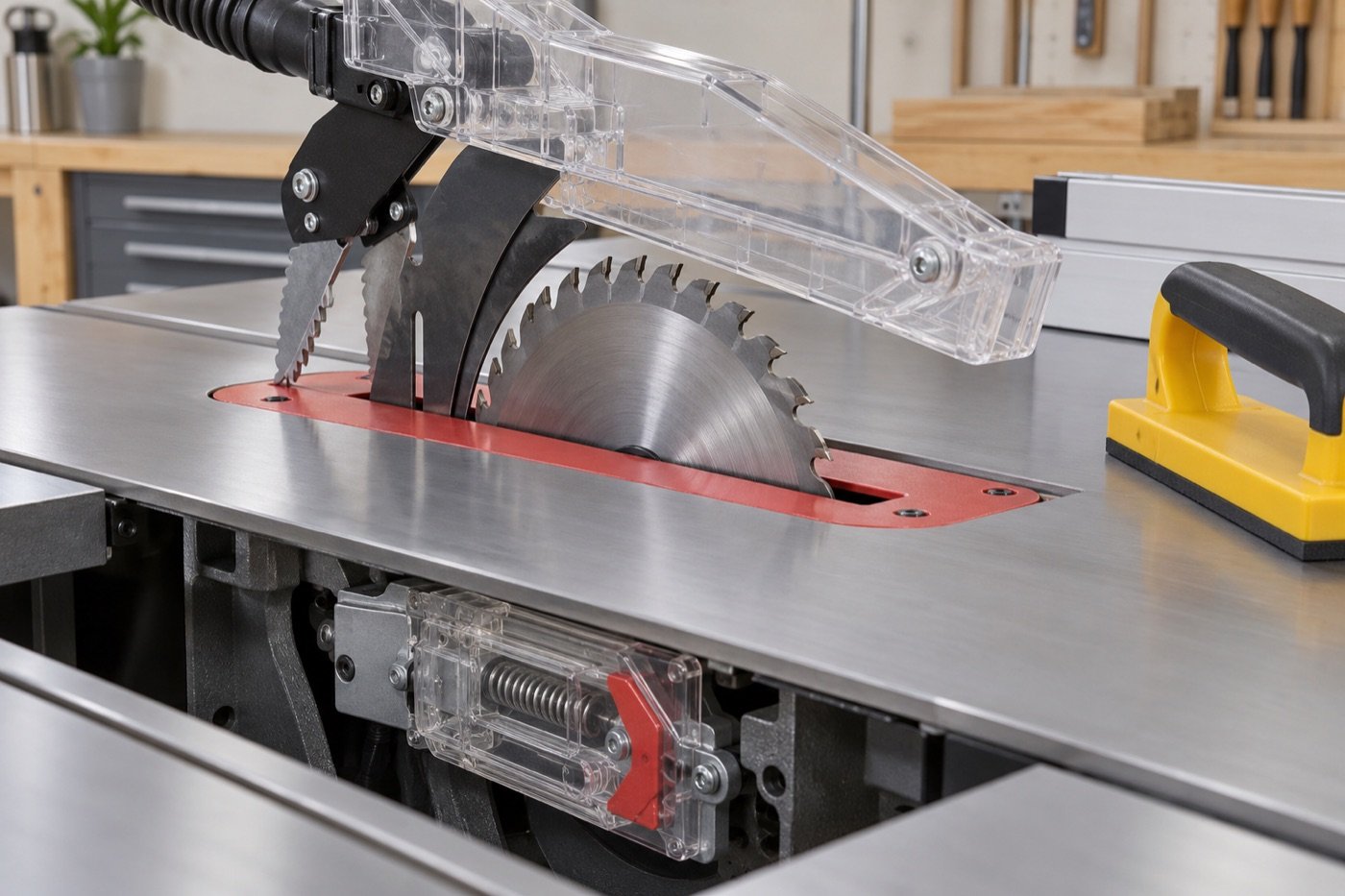
Build a layered safety specification
| Layer | Buyer question | Verification |
|---|---|---|
| Prevent contact | How is the blade guarded above and below the table? | Manual, inspection and functional check |
| Control kickback | Are riving knife, splitter, fence and anti-kickback components appropriate? | Alignment and setup demonstration |
| Stop or limit motion | What braking or detection system is fitted and under what conditions? | Manufacturer documentation; never create an unsafe live test |
| Isolate energy | Can power be locked out for blade changes and service? | Site procedure and isolator review |
| Maintain capability | Are cartridges, guards, switches and service available long term? | Written parts and support commitment |
What official guidance establishes
In the United States, OSHA’s woodworking machinery requirements address guarding, controls, prevention of unexpected restart, maintenance, cracked saws and push devices. Buyers outside the US should identify their own applicable legislation and machine standards. Compliance cannot be inferred from a marketing badge alone.
Riving knife, splitter and fence alignment
The workpiece can close on the rising rear teeth or twist against the blade. A correctly specified and adjusted riving knife or splitter, a fence that remains parallel and stock support appropriate to the cut are fundamental. Confirm the permitted blade/kerf range because an incompatible thin-kerf blade can make the riving system ineffective.
Brake and detection technology
Ask what event the system detects, how quickly it responds, which blades and operating modes are compatible, what damage may occur during activation, and what must be replaced before restart. Conductive, wet or unusual materials may require a defined mode or procedure. The manufacturer’s current manual—not assumptions from another brand—must govern use.
Support continuity is part of safety
If a manufacturer changes regional operations, the buyer needs written answers for warranty handling, service partners, firmware, brake cartridges, guards, switches and ordinary wear parts. A promise of continuing support should be converted into part numbers, channels, lead times and responsibility.
Pre-purchase acceptance plan
- Confirm machine voltage, plug, braking and restart behaviour.
- Inspect upper/lower guarding and riving-knife compatibility with planned blades.
- Demonstrate fence alignment, blade change and isolation.
- Review dust extraction and visibility at the cut.
- Record all safety consumables and recommended stock quantities.
- Verify training material, local service and serial-number traceability.
- Require a controlled handover checklist for every operator and site.
Do not convert technology into a behavioural exemption
No safety feature authorises freehand ripping, reaching over a blade, defeating a guard or ignoring unstable stock. Procurement should make safe work easier, but management must still control task selection, competence, supervision, housekeeping and maintenance.