
A vertical panel saw changes material handling, but it does not remove the need to match blade, board and machine. Clean panel cutting depends on correct diameter and bore, stable plate and kerf, tooth geometry, scoring strategy, feed control, extraction, support and low runout.
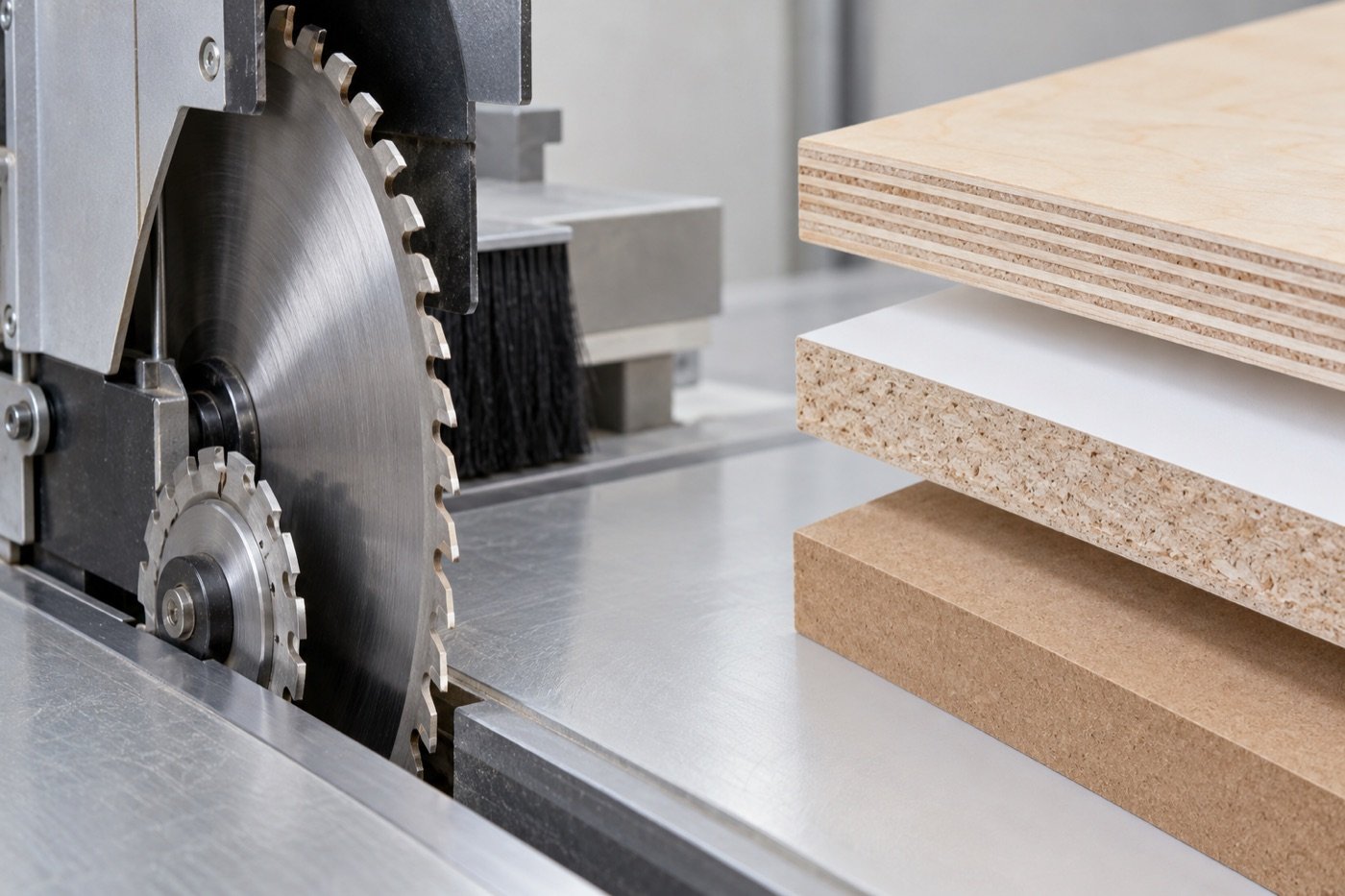
Identify the panel stack
| Panel | Main cutting challenge | Blade priority |
|---|---|---|
| MDF | Abrasive fibres and fine dust | Wear resistance, sharp geometry and extraction |
| Melamine-faced board | Top and bottom surface chipping | Low runout, suitable TCG/ATB family and scoring strategy |
| Plywood | Crossed grain and veneer breakout | Sharp edge, enough teeth and controlled feed |
| Particleboard | Abrasive inclusions and edge quality | Stable plate, durable tips and chip clearance |
Machine fit comes before tooth count
Confirm manufacturer-approved diameter range, bore, key or pin arrangement, kerf, plate thickness, maximum speed and rotation. On machines with a riving or splitting device, the kerf and plate must remain compatible. A blade selected only from a tooth-count chart can be unsafe or mechanically unsuitable.
Tooth geometry and finish
ATB-family geometries can give clean cross-grain wood cuts; TCG-family geometries are often used for abrasive faced panels and composites. The precise design, hook angle and top/face grind must match machine feed and board. A very high tooth count can rub and overheat if feed is too low or extraction is poor.
Scoring options
Some panel systems use a scoring blade or scoring function; others depend on the main blade and cutting direction. Confirm whether the vertical saw supports scoring, the scoring kerf relationship and how the machine approaches coated faces. Do not assume settings from a horizontal beam saw transfer directly.
Runout, flange and support
Edge chipping can come from arbor or flange runout, dirt behind the blade, damaged bore fit, loose panel support or carriage play. Measure the machine before repeatedly changing blade grade. Large sheets must remain flat and supported through the cut so they do not pinch or deflect the blade.
Feed, extraction and heat
Feed should allow the tooth to cut rather than rub. Fine panel dust must be captured without restricting the blade path. Resin and adhesive deposits change side clearance and can create heat even while tooth tips look sharp. Cleaning intervals should be part of the trial record.
Supplier quotation checklist
- Vertical panel saw brand, model and permitted blade size.
- Bore, pin holes, rotation, kerf and plate thickness.
- Board type, coating, density, thickness and single/stack cutting.
- Required edge quality on entry and exit faces.
- Scoring arrangement and current scoring/main kerf relationship.
- Feed method, RPM, extraction and current failure photos.
- Monthly volume, sharpening route and private-label requirements.
Run a controlled panel trial
Use the same board batch and inspect both faces at repeated positions. Record chip-out length, edge roughness, cut time, sound, dust capture, blade temperature and cut count before cleaning or sharpening. Approve a blade against written criteria rather than a single visually good cut.
Related Wryno guide: Saw Blade Selection for SPC, LVT and Laminate Flooring provides a practical selection, troubleshooting and buyer-verification framework.