
Two saw blades can look almost the same in a product photo. They may have the same diameter, the same bore size, the same number of teeth, and even the same application written on the quotation sheet. But one supplier quotes a very low price, another supplier quotes twice as much, and a local retail platform may sell a similar-looking blade for even more.
For buyers, this is confusing. Is the expensive blade overpriced? Is the cheap blade a good deal? Or are these products not really the same?
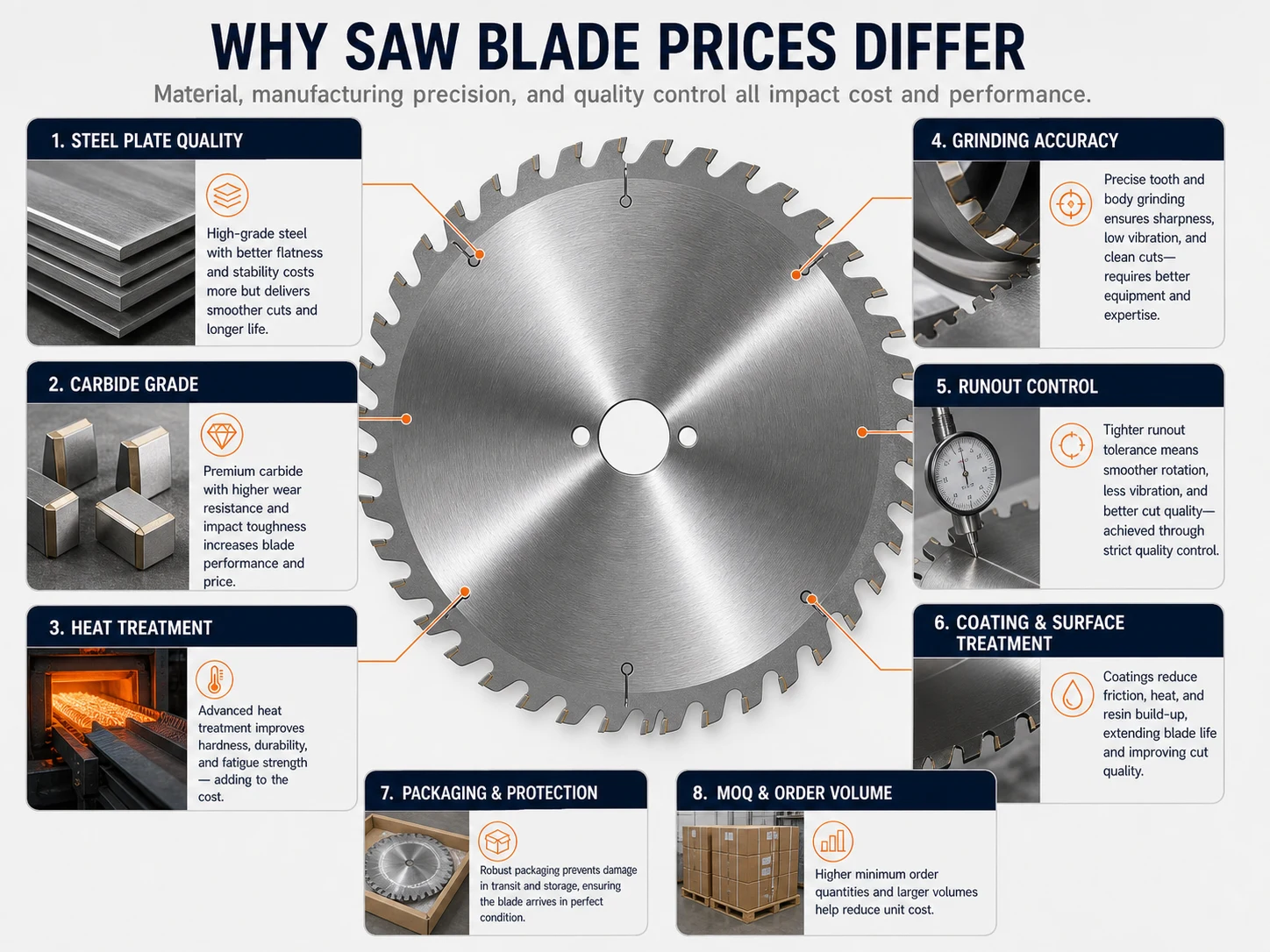
The short answer: a saw blade is not defined by size alone. The final price depends on the steel plate, carbide or cermet grade, tooth geometry, heat treatment, grinding accuracy, coating, runout control, packaging, order quantity, and whether the blade is matched to the buyer’s actual material and machine.
This article explains why saw blade prices can vary so widely across the industry, from wood cutting TCT blades to aluminum blades, panel sizing blades, and industrial metal cutting blades.
A Real Inquiry That Shows the Problem
Recently, a buyer from India contacted us on WhatsApp with a short message: “Want to buy 285×75 steel grade circular saw cutter.” At first, that sounded like a 285mm blade with a 75mm bore. But the message was not enough to quote safely.
The buyer then sent a photo of the current blade. The marking looked closer to 285 x 2.0 x 1.75 x 32 x 80T. Later, he confirmed the bore was 32mm, not 75mm. He also wrote “Need in MS”, meaning mild steel, and confirmed the material was solid bar.
The customer was a wholesaler and wanted to start with 5-10 sample pieces. For the grade, he said carbide or cermet were both acceptable if we recommended the right option.
This is a typical real-world saw blade inquiry. The buyer knows the general size and application, but several critical details are still missing: material diameter, machine RPM, pin-hole PCD, cutting method, and whether the machine condition is suitable for carbide or cermet. If we compare prices before confirming these details, we may be comparing different products.
Factory note: In this case, because the machine data was not clear, the safest first recommendation was a stable carbide grade for sample testing. Cermet may be a better upgrade later if the machine is stable and the buyer needs better finish or longer life.
What the Size Code Tells You — and What It Does Not
A blade marked 285 x 2.0 x 1.75 x 32 x 80T usually means:
| Parameter | Meaning | What It Controls |
|---|---|---|
| 285 | Outer diameter | Machine fit, cutting depth, blade speed |
| 2.0 | Kerf / cutting width | Material loss, cutting load, chip removal |
| 1.75 | Plate/body thickness | Blade stiffness, vibration, stability |
| 32 | Bore / arbor hole | Machine mounting accuracy |
| 80T | Number of teeth | Cutting finish, chip load, heat generation |
Those numbers are important, but they do not tell you the grade of steel, the carbide grade, the tooth form, the grinding precision, the coating, the runout tolerance, or the quality inspection standard. That is where most price differences begin.
1. Raw Material: The Same Blade Size Can Use Different Steel
The steel plate is the foundation of the blade. In TCT saw blades, common plate materials include carbon steel and alloy steel such as 75Cr1. In metal cutting blades, the plate must be stable enough to handle higher cutting load and vibration. Better steel costs more, but it also improves tension stability, flatness, and service life.
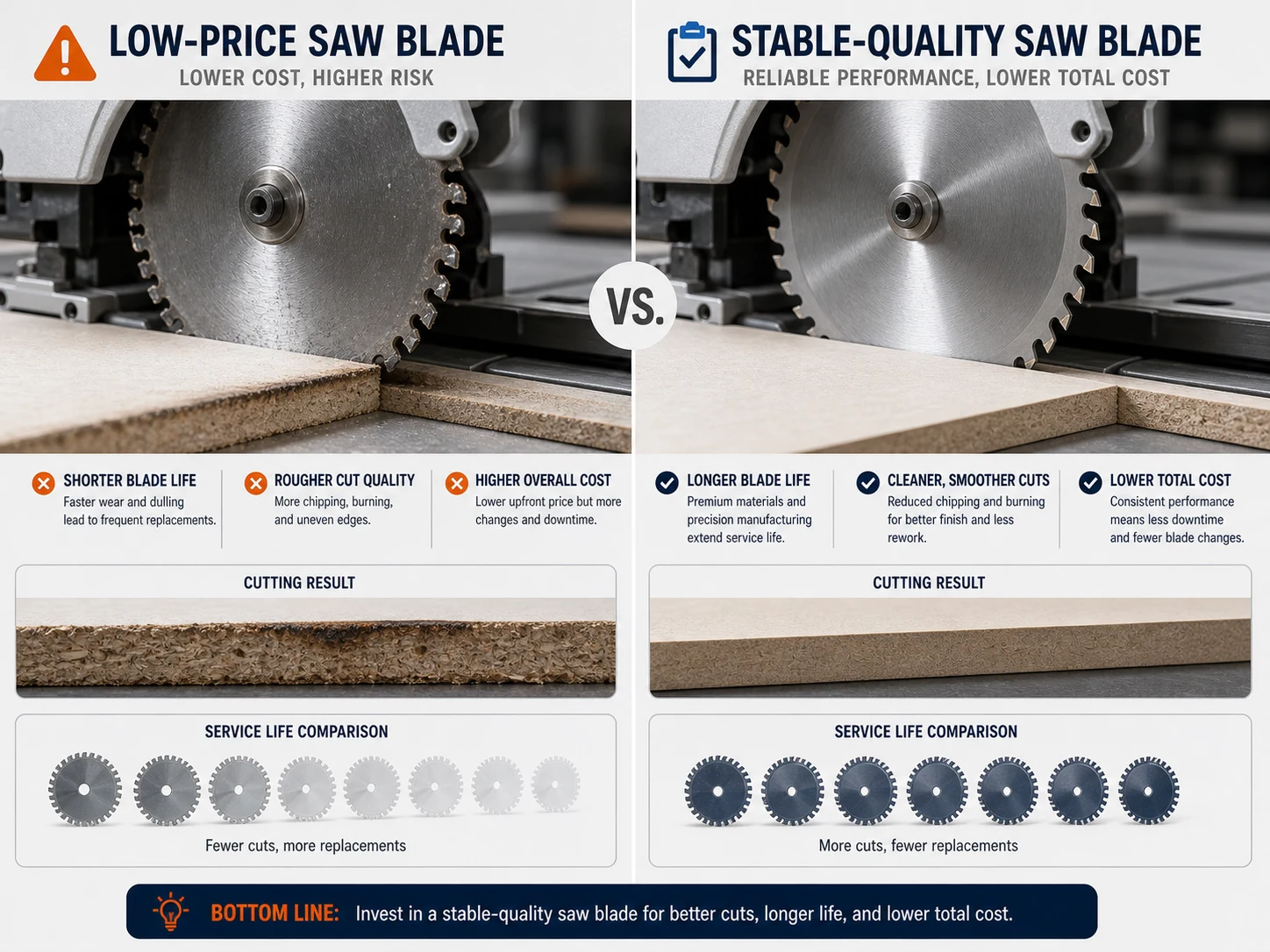
Low-cost plates may look fine before use. The difference appears during cutting: more vibration, more noise, faster tooth wear, and higher risk of blade body deformation. For buyers who sell to professional users, this difference becomes a warranty and reputation issue.
2. Tip Material: Carbide, Cermet, and Grade Differences
The tip material is one of the biggest cost drivers in saw blade production. A wood cutting TCT blade, an aluminum TCG blade, and a cermet metal cutting blade may all be called “circular saw blades,” but the tip material and geometry are very different.
| Tip / Grade | Typical Use | Price Impact | Buyer Note |
|---|---|---|---|
| YG8 / K40 type carbide | Economy wood cutting | Lower | Good for price-sensitive markets |
| YG6A / K30 type carbide | Standard and premium TCT blades | Medium | Balanced wear resistance and toughness |
| YG6X / K20 type carbide | Professional cutting, harder material | Higher | Better for industrial users |
| Cermet | Metal cutting, stable machine conditions | Higher | Can improve finish and wear life when used correctly |
For metal cutting, carbide is often safer when machine data is unclear. Cermet can perform better in stable high-speed machines, but it is not automatically the best choice for every user.
3. Tooth Geometry Must Match the Material
Tooth geometry is not decoration. It determines how the blade enters the material, how chips are formed, and how heat leaves the cutting zone.
- Wood cutting blades often use ATB geometry for clean grain cutting.
- Aluminum blades often use TCG geometry and a suitable hook angle to reduce grabbing.
- Laminate or panel blades may need special geometry for clean finish.
- Metal cutting blades require geometry matched to solid bar, pipe, tube, profile, or stainless steel.
This is why a 285mm 80T blade for stainless steel is not automatically the same as a 285mm 80T blade for mild steel solid bar. The size may match, but the cutting problem is different.
4. Heat Treatment and Tensioning Affect Blade Stability
Heat treatment, tensioning, and stress control are difficult for buyers to see from a photo, but they directly affect blade performance. A blade must stay flat and stable while rotating at high speed. If the body is poorly treated, the blade may wobble, vibrate, cut unevenly, or damage teeth prematurely.
Professional factories control hardness, flatness, side runout, tension, and bore accuracy. These steps add cost, but they reduce failures in real use.
5. Grinding Equipment Changes the Final Cutting Edge
Even when two blades use the same steel and the same carbide grade, grinding quality can separate a reliable blade from a cheap blade. CNC grinding accuracy affects tooth height, rake angle, side clearance, edge sharpness, and tooth-to-tooth consistency.
In precision cutting tools, the edge is where the value is created. Poor grinding can cause:
- Rough cutting surface
- Burn marks or overheating
- Oversized or uneven cuts
- Tooth chipping
- Short blade life
- More vibration and noise
This is especially important for cermet and metal cutting blades, where the edge must handle high load and heat.
6. Coating and Surface Treatment Are Not Always Equal
Some blades use coating, polishing, anti-rust treatment, or surface finishing to reduce friction, improve heat resistance, or improve appearance. Coating can add value, but only when it matches the application.
A coated blade may cost more, but if the buyer’s machine is unstable or the tooth geometry is wrong, coating alone will not solve the problem. In many sample orders, it is better to first confirm the correct grade and geometry, then decide whether coating is needed.
7. Inspection Standard and Tolerance Control Add Cost
Two suppliers may both say “QC passed,” but the inspection level can be very different. A professional saw blade supplier should be able to check and control:
- Outer diameter and bore tolerance
- Kerf and plate thickness
- Side runout
- Tooth height consistency
- Hardness
- Pin-hole diameter and PCD
- Sample cutting performance when required
For OEM buyers and wholesalers, consistent inspection is often more important than saving a small amount on each blade.
8. Trade Terms, Quantity, and Local Market Costs Change the Visible Price
Price comparisons also become confusing because different prices include different things. A China factory price may exclude freight and import tax. A platform sample price may exclude shipping. A local retail price in India or another market may include import cost, GST, local stock, distribution margin, and after-sales support.
That means a USD 40 platform listing, a USD 60 factory sample quote, and a USD 110 local retail price may all exist for similar-looking blades. They are not necessarily contradictory; they may represent different trade terms, quantities, and service levels.
How This Applies to the Whole Hardware Precision Industry
The same logic applies beyond saw blades. In precision hardware, two products can share the same drawing but perform differently because of hidden manufacturing factors:
- Raw material: grade, certification, batch stability.
- Heat treatment: hardness, toughness, distortion control.
- Machining equipment: CNC accuracy, fixture rigidity, tool wear control.
- Grinding and finishing: surface roughness, edge quality, dimensional consistency.
- Inspection: real tolerance control rather than visual checking only.
- Application matching: product design based on how the customer actually uses it.
This is why serious buyers should not compare only the drawing or the size code. They should compare material, process, tolerance, testing, and application recommendation.
Buyer Checklist: What to Ask Before Comparing Saw Blade Prices
- What material is the blade designed to cut?
- What steel plate and tip grade are used?
- Is the blade carbide, cermet, or another grade?
- What tooth geometry is recommended for the material?
- What machine RPM and feed condition are assumed?
- What runout and bore tolerance are controlled?
- Are pin holes and PCD included in the quotation?
- Is the price for sample order or mass production?
- Does the price include freight, import duty, or local tax?
- Can the supplier adjust the blade after sample feedback?
Our Recommendation for First Sample Orders
Blade price should also be evaluated against kerf loss and total cost per accepted cut, especially for large or high-value workpieces.
When the buyer cannot confirm all machine data, Wryno Global usually recommends a sample-first approach. Start with a stable grade, test it on the real machine and real material, then adjust tooth geometry, carbide/cermet grade, coating, or plate specification based on feedback.
For a metal cutting blade like 285 x 2.0 x 1.75 x 32 x 80T, we normally ask for:
- Material being cut, such as mild steel solid bar, pipe, tube, profile, stainless steel, wood, aluminum, or panel material
- Material size, such as bar diameter or pipe wall thickness
- Machine photo, model, or RPM
- Pin-hole drawing: hole diameter, quantity, and PCD
- Dry cutting or coolant cutting
- Sample quantity and destination city
Once those details are confirmed, the quotation becomes more than a price. It becomes a technical recommendation designed to reduce failures, improve blade life, and support long-term supply.
Before comparing prices
Use this selection guide to understand which blade specification actually matches the customer's machine and cutting material. Read the guide.
FAQ
Why do saw blades with the same size have different prices?
Because size only describes part of the product. Steel plate, carbide or cermet grade, tooth geometry, grinding accuracy, heat treatment, coating, runout control, and inspection standard all affect cost.
Is the cheapest saw blade always a bad choice?
No. A low-cost blade can be suitable for price-sensitive or light-duty applications. The risk is buying a low-cost blade for a demanding application where it cannot meet the required life, finish, or stability.
Is cermet always better than carbide?
No. Cermet can perform very well in stable metal cutting conditions, but carbide is often safer when machine data is unclear or cutting conditions vary. The right choice depends on the application.
Why does a supplier ask so many questions before quoting?
Because the same blade size can be used in different machines and materials. Without material, RPM, feed, coolant, and mounting details, the supplier may recommend the wrong blade.
How should wholesalers compare saw blade suppliers?
Compare more than unit price. Ask about material grade, tooth geometry, tolerance, runout, inspection, sample testing, packaging, and whether the supplier can adjust the blade after test feedback.
If you are comparing saw blade suppliers or need a sample-first recommendation, contact Wryno Global. We help buyers match blade specifications to real materials, machines, and market requirements.