
When a cold saw blade fails early, the first reaction is usually simple: “the blade is bad.”
Sometimes that is true. A poor blade body, weak brazing, wrong tip grade or rough grinding can absolutely shorten blade life. But in real steel cutting work, early failure is often a combination of blade choice, machine condition, clamping, RPM, feed, coolant and material shape.
This matters for buyers and wholesalers because replacing the blade alone may not solve the problem. If the same cutting condition remains, the next blade may fail in the same way.
Factory note: before blaming the blade, check the cutting setup. A good supplier should help you read the failure pattern, not just sell another blade.
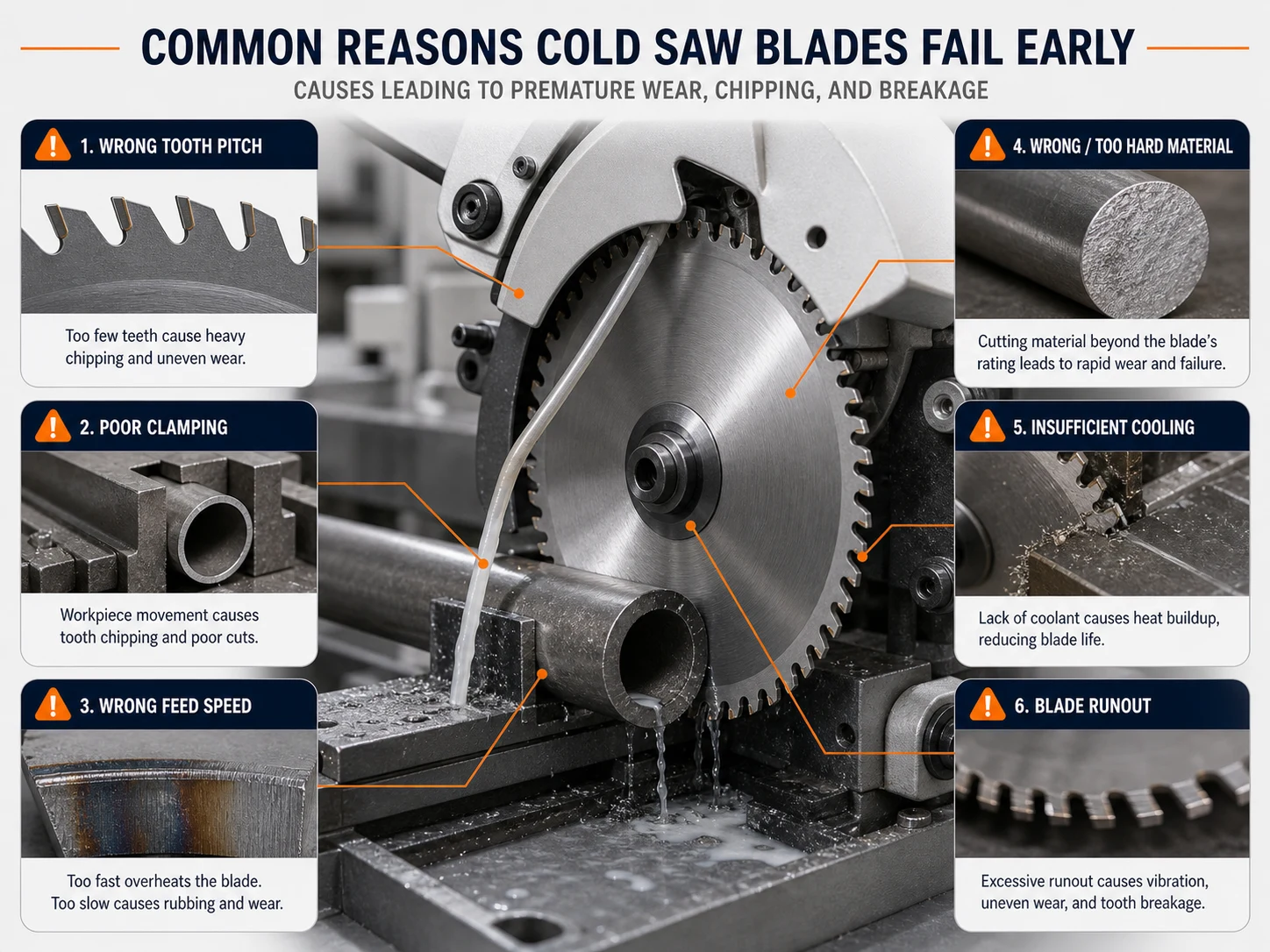
Start With the Failure Pattern
“The blade failed” is not enough information. The useful question is: how did it fail?
| What You See | Possible Cause | What to Send |
|---|---|---|
| Chipped teeth near the beginning of use | Vibration, wrong feed, unstable clamping, wrong grade or wrong tooth form | Blade edge photo, machine photo, cutting video |
| Blade becomes dull quickly | Wrong material match, speed too high, coolant weak, grade too soft | Material grade, RPM, coolant condition, chips photo |
| Heavy burr or rough cut surface | Wrong tooth count, wrong feed, blade runout, material movement | Cut surface photo and short cutting video |
| Burn marks or blue chips | Too much heat, poor coolant, wrong speed/feed balance | Chip photo, coolant video, machine settings |
| Noise and vibration | Loose clamping, dirty flange, poor bore fit, unstable machine | Bore photo, flange photo, clamping photo |
Check 1: Was the Blade Chosen for the Actual Material?
A blade for mild steel solid bar is not automatically right for stainless steel tube. A blade for profile cutting is not automatically right for a heavy solid bar. Even if the outside diameter, bore and teeth look similar, the tooth geometry and grade may need to be different.
This is why we ask buyers to confirm the material and shape:
- Mild steel or stainless steel?
- Solid bar, tube, profile or plate?
- Bar diameter or tube wall thickness?
- Single-piece cutting or bundle cutting?
If the buyer only says “steel,” the quotation is still incomplete. The blade may cut, but it may not cut well for long.
Check 2: Is the Tooth Count Right for the Workpiece?
Tooth count is not a beauty contest. More teeth does not always mean a better blade.
If too few teeth are engaged, the blade can grab and chip. If too many teeth are engaged, chips cannot clear well and heat builds up. Solid bar, thin tube and profile cutting all need different thinking.
For example, a buyer may send 285 x 2.0 x 1.75 x 32 x 80T. That size line is useful, but we still need to know whether the blade is cutting solid bar, pipe, tube, profile or plate. The same 80T design may not be ideal for every shape.
Check 3: Is the Machine Stable?
Cold saw blades are precision tools. They do not like vibration. A blade can be well-made and still fail early if the spindle, vice, flange or feeding system is unstable.
Before judging the blade, check:
- Is the workpiece clamped tightly?
- Does the material move during cutting?
- Is the machine spindle stable?
- Is there obvious blade wobble?
- Are the flange and mounting surface clean?
Many tooth-chipping cases are not caused by tip material alone. They are caused by small movement at the wrong moment.
Check 4: Are Bore and Pin Holes Correct?
If the bore is wrong or the pin holes do not match, the blade may mount imperfectly. This creates runout, vibration and uneven load on the teeth.
For custom cold saw blades, the center area matters as much as the teeth. Confirm:
- Bore diameter
- Pin-hole quantity
- Pin-hole diameter
- Pin-hole PCD
- Rotation direction
A clear photo of the blade center hole area often saves a lot of back-and-forth messages.
Check 5: Is the RPM and Feed Too Aggressive?
Speed and feed are not just machine settings. They decide how the tooth enters the material, how chips form, and how much heat stays near the edge.
Signs that the cutting condition may be too aggressive:
- Blue or burnt chips
- Sudden tooth chipping
- Heavy noise during entry
- Blade edge dulling quickly
- Rough cut surface and heavy burr
Signs that feed may be too light:
- Dust-like chips instead of proper chips
- Rubbing sound
- Heat without efficient cutting
When the buyer does not know RPM or feed, a short cutting video is often more useful than a long written explanation.
Check 6: Is Coolant Actually Reaching the Cut?
Some buyers say the machine has coolant, but the coolant may not be reaching the cutting point properly. The nozzle direction, concentration, flow and cleanliness all matter.
Poor coolant can cause:
- Heat build-up
- Material sticking to the tooth
- Poor finish
- Shorter blade life
- Unstable chips
If the application is stainless steel or harder material, coolant problems become even more visible. For dry cutting, the blade grade and tooth geometry should be selected with that condition in mind.
Check 7: Was the Right Grade Tested First?
Carbide and cermet are both useful, but they are not magic words. Cermet can be excellent in stable production cutting, but it is more sensitive to vibration, feed and machine condition. Carbide is often safer for a first sample when machine details are unclear.
For a new buyer, the best first sample is not always the most expensive blade. It is the blade that gives the safest starting point for the real cutting condition.
If the first sample works but the buyer wants longer life or cleaner finish, then we can adjust grade, tooth geometry, coating or body design.
What We Ask for When a Blade Fails Early
If a buyer tells us the blade failed early, we usually ask for practical evidence, not a perfect report.
- Photo of the full blade.
- Close-up photo of damaged teeth.
- Current blade marking.
- Photo of machine and clamping.
- Short video of cutting, if possible.
- Photo of the material being cut.
- Photo of chips and cut surface.
- RPM, coolant and feed information if available.
With these details, the supplier can usually judge whether the issue is grade, geometry, mounting, machine condition, coolant, or a mixed problem.
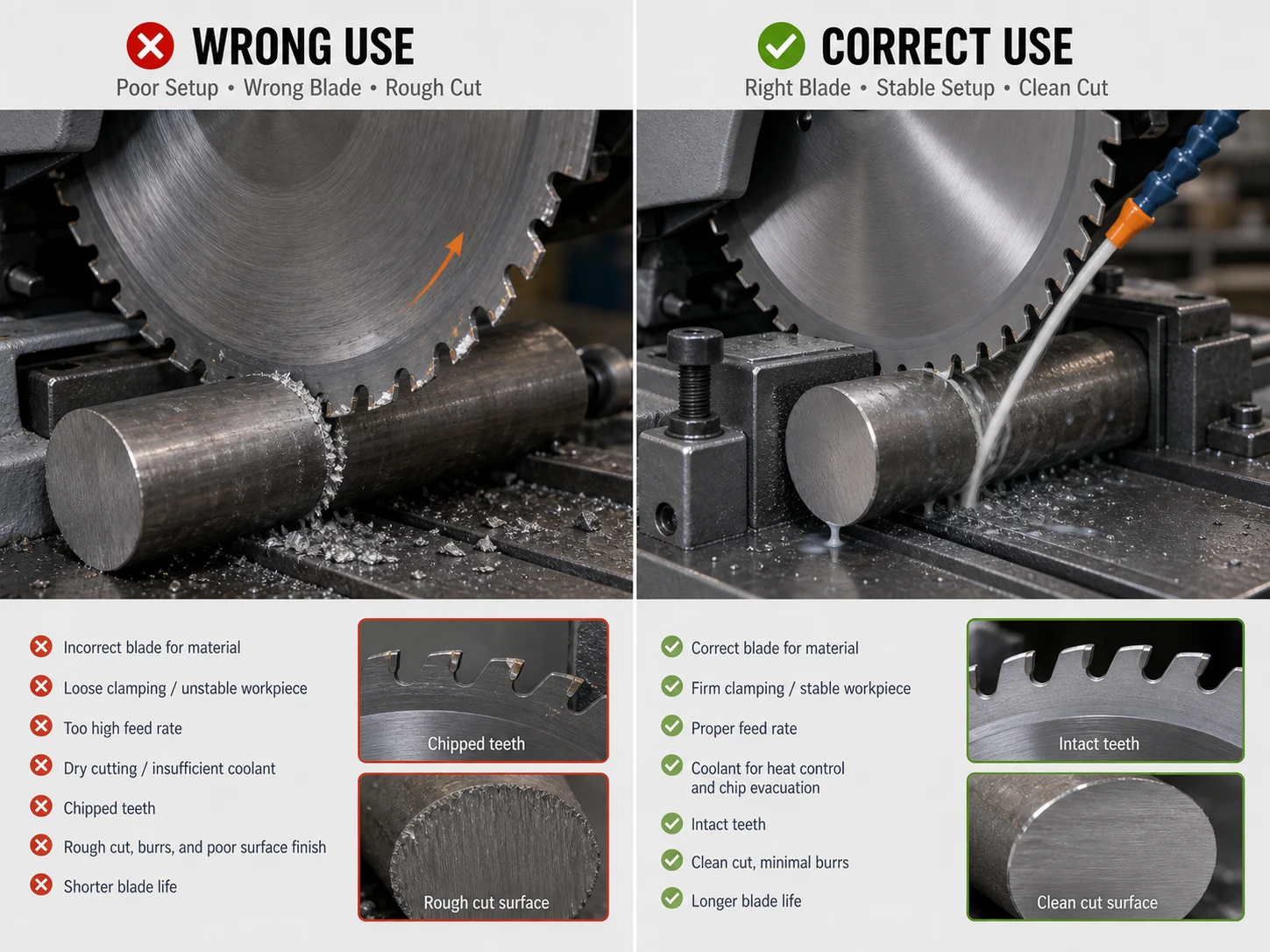
A Better Way to Handle Sample Testing
For sample orders, especially 5-10 pieces, the first goal should be stable cutting. After the first test, the buyer and supplier can improve the blade step by step.
A practical sample process looks like this:
- Confirm blade size and machine fit.
- Choose a safe starting grade based on material and machine information.
- Run the blade on real material.
- Record cut surface, burr, noise, chips, cut time and blade life.
- Adjust tooth form, grade, coating or body thickness after feedback.
This is slower than giving a random low price, but it is better for repeat business. A wholesaler does not win by selling one blade. He wins when the customer comes back because the blade solved the problem.
Related Guides
- Carbide vs Cermet Cold Saw Blades – choose a safer grade for sample testing.
- How to Read Cold Saw Blade Size – understand OD, kerf, plate thickness, bore and teeth.
- Steel Cutting Cold Saw Blades – product page for metal cutting blades.
- Why Saw Blade Prices Differ – compare quotes beyond visible size.
Related guide: How to Cut Stainless Steel Tube Without Burrs or Blue Heat Marks covers practical checks for cut stainless steel tube without burrs.
Related guide: Bundled Tube Cutting Saw Blade Guide: Reduce Burrs, Vibration and Tooth Breakage adds a practical buyer checklist for bundled tube cutting saw blade.
Related guide: Why Cold Saw Blade Teeth Chip: Buyer Troubleshooting Guide adds a practical buyer checklist for cold saw blade teeth chip.
FAQ
Does early tooth chipping mean the blade is poor quality?
Not always. Chipping can also come from vibration, poor clamping, wrong feed, wrong tooth count, wrong bore fit or cutting a different material than expected.
Why does my blade become dull very quickly?
Possible causes include wrong grade, speed too high, coolant problem, hard material, poor chip evacuation or wrong tooth geometry.
What should I send to the supplier after a failure?
Send the damaged tooth photo, blade marking, machine photo, material photo, cut surface photo, chips photo and cutting video if possible.
Can the next blade be improved?
Yes. After test feedback, the supplier can adjust grade, tooth geometry, coating, plate thickness, bore or pin-hole details.
Should I start with carbide or cermet?
If machine data is unclear, carbide is often the safer first sample. Cermet can be tested after machine and cutting conditions are confirmed.
If your cold saw blade is failing early, send us photos and cutting details. We will help check the likely cause before recommending the next sample.