
Dynamic balance is not the first specification most buyers ask about.
When people source circular saw blades, they usually start with diameter, bore size, kerf, plate thickness, tooth count, carbide grade and price. That is understandable. These details are easier to see and easier to compare.
Compared with woodworking router bits or high-speed milling cutters, many saw blades do not run at extremely high speed. They are also relatively thin and light. In normal production, a decent factory process can usually keep balance within an acceptable range.
So for many common cutting jobs, dynamic balance may not be the biggest problem.
But that does not mean it can be ignored.
When balance deviation becomes too large, the blade and machine may vibrate abnormally. Once vibration enters the cutting system, it can affect cutting finish, tool life, machine stability and even safety. In some applications, controlling dynamic balance is a small detail that makes a big difference.
What Dynamic Balance Means in Saw Blade Use
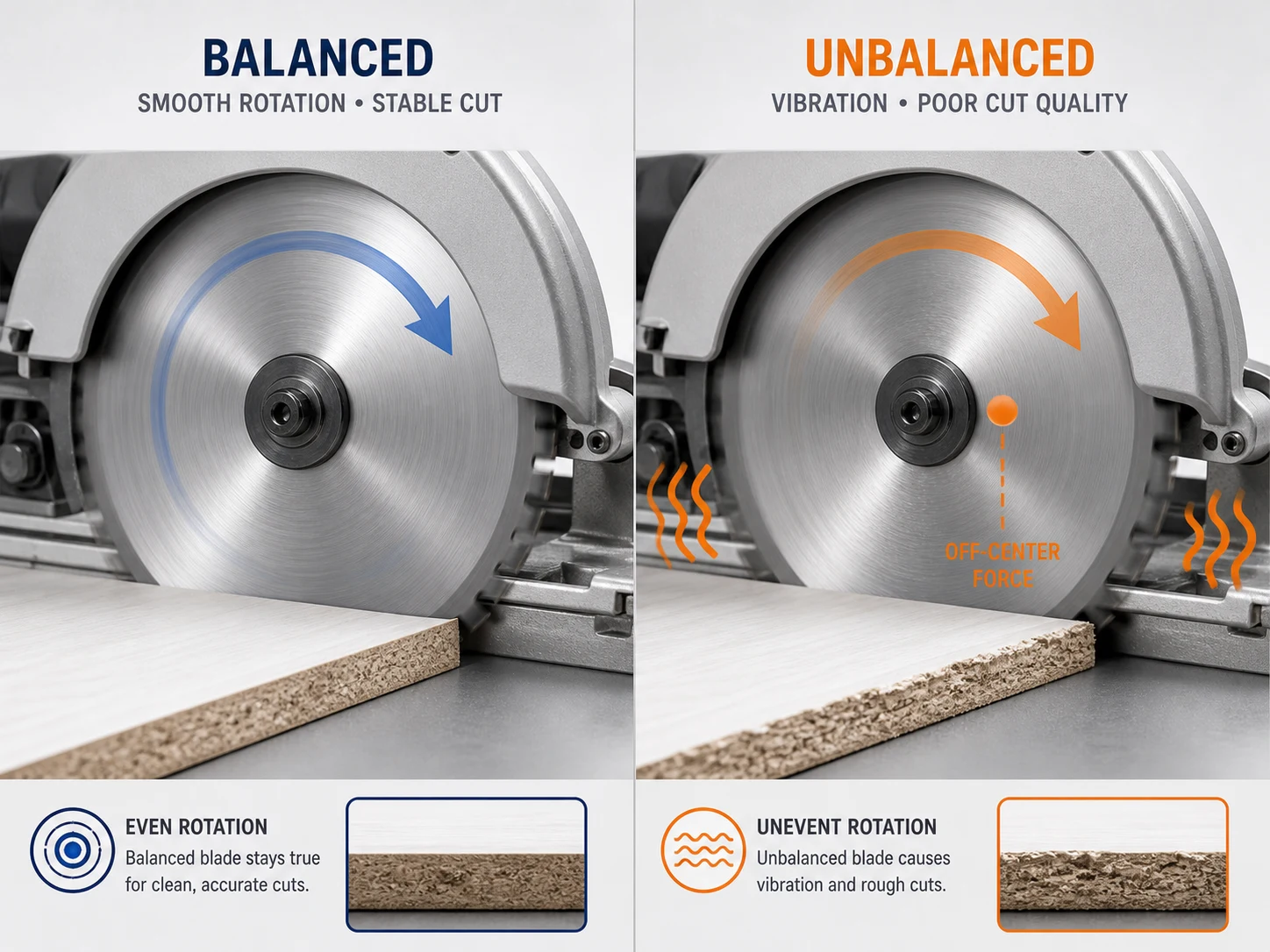
A circular saw blade rotates around the spindle. Ideally, the mass of the blade is distributed evenly around the center. If one side is heavier or the blade body is not processed evenly, the blade may create extra centrifugal force during rotation.
At low or moderate speed, a small imbalance may not be obvious. But as RPM increases, the effect becomes stronger. The blade may start to vibrate, the machine may feel rougher, and the cutting surface may show small marks that are hard to explain by tooth sharpness alone.
This is why dynamic balance should be understood as part of the whole cutting system, not just one isolated factory number.
Why Most Blades Do Not Have Serious Balance Problems
For standard circular saw blades, the production process itself already helps control balance to some degree.
The steel plate is cut, heat treated, tensioned, ground and finished in a controlled sequence. If the material is stable and the processing is consistent, the final blade should not be badly unbalanced.
That is why buyers do not need to treat dynamic balance as a mystery. A normal blade from a responsible factory should not shake violently just because balance was ignored.
The real risk appears when several unfavorable conditions come together: poor material, weak process control, high RPM, light machines or very strict cutting quality requirements.
When Dynamic Balance Becomes Important
1. High RPM Cutting
The higher the RPM, the more sensitive the blade becomes to balance deviation.
For some electric tools or compact saws, the blade may run at 6,000 RPM, 8,000 RPM or even around 10,000 RPM depending on the tool design. At this speed, a small balance issue can become much more visible.
The user may notice stronger vibration, louder noise, rougher cutting or faster bearing wear. The blade may still cut, but the whole cutting experience feels unstable.
If your customer uses high-speed tools, balance control deserves more attention.
2. Light or Thin Machines
Some machines are more sensitive than others.
A heavy industrial machine with a rigid frame can absorb some vibration. A light electric tool, cordless saw or thin machine body cannot. The same blade may feel acceptable on one machine and problematic on another.
This is common in power tool accessories. The machine is compact, the motor speed is high, and the user feels vibration directly through the tool body. In this case, balance, runout and plate tension all become more important.
3. High-Finish Cutting
If the cutting quality requirement is low, slight vibration may not be noticed immediately.
But for visible furniture parts, aluminum profiles, laminated boards, acrylic, decorative panels or clean crosscutting, vibration can leave marks on the surface. It may also increase burrs, chipping or edge roughness.
In high-finish cutting, buyers should not only ask whether the carbide is sharp. They should also check whether the blade runs smoothly.
4. Blades Made With Poor Material or Loose Process Control
Some balance problems start much earlier in production.
If the steel plate has material defects, uneven thickness or unstable internal stress, the blade body may not behave consistently during rotation. If heat treatment, tensioning, grinding or slot processing is not controlled well, the blade can also become less stable.
These issues may not be obvious in a product photo. Two blades can look similar online, but perform differently once mounted on a machine.
This is one reason price differences exist in the saw blade market. A lower price may come from lower-grade material, less inspection or weaker process control. Sometimes the risk only appears after the blade starts working.
What Problems Can Poor Balance Cause?
When dynamic balance is poor, users may see several symptoms:
- abnormal vibration during cutting
- higher machine noise
- visible cutting marks
- rougher finish or more burrs
- faster tooth wear
- unstable feeding
- shorter bearing or spindle life
- lower operator confidence
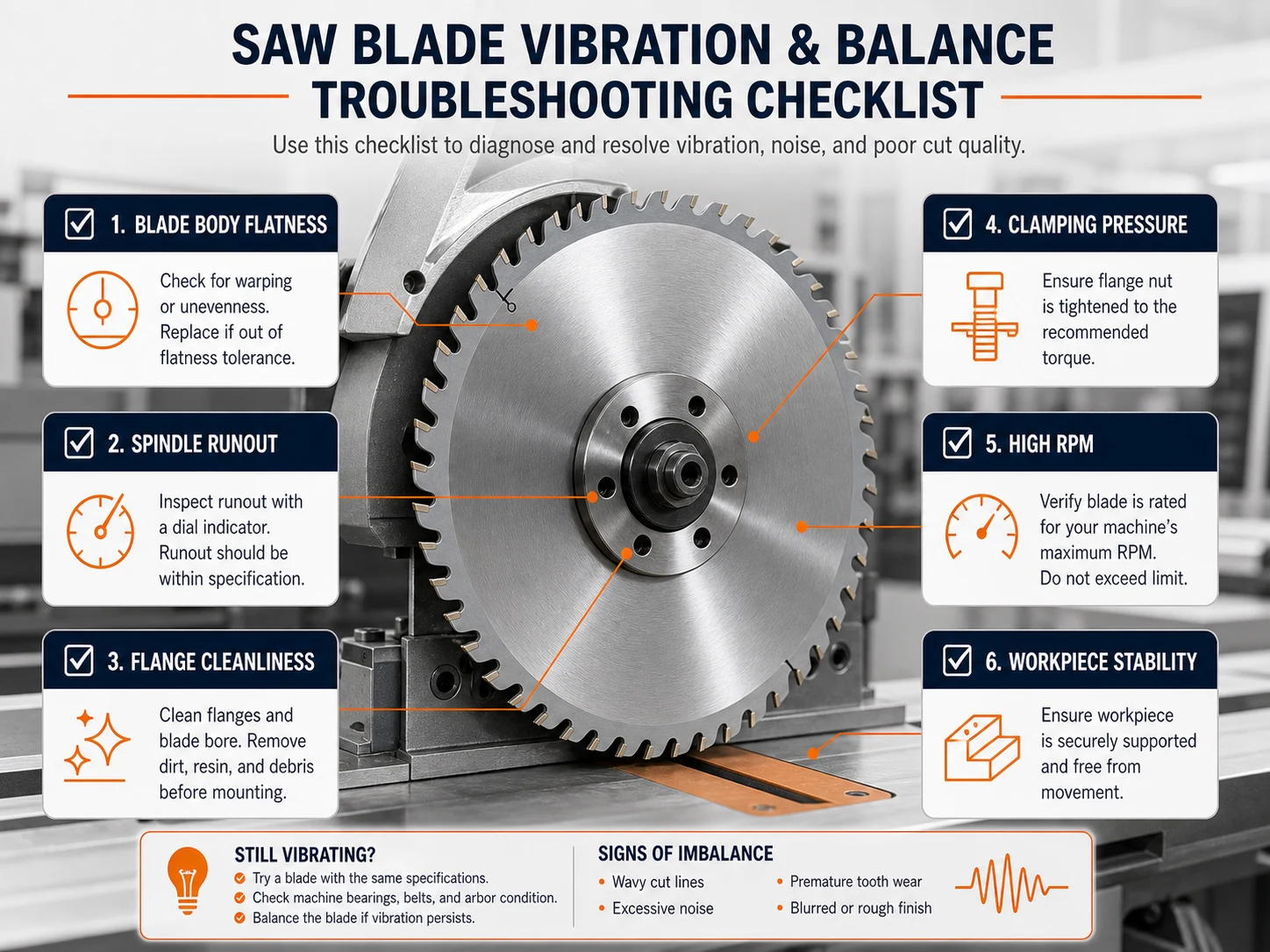
These problems are not always caused by balance alone. Runout, poor clamping, dirty flanges, wrong tooth count, dull carbide and aggressive feed speed can also create vibration.
That is why a buyer should not diagnose the problem from one detail only. But dynamic balance is one of the details worth checking when other causes are not obvious.
How Buyers Can Check Before Ordering
If your application is normal woodworking or general cutting, you do not need to make the discussion overly complicated. Start with the correct specification and a reliable quality grade.
But if your customer uses high-speed tools, light machines or needs a clean finish, ask the supplier a few direct questions:
- Is this blade suitable for my machine RPM?
- Do you control dynamic balance for this blade size?
- What is the recommended maximum RPM?
- Is the blade plate tensioned after heat treatment?
- What runout tolerance do you control?
- Is this blade designed for light electric tools or heavier machines?
- Can you recommend a higher grade if vibration control is important?
A professional supplier should not only answer with “good quality.” They should explain whether the blade design matches the machine and cutting condition.
Balance Is Not the Only Factor
It is also important not to overstate dynamic balance.
A well-balanced blade with the wrong tooth count will still cut poorly. A high-grade blade mounted on a dirty flange may still vibrate. A blade used beyond its recommended RPM is still risky.
Good cutting performance comes from a combination of blade body quality, carbide grade, tooth geometry, kerf, runout, balance, machine condition and operation.
For buyers who are still choosing blade specifications, our TCT saw blade selection guide and saw blade tooth guide are useful starting points.
Before blaming a blade for vibration or poor finish, follow our saw blade runout measurement guide to isolate the blade, arbor and flange with a dial indicator.
Final Thought
Dynamic balance is not always the most important saw blade specification. For many standard applications, normal factory control is enough.
But in the right conditions, it becomes very important: high RPM, light tools, strict cutting finish, unstable material or weak production process control. When these factors appear together, poor balance can turn into vibration, noise, poor finish and shorter blade life.
For buyers, the practical approach is simple: do not overpay for unnecessary specifications, but do not ignore balance when the machine or application is sensitive. Sometimes this small detail is exactly what keeps the cutting system stable.