
Drilling hardened steel is not simply a matter of buying the hardest
drill bit. The correct choice depends on the actual workpiece hardness,
hole diameter and depth, machine rigidity, coolant delivery, required
tolerance and production volume. A drill that works in a rigid machining
center can fail immediately in a hand drill, while a cobalt HSS drill
that is forgiving in repair work may wear too quickly in continuous
production.
This guide gives buyers and process engineers a practical way to
choose between M35/M42 cobalt, solid carbide and replaceable-tip carbide
drills—and explains the setup details that often matter more than the
label on the package.
Quick answer: For intermittent shop work in
moderately hard steel, start with a short M42 cobalt drill with a 135°
split point. For stable CNC production or steel above roughly 45–50 HRC,
solid carbide is usually the better starting point. Machine rigidity and
controlled feed are mandatory.
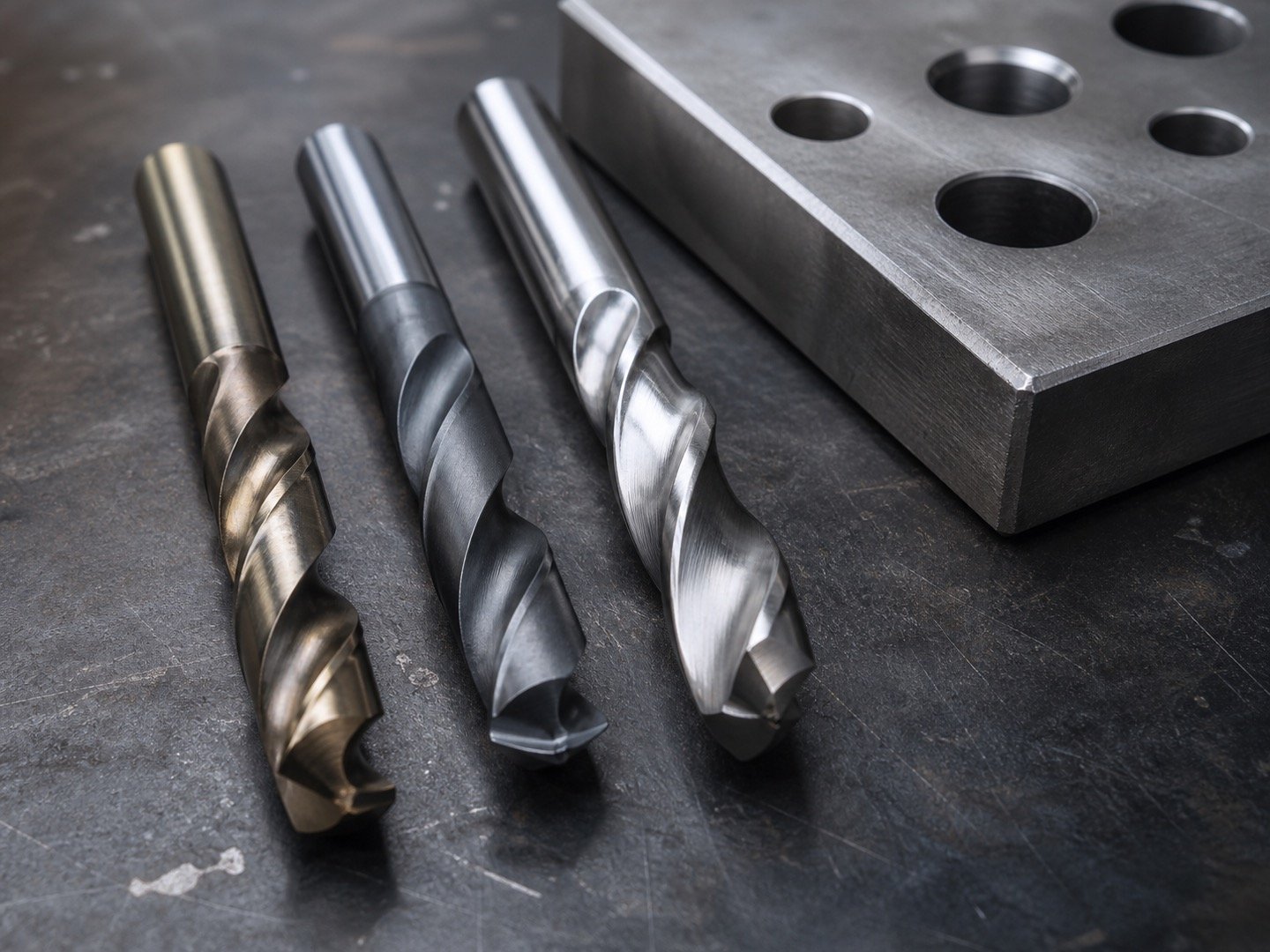
First confirm what
“hardened steel” means
The phrase covers very different jobs. Pre-hardened mold steel at 32
HRC, a heat-treated shaft at 45 HRC and a bearing race above 60 HRC
should not be quoted with the same tool.
| Workpiece condition | Typical hardness | Practical starting tool |
|---|---|---|
| Pre-hardened alloy or mold steel | 28–38 HRC | M35/M42 cobalt or carbide |
| Heat-treated tool steel | 38–48 HRC | M42 cobalt for flexible work; carbide for production |
| Hardened shaft, die or bearing component | 48–58 HRC | Solid carbide on a rigid machine |
| Very hard finished component | 58–65 HRC | Application-specific micrograin carbide; consider EDM or grinding for difficult holes |
Hardness alone is not enough. Buyers should also identify scale,
interrupted surfaces, case depth, abrasive inclusions and whether the
surface is harder than the core.
M35 vs M42 cobalt drill bits
Cobalt drill bits are high-speed steel containing cobalt. M35
commonly contains about 5% cobalt, while M42 commonly contains about 8%.
The added cobalt improves hot hardness, but it does not make the drill
unbreakable.
When M35 is useful
M35 is suitable for stainless steel, alloy steel and moderately hard
workpieces when the setup has some vibration or the operator needs a
more forgiving tool. It is often a better value for maintenance
departments and mixed-job workshops.
When M42 is useful
M42 maintains hardness better as cutting temperature rises. It is a
stronger candidate for harder steel, deeper holes and repeated
production, provided feed is positive and the drill is not allowed to
rub. Because M42 is less forgiving of impact than ordinary HSS, a short
flute and secure workholding are important.
| Factor | M35 cobalt | M42 cobalt |
|---|---|---|
| Heat resistance | High | Higher |
| Toughness in imperfect setup | Better | Lower than M35 |
| Suitable work | Stainless, alloy steel, moderate hardness | Harder alloy/tool steel and repeated drilling |
| Cost | Medium | Medium-high |
| Resharpening | Practical | Practical, but geometry must be restored accurately |
When solid carbide is
the better choice
Solid carbide has much higher compressive strength and wear
resistance than HSS. It can maintain an edge at cutting speeds that
would soften a cobalt drill. That advantage is realized only when
runout, workholding and feed are controlled.
Choose solid carbide when:
- the steel is consistently above about 45–50 HRC;
- holes are produced on a rigid CNC machine;
- spindle runout is low and the holder is in good condition;
- coolant reaches the cutting zone;
- hole position, roundness or cycle time justifies the higher tool
cost.
Do not choose solid carbide merely because it is “premium.” In a
flexible hand-held setup, carbide can chip before a cobalt drill becomes
dull.
Drill point geometry: 118° or
135°?
A 135° split point is normally the safer starting geometry for
hardened steel. It reduces the tendency to walk, shortens the chisel
edge and produces a more controlled entry. A conventional 118° point is
more aggressive and versatile in softer materials, but it can create
higher thrust and unstable entry on a hard smooth surface.
For difficult holes, buyers should ask for more than the included
angle:
- split-point or web-thinning method;
- lip-height variation;
- chisel-edge centering;
- margin width and back taper;
- flute finish and edge preparation.
Two drills marked “135°” can perform very differently if one has
unequal lips or excessive web thickness.
Coating selection
A coating cannot compensate for poor substrate or geometry. It can,
however, reduce friction and slow crater or flank wear when the
temperature and workpiece match the coating.
| Surface option | Typical use | Buyer caution |
|---|---|---|
| Bright/uncoated cobalt | Low-volume work, easy inspection, frequent regrinding | Needs suitable lubricant |
| Black oxide | General HSS drills; some lubricant retention | Not a high-performance hard-steel coating |
| TiN | General wear improvement and product identification | Limited at very high cutting temperature |
| TiAlN/AlTiN | Dry or high-temperature alloy-steel cutting | Works best on carbide or a stable premium substrate |
| Proprietary multilayer coating | High-volume controlled process | Ask for substrate, thickness and regrinding policy—not only color |
Starting
cutting data without destroying the tool
Exact data must come from the drill supplier after material, hardness
and machine are confirmed. The safest commissioning method is to begin
conservatively and watch chip shape, spindle load, sound and edge
wear.
For a drill diameter D in millimeters and cutting
speed Vc in meters per minute:
RPM = (1000 × Vc) ÷ (π × D)
Feed rate is:
Feed rate (mm/min) = RPM × feed per revolution
(mm/rev)
A 10 mm drill at 12 m/min starts near 382 rpm. If feed is 0.08
mm/rev, the feed rate is about 31 mm/min. These numbers are an example,
not a universal recommendation.
The common mistake is reducing feed until the drill rubs. Hardened
steel requires a continuous cut. If chips stop forming while the spindle
continues to turn, heat rises rapidly and the cutting edge can lose
hardness or chip.
Coolant, pecking and hole
depth
For shallow holes, a consistent external lubricant can be sufficient
with cobalt drills. For deeper holes and carbide production,
through-coolant improves chip evacuation and stabilizes temperature.
Use pecking only when chip evacuation requires it. Repeated short
pecks can increase cycle time and thermal shock. A better solution may
be a polished flute, through-coolant, different helix or a drill
designed for the target depth.
Classify hole depth by diameter:
- up to 3×D: standard drilling conditions;
- 3–5×D: chip control becomes more important;
- above 5×D: use a dedicated deep-hole strategy and confirm coolant
delivery.
Setup checklist before
the first trial
- Confirm hardness in HRC or HB instead of relying on a material
name. - Remove hard scale or prepare a flat entry surface when
possible. - Minimize drill overhang and use a rigid holder.
- Measure spindle and holder runout.
- Clamp the workpiece so it cannot vibrate or move at
breakthrough. - Use a positive feed; do not dwell at the bottom.
- Inspect chips and cutting lips after the first holes.
- Record hole count, speed, feed, coolant and failure mode.
Failure symptoms and likely
causes
| Symptom | Likely cause | Corrective direction |
|---|---|---|
| Drill squeals but makes powder | Feed too low; rubbing; dull edge | Increase controlled feed, check edge and point geometry |
| Outer corners chip | Runout, interrupted entry, excessive speed or brittle grade | Reduce runout/overhang; check grade and entry |
| Drill breaks near flute exit | Chip packing or workpiece movement | Improve evacuation and clamping |
| Hole is oversized | Runout, unequal lips, unstable holder | Measure runout and lip height |
| Edge turns blue | Insufficient coolant, excessive speed or dwelling | Reduce heat input; restore cutting action |
| Good first holes, rapid wear later | Wrong substrate/coating or abrasive case | Upgrade grade/coating and verify hardness profile |
What buyers
should send for an accurate quotation
A useful RFQ should include:
- steel grade and measured hardness;
- hole diameter, tolerance and depth;
- blind or through hole;
- machine type, spindle taper and available coolant;
- expected monthly quantity;
- required drill material and coating, if fixed;
- acceptable resharpening policy;
- current tool life and failure photos.
When the application is uncertain, send the current drill, chips and
a short cutting video. These often reveal runout, rubbing or chip
packing more quickly than a long description.
Cobalt or carbide:
final selection table
| Situation | Preferred starting point |
|---|---|
| Hand drill or flexible maintenance setup | Short M35/M42 cobalt |
| Mixed materials and small batches | M35 or M42 cobalt |
| Stable CNC, repeated holes, 40–50 HRC | M42 or carbide trial |
| Rigid CNC, high volume, above 50 HRC | Solid carbide |
| Interrupted or uneven hard surface | Tough carbide grade or cobalt trial with conservative entry |
| Very deep hole | Dedicated through-coolant carbide/deep-hole drill |
Related guides
- Drill Bit for Stainless
Steel - HSS vs Cobalt Drill
Bits - Drill Speed
Chart for Steel, Stainless Steel and Aluminum - Why Drill Bits Break,
Burn or Wear Out - Drill Bit Materials
Explained
Compare entry behavior and edge support in our 118° vs 135° drill bit point-angle guide.
Match finish and PVD chemistry to the application with our drill bit coatings guide.
See how point, web, flute and margin design interact in our twist drill bit geometry guide.
For oversized or out-of-round holes, follow our drill runout measurement and correction guide.
Decide whether to restore or replace worn tools with our drill bit sharpening and regrinding guide.
For holes beyond normal flute evacuation limits, use our peck drilling and deep-hole coolant guide.
Frequently asked questions
Can an M42 cobalt
drill cut 60 HRC steel?
It may make a limited hole under ideal conditions, but predictable
production at this hardness normally requires application-specific
carbide and a rigid machine. A trial should be based on measured
hardness, hole depth and tolerance.
Is carbide always faster
than cobalt?
Carbide supports higher cutting speed, but only when the machine and
holder are rigid enough. In an unstable setup, edge chipping can make
cobalt the faster and cheaper practical choice.
Should I use oil
when drilling hardened steel?
Usually yes for cobalt drilling, unless the tool supplier specifies
another method. Carbide processes may use through-coolant, external
emulsion or a validated dry/coated strategy.
Why
does the drill stop cutting after the first millimeter?
The surface may be case-hardened, the point may be rubbing, or work
hardening may have occurred after an interrupted start. Confirm hardness
profile, restore a sharp centered point and use a positive feed.
What information
matters most when ordering?
The measured hardness, hole diameter and depth, machine rigidity,
coolant delivery, tolerance and required volume are more useful than the
generic phrase “hardened steel drill bit.”
ENGINEERING KNOWLEDGE
Related Drill Bit Engineering Guides
Continue from product type into geometry, coating, hole quality, regrinding and deep-hole process control.